
Travel Blog December 9, 2025 to January 26, 2026A Western Around-the-World Trip Including Countries in Indochina and the Greater Horn of AfricaVancouver, B.C., Canada to South Sudan via Laos, Cambodia, Singapore, Brunei, Djibouti, and SomalilandPART II: Brunei to South Sudan, January 1 - 26, 2026Continuation from PART I: Laos, Cambodia, and Singapore.
Thursday, January 1: Singapore to Bandar Seri Begawan, Brunei After another early morning wake up and hurried breakfast, I checked out of my hotel in Singapore and took a taxi back to the airport. The taxi driver I had was quite chatty and told me he'd been working his current capacity for only one month. His second job was in the recycle, reuse, repair industry. According to him, the majority (60%) of Singaporeans were Chinese origin and spoke Mandarin, although he had also heard other Chinese dialects being spoken, such as Cantonese and Hokkien. He also said Singapore was considered one of the most expensive places to live, perhaps because they had to import everything, and that education was no longer free, although it had been when he was in school. I checked into my Singaporean Airlines flight once I reached the airport but did not go to the business lounge this time. On the flight, I was seated next to a little girl in black Muslim garb complete with hijab. She smiled at me when she sat down but that was all the communication we had. When I reached Brunei (my 146th UN country), I explained to the Immigration officer that I had tried to register for the arrival card online, but it had given me an error message the four or five times I had tried to submit it. Luckily, however, she was able to confirm that it had indeed been received, so there was no further formality to worry about after she had taken my finger and thumb prints. I picked up my bag and found a taxi to take me to my hotel. The driver pointed out all the government and ministerial buildings on the short route from the airport. Like most taxi drivers, I was told, he had no credit card machine, but he accepted USD cash for his fare. The receptionist at my hotel was friendly and said he would try to find an appropriate tour that would correspond to my wishes regarding local culture to photograph. He confirmed that today was a holiday and that tomorrow, Friday, many things would be closed. After getting to my room, I worked on emails and various computer tasks, and then at about 3:00 p.m., wandered out of the hotel and into the city centre. Few people were about, but I did hear the call to prayer and found a mall, in the basement of which I found a large grocery store and managed to purchase a few items to eat during the coming days. Coming out of the mall, I then saw this Happy New Year 2026 sign in front of the Omar Ali Salfuddien Mosque, constructed in 1958 and the tallest structure in Bandar Seri Begawan at 52 metres, able to accommodate 3,000 worshippers. Around the corner, I found a painting of the national flag, as well as this mural called appropriately “The Big Wall Mural,” which I read was created between December 15, 2020 and January 8, 2021 in an effort to “liven up sections of the capital,” on the ground beneath which were these paintings of boats. I will comment here that I had a miserable rest of my evening in the hotel room because from about 6:00 p.m., the hotel was hosting a New Year's Day Party around its swimming pool, which included very loud music, singing, and blaring announcements in the local language, not soundproofed by my windows, which overlooked the pool. I grinned and bore it, however, hoping it would end by 10:00 p.m., and it did, so at least I had a peaceful night.    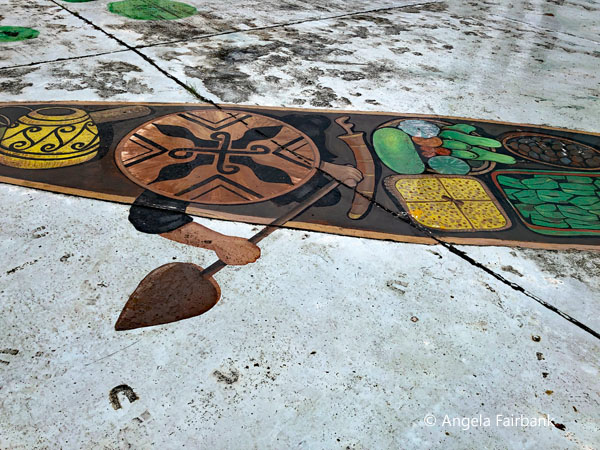 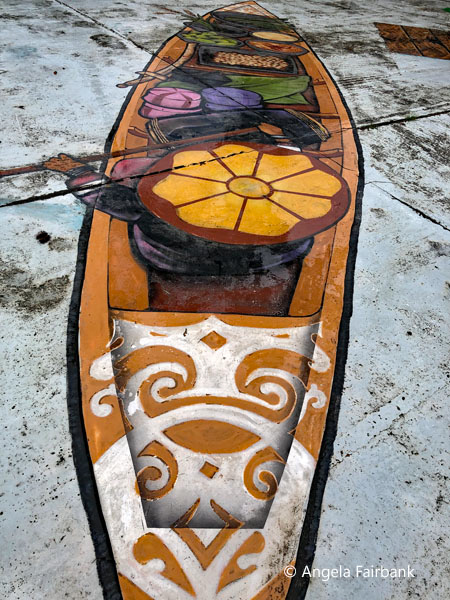  Wikipedia says that Brunei Darussalam, formally known as [the] State of Brunei, is a country in Southeast Asia, situated on the northern coast of the island of Borneo. Apart from its coastline on the South China Sea, it is completely surrounded by the Malaysian state of Sarawak, with its territory bifurcated by the Sarawak district of Limbang. Brunei is the only sovereign state entirely on Borneo; the remainder of the island is divided between its multi-landmass neighbours of Malaysia and Indonesia. As of 2025, the country had a population of 466,330, of whom approximately 64,409 resided in the capital and largest city of Bandar Seri Begawan. Its official language is Malay, and Sunni Islam is the state religion of the country, although other religions are nominally tolerated. The government of Brunei is an absolute monarchy ruled by the Sultan, and it implements a fusion of English common law and jurisprudence inspired by Islam, including sharia.
At the Sultanate of Brunei's peak during the reign of Sultan Bolkiah (1485-1528), the state is claimed to have had control over ... most of Borneo, including modern-day Sarawak and Sabah, as well as the Sulu archipelago and the islands off the northwestern tip of Borneo ... The maritime state of Brunei was visited by the surviving crew of the Magellan Expedition in 1521, and in 1578 it fought against Spain in the Castilian War. During the 19th century, the Bruneian Empire began to decline. The Sultanate ceded Kuching to James Brooke and installed him as the White Rajah. [It also] ceded Sabah to the British North Borneo Chartered Company. In 1888, Brunei became a British protectorate and was assigned a British resident as colonial manager in 1906. After the Japanese occupation during World War II, a new constitution was written in 1959. In 1962, a small armed rebellion against the monarchy, which was indirectly related to the Indonesia-Malaysia confrontation, was ended with British assistance and led to the ban of the pro-independent Brunei People's Party. The revolt ... also influenced the Sultan's decision not to join the Malaysian Federation while it was being formed. Britain's protectorate over Brunei [eventually ended] on January 1, 1984, when it became a fully sovereign state. Brunei has been led by His Majesty Sultan Haji Hassanal Bolkiah Mu'izzadin Waddaulah, Sultan and Yang-Dipertuan of Brunei since 1967 ... The country's unicameral legislature, the Legislative Council, is simply consultative and all its members are appointed by the Sultan. The country's wealth derives from its extensive petroleum and natural gas fields. Economic growth during the 1990s and 2000s has transformed Brunei into an industrialized country, with its GDP increasing 56% between 1999 and 2008. Political stability is maintained by the House of Bolkiah by providing a welfare state for its citizens, with free or significant subsidies in regard to housing, healthcare, and education. It ranks very high on the Human Development Index (HDI), the second highest among Southeast Asian states after Singapore, [with] which it maintains close relations ... including a Currency Interchangeability Agreement. (The Brunei dollar and the Singapore dollar have equal value.) According to the International Monetary Fund (IMF), Brunei is ranked seventh in the world by gross domestic product per capita at purchasing power parity. Brunei is a member of the United Nations, the World Trade Organization, the East Asia Summit, the Organisation of Islamic Cooperation, the Non-Aligned Movement, the Commonwealth of Nations, and ASEAN. The official language of Brunei is Standard Malay, for which both the Latin alphabet (Rumi) and the Arabic alphabet (Jawi) are used. Initially, Malay was written in the Jawi script before it switched to the Latin alphabet around 1941. The principal spoken language is Melayu Brunei (Brunei Malay), [which] is rather divergent from standard Malay and the rest of the Malay dialects, being about 84% cognate with standard Malay, and is mostly mutually intelligible with it. English is widely used as a business and official language and is spoken by a majority of the population in Brunei. English is used in business as a working language and as the language of instruction from primary to tertiary education. Chinese languages are also widely spoken, and the Chinese minority in Brunei speaks a number of varieties of Chinese. Arabic is the religious language of Muslims and is taught in schools, particularly religious schools, and also in institutes of higher learning. [In] 2004, there [were] six Arabic schools and one religious teachers' college in Brunei. A majority of Brunei's Muslim population has had some form of formal or informal education in ... reading, writing, and [pronouncing] the Arabic language as part of their religious education. Other languages and dialects spoken include Kedayan Malay dialect, Tutong Malay dialect, Murut, and Dusun. Friday, January 2: Bandar Seri Begawan, Brunei Now I couldn't continue without learning some local words. The first phrase I asked for, as usual, was thank you, which is terima kasih, good morning is selamat pagi, good afternoon, selamat petang, and goodnight, selamat malam, while yes is simply ya and no is tidak. It all sounded familiar to me so I realised I had learned all these phrases back in the 1990s when I was been a tourist in Malaysia and Indonesia for the first time, Indonesian being practically identical in these particular examples. As it was a Friday and I was told most buildings would be closed, I stayed in my hotel room all day and worked on a book translation. Saturday, January 3: Bandar Seri Begawan, Brunei
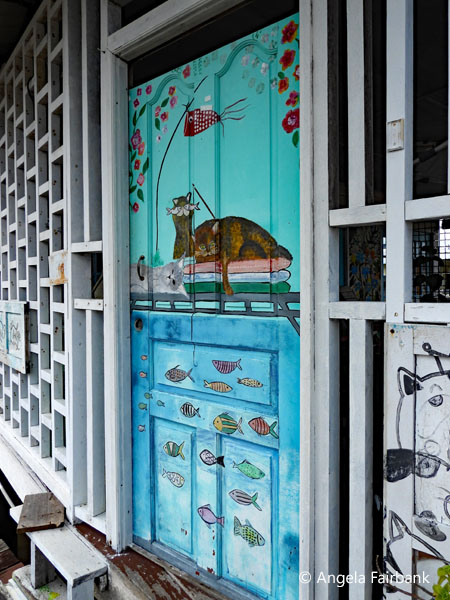
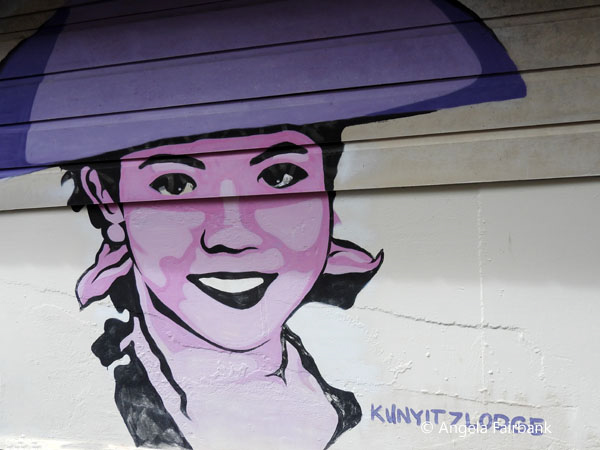
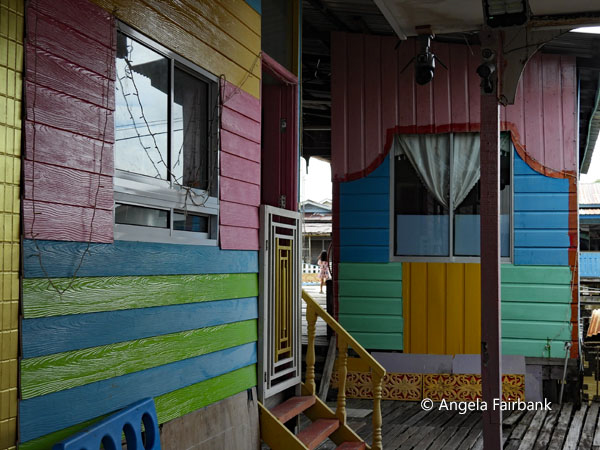
After breakfast this morning, I headed out as per the concierge's suggestion to the Kianggeh Market, where I photographed these two women, who were happy to be photographed and to chat, asking me where I was from and how long I would be in Brunei. Then after remarking to one souvenir vendor on the fact that the market was only about 1/3 full, he told me I should have come yesterday, because on Friday, a religious, non-business day, it was usually quite full. Not finding anything I particularly wished to purchase, I continued on walking to the Brunei Arts and Handicrafts Training Centre, which contained things like weaving, silverware, brassware, wood carvings, men's flat, felt hats called Songkok, batik work, and basketry. Although there were things for sale, the prices were high. Next, I walked further toward the waterfront and jetty and stepped gingerly onto a wooden boat with an outboard motor driven by a driver who did not offer me a lifejacket, despite many signs advising that it was the law to wear one on a boat. He did, however, express concern for the fact that I looked a bit unsteady on my feet as I was clambering into the boat, which was not tied up but merely had its bow resting on the jetty's cement stairs. At no time did he offer to help me in or out of the boat. I managed nonetheless and for the quoted price of one Brunei dollar, he drove me over to the Kampong Ayer, containing a rather dilapidated group of houses on stilts, whose description reads as follows: “In the 15th century, as described by Antonio Pigofetto, an Italian traveler, the water village was made up of about 25,000 households surrounding a palace. The village was a major port from which Brunei exported a variety of goods ... With an area of 10 km2 and about 20,000 inhabitants in today's Kampong Ayer of 42 villages, it is still the largest water village in the world.” I must say I was rather unimpressed and frankly felt unsafe walking along wooden raised platforms that joined various houses, some of them leading into the houses themselves. There was a distinct lack of signage, no hand rails, and many gaps in the wooden planks. Although the only alternative I had been offered was to pay 20 dollars for a boat ride on the water around the village, and I may have seen more of it that way, including Proboscis Monkeys, which I gather was the draw, I surely would not have had the opportunity I had to photograph this gorgeous blue-feathered White-Faced Heron (Egretta novaehollandiae) below me, these red-eyed Asian Glossy Starlings (Aplonis panayensis) above me or the two domestic cats living clearly comfortably in squalor. As an additional note, I had seen Proboscis Monkeys in a zoo in Kota Kinabalu in December 2018 on my first visit to the Island of Borneo, the third largest island in the world after Greenland and New Guinea, and located in the state of Sabah, Malaysia. As hinted at earlier, Borneo is curious in that it consists of three different countries (or parts thereof: The Sultanate of Brunei being the smallest, the Malaysian states of Sabah and Sarawak, and the Indonesian state of Kalimantan in Southern Borneo, making up the largest share. 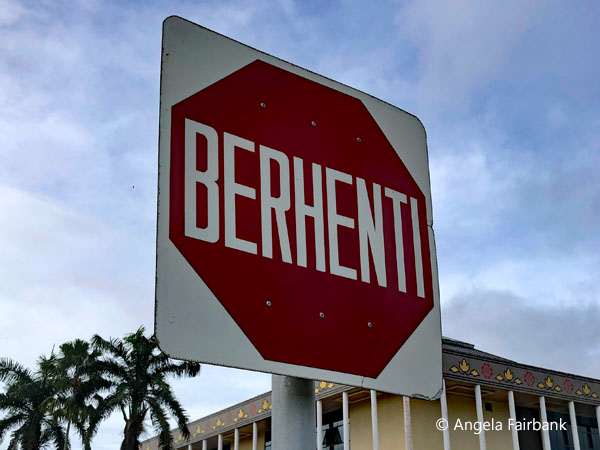  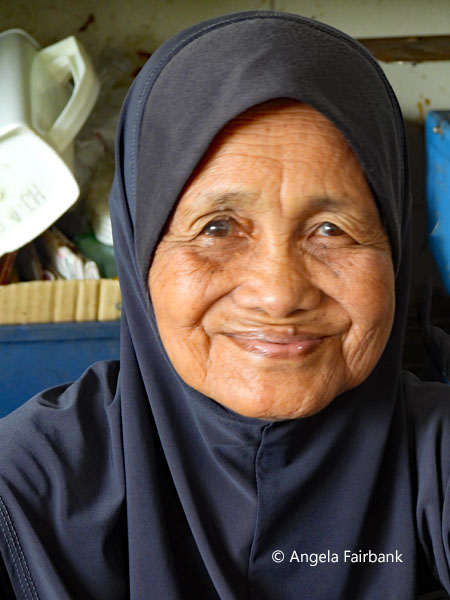 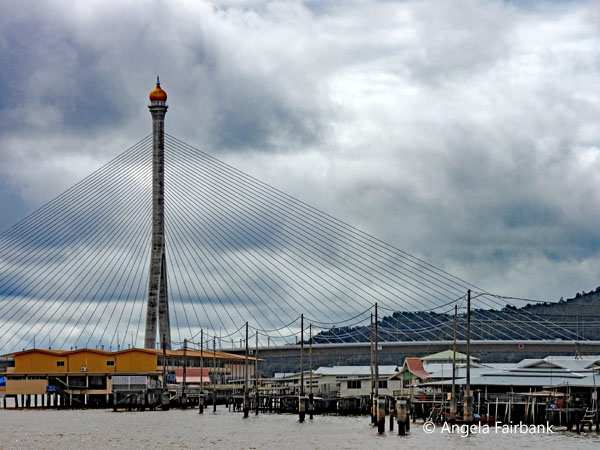   My next stop on my stroll in Bandar Seri Begawan, the capital of Brunei, was the mosque Masjid Omar Ali Saifuddien dan Bahtera Mahligai. “His Majesty Maulana Al-Sultan Haji Omar 'Ali Saifuddien Sa'sadul Khairi Waddien, the 28th Sultan of Brunei had consented to officiate at the opening of this mosque on the Friday of 13th Rabiulawal 1378 Hijrah, corresponding to [September 25, 1958]. The mosque is the first state mosque that can accommodate 3,000 worshipers and is also the main mosque used for religious state activities and ... royal solemnization ceremonies.” On my way back to the hotel, I passed a number of murals on boards surrounding an area of construction, including the below mural of Proboscis Monkeys. The bird in the photo beside that of the Proboscis Monkeys mural is a Yellow-vented Bulbul (Pycnonotus goiavier). The sparrow you will see before the photos of the water village is a Eurasian Tree Sparrow (Passer montanus).
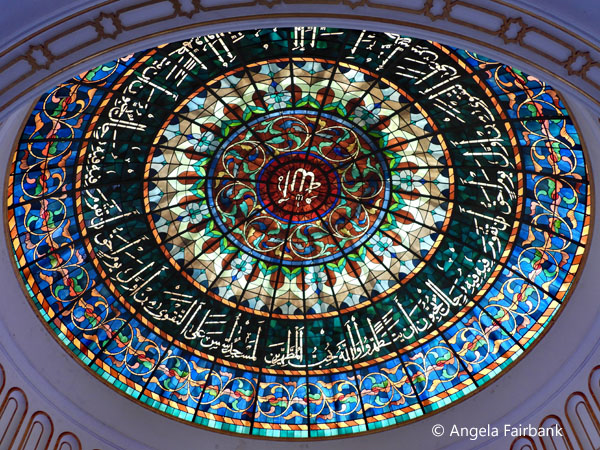
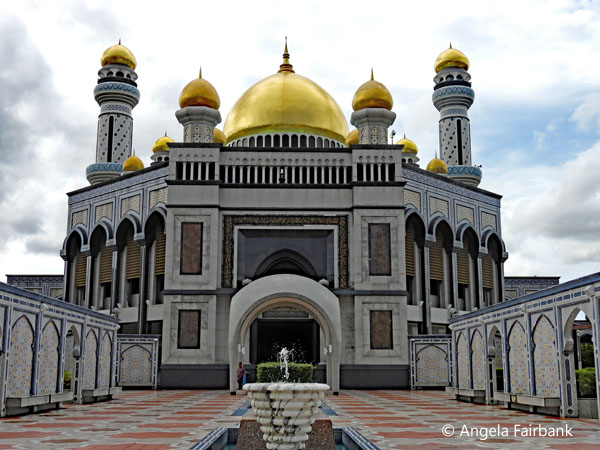
      After recovering from the intense heat in my air-conditioned room for an hour or so, I next caught the hotel's free shuttle ride to the (Sunni) mosque, Jame 'Asr Hassanil Bolkiah, the largest mosque in Brunei, and had a private tour by a young man who told me that the current Sultan had had it built between 1986 and 1994 and paid for it out of his own pocket. It features 29 golden domes and four minarets, each standing 58 metres (190 ft) high. The domes commemorate the 29 Bruneian Sultans, while the marble stairs, with 29 steps, honour the current 29th Sultan of Brunei, Hassanal Bolkiah. Five water fountains symbolize both the five daily prayers and the five pillars of Islam (Shahada (declaration of faith), Salah (five daily prayers), Zakat (charity), Sawm (fasting during Ramadan), and Hajj (pilgrimage to Mecca). The mihrab is decorated with 24-carat gold-plated tiles and black marble stones, with the largest dome situated above the male prayer hall. The mosque's air-conditioned interiors, which can accommodate up to 5,000 worshipers at once, are designed with materials imported from across the world, including Persian carpets, Austrian strass crystal, Italian marble, Philippine hardwood, and gold. The mosque also has areas dedicated to male and female ablution. You'll see a photo of the female ablution room below.
     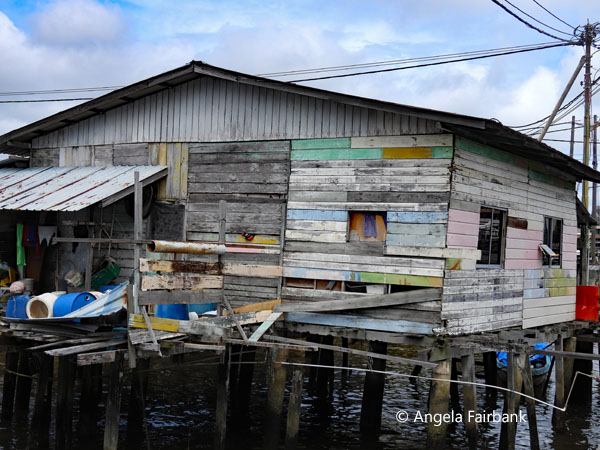 Instructions for the ablution were presented in order, as follows: 1. Begin by reciting Bis millah (meaning 'in the name of God,' an invocation used by Muslims at the beginning of an undertaking); 2. Completely wash both hands including the wrists and between the fingers three times; 3. Put the water inside your mouth and then gargle. Repeat three times; 4. Sniff water into the nostrils and then blow them out. Repeat three times; 5. Wash your face three times by spreading your hands from your right ear to the left and from the hairline to the chin; 6. Wash your lower arms from wrists to elbow leaving no part dry. Repeat three times for each arm, starting from the right; 7. Using your wet hands, wet a part of your head. Repeat three times; 8. Wipe the inside of your ears with the index fingers and the back of your ears with your thumbs; 9. Wash both feet up to your ankles, making sure that water goes between the toes. Repeat three times for each foot starting from the right.
   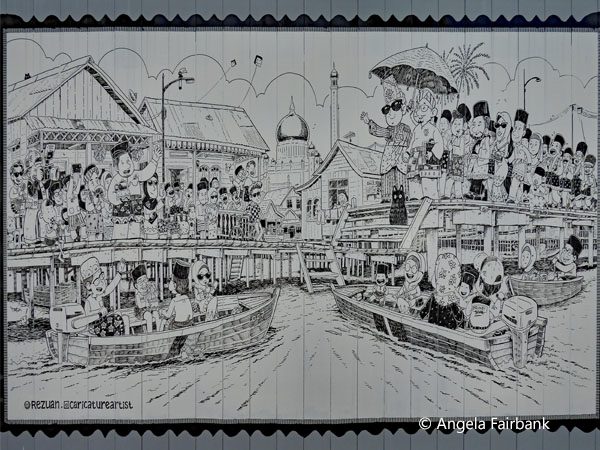   Although I had been dropped off in front of the mosque by the hotel shuttle van, I was told I would have to find my way past this zebra dove (Geopelia striata) to the nearby shopping centre department store, which entailed my asking a few people. I eventually found it and then spent a good half hour watching locals going in and out of the store to buy their groceries. The majority of locals here were Malay and Chinese with a few Indians. The middle-aged couple I travelled with in the hotel shuttle from and to the hotel were from Taiwan and spoke Mandarin. After processing my photos, I ate a dinner of salmon in the hotel restaurant and when I was about to return to my room, the receptionist told me they had finally found a tour for me for tomorrow to visit the Iban indigenous group just as I had requested on Thursday upon my arrival. Owing to the fact that I had my onward flight to Singapore the next day, I had to bargain hard to get a price and schedule that would work for both me and the tour guide. We arranged that after checking out of the hotel tomorrow morning, I would take my bags with me, and my driver/guide would drop me off at the airport in time for my afternoon flight.
       Sunday, January 4: Bandar Seri Begawan, Brunei - Singapore
After consuming an early breakfast, I checked out of the hotel and was met at 7:00 a.m. by my tour guide for today called something like Reeswaudi, a 54-year-old Muslim and father of three adults in their twenties. Our itinerary for the day was first to visit the Teraja Longhouse in Labi, 100 kilometres (62 miles) by road from Bandar Seri Begawan in the interior of the Belait District. It was about a 2-hour drive and my guide explained many of the buildings and natural phenomena on the way. He pointed out an area of what he called white sand from which glass is made i.e. silica or quartz sand. He also mentioned that the forests contained many trees, whose wood was used for flooring, doors, and furniture but no longer for houses, as it was too expensive. It also contained many species of wildlife, although, unfortunately, we did not see much apart from a few birds and insects. I should probably tell you why I was interested in visiting this area. On learning that I was coming to Brunei, a girlfriend of mine recalled visiting as a child and particularly remembered the stilt houses in the water village and indigenous peoples with long earlobes. Curious to see the latter for photography purposes, I had asked the concierge at the hotel front desk on my arrival if he could arrange a tour for me to do so. Although he said that most of these people were in Sarawak, he said he knew a guide who might be able to take me to visit the Iban in the Belait District. Unfortunately, he only received an answer on Friday night, telling him that such tours were only possible on Fridays and Sundays. I had been hoping to go on Saturday but as that was not possible, decided that Sunday was a bit tight as I was flying in the afternoon. Long story short, due to the higher price quote for a person going on her own, although another receptionist tried her best with other tour guides to see if they had a group tour already organized that I could join on Sunday, I was told I was the first person since 2024 to request such a tour, and being only one person, I would need to pay double the usual price. Given a few hours to think about it and make up my mind, I eventually decided to turn down the offer. Then this other tour guide's quotation at a lower, more affordable price was quoted to me on Saturday night after dinner, and I accepted very last minute. It came to light later, however, that this was this tour guide's first visit to the Iban Teraja Longhouse. He also included in his quote visits to waterfalls, a coffee plantation, and a lake, although I was prepared to drop any of the latter three sites in the interest of getting my afternoon flight in time.   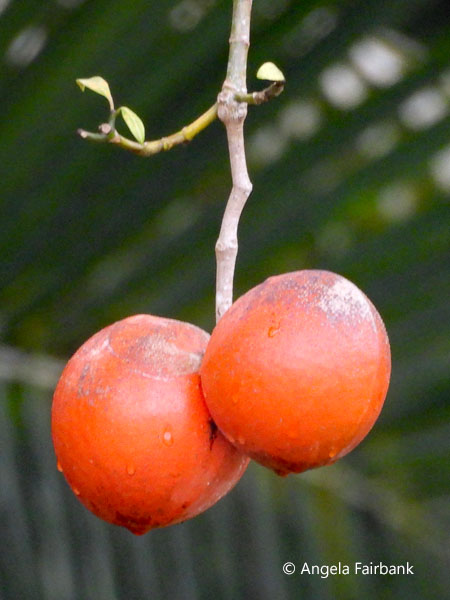 In any case, we were lucky with the Sunday traffic and encountered no delays either to Labi, which I was told was within 20 kilometres of the Sabah border, or back again. Finally arriving at our first destination, the Teraja Longhouse, we got out of the car and used the fly-filled but otherwise clean toilets that required me to bring my own toilet paper. We were then invited to remove our shoes and climb the stairs up to the longhouse, constructed of wood and cement, which was in essence a communal living structure for five families, consisting of several generations per family and up to 30 people per household. I was not invited to look into the living areas (consisting of bedrooms and kitchens) but was free to walk around the communal area where they all ate their meals and took part in celebrations. On the walls, they displayed some rattan or bamboo basketry (I bought a small pink one), several newspaper articles about people who had visited, posters containing information about the snakes, frogs, hornbills, and figs found in the area, and photos of four waterfalls within a 1-hour walk from the longhouse. This was our first discovery. My guide's promise of a visit to a waterfall was logically impossible given my time limit (not a disappointment to me actually because after all, I had visited a number of probably more impressive waterfalls in Laos recently). I asked a lot of questions, including why none of the longhouse inhabitants had long earlobes. Apparently this was more a characteristic of the Dayak in Sarawak. Wikipedia says, “The Dayak people, particularly groups like the Penihing, Kayan, Bahau, and Kenyah in Borneo, practiced elongating earlobes as a traditional sign of beauty, status, and patience, using heavy metal earrings (hisang or abe) to stretch them, although this custom is fading with modern times.”
Disappointed, I took a photograph of the group I was able to speak to, which included my guide, a representative guide from the Iban tribe, a younger woman who explained the little dish of offerings (see Miring explanation below), and the older woman who sold the basket to me. There were a number of youth going in and out as well and I spoke to this young man, who because of his long hair I initially thought was a young woman. He told me he had finished high school and was now working at the liquid gas company, occasionally went into the capital city for groceries, but otherwise enjoyed his life at the longhouse out in the countryside together with 30 members of his multi-generational family. On the walls, too, were three explanations of the history and rituals of the longhouse, which I was encouraged to photograph and shall reproduce here as text:  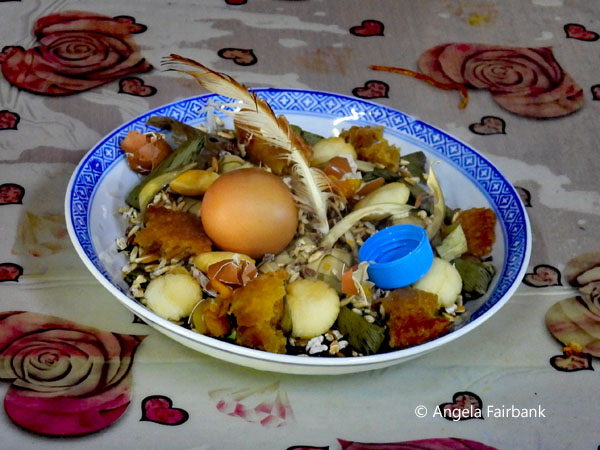 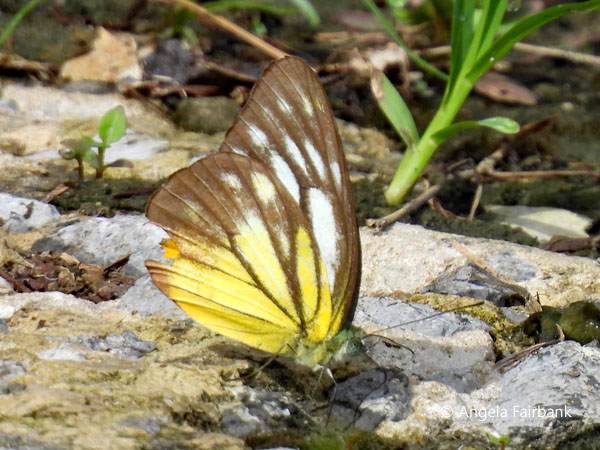 “Awang Jamit Anak Lasah was an Iban man from Marudi who fled into the forest with his father to search for a new settlement. The journey brought them to Teraja, Brunei. He met his wife, Cherambeang Anak Gunong, in Teraja. [She had] fled with her mother to Teraja after enduring the bombing of Marudi and Labi by Japanese soldiers in World War II. Forced to leave behind their destroyed home and unfit living condition, they sought safety and a new beginning in Teraja, drawn by its abundant natural resources and sparse population. She first settled in Menaram, the site of the first longhouse in Teraja. Awang Jamit came to Teraja and began to build the third longhouse in Teraja called the Teraja Longhouse. He married Cherambang after [frequent meetings at] festivals [such as] Gawai and New Year. Over time, the community expanded from a small two-door longhouse to the present five-door structure, now 38 years old, built from traditional materials like umbut jaum for the frame, tree bark for walls, and bamboo for the flooring. The construction of a new longhouse followed strict rules and spiritual practices. Before building, the location was chosen carefully by Awang Jamit and a ritual called Miring was performed to seek blessings. If anyone experienced bad dreams during the process, the site would be deemed unsuitable, and a new location would be chosen. After finalizing the spot, a ceremonial Gawai Makung Tiang was held, where offerings were made for each pillar, symbolizing protection and blessing for the new home. Moving to the new longhouse involved transporting belongings early in the morning and continuing until late at night, with a belief that sleeping during the transition could invite bad luck. After the move, the residents refrained from returning to the old house for three days to allow the spirits to settle. Gawai ceremonies, which included prayers at the site of the old house, symbolized gratitude, continuity, and the preservation of Iban traditions.”
“For the Iban people in Brunei, Miring remains a vital ritual that connects them to their spiritual beliefs and ancestral heritage. This ceremonial offering [a photograph of which you will see above] is performed during significant events such as festivals, for example, Gawai, weddings, or life transitions, including funerals, to seek blessings, protection, or harmony. The ritual typically involved preparing symbolic offerings like food, drinks, and occasionally animal sacrifices, which are arranged on trays as gifts to the spirits and ancestors. Led by an elder or spiritual figure, prayers and chants are recited to invoke divine favour and guidance. While adapted to fit Brunei's cultural and religious context, Miring continues to be a meaningful practice that strengthens the Iban community's sense of identity and connections to their traditions.” The offering in the photo you will find for today includes one chicken feather, one chicken egg, a plastic water bottle cap filled with rice wine, various crops, and reeds woven into thumb-size items. The numbers of these various items are significant and apart from the one feather, the one egg, and the one capful of rice wine, other items are found in threes, sevens, nines or eights. “For the Iban community in Brunei, Gawai Dayak is a cherished cultural celebration that honours the end of the harvest season and serves as a time for thanksgiving, unity, and renewal. While adapted to Brunei's unique cultural and societal context, the essence of the festival remains deeply rooted in Iban traditions. The ceremony begins with the Miring ritual, where offerings are made to ancestors and spirits to express gratitude and seek blessings for future prosperity. Families and friends gather to share festive meals, enjoy traditional dances like the Ngajat, and partake in storytelling, strengthening their communal bonds. Although celebrated on a smaller scale compared to neighbouring regions, Gawai in Brunei highlights the Iban people's dedication to preserving their heritage and identity within the nation's multicultural framework.” 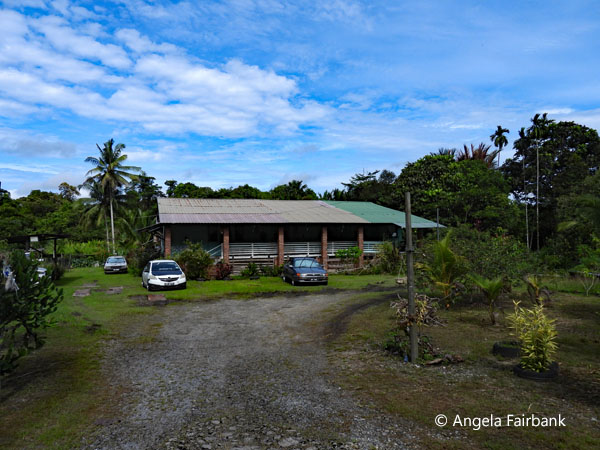   Noticing the time, we finally pulled ourselves away after being shown a box in a tree that they had placed for visiting hornbills, which apparently like to feed on these red fruits, possibly a type of fig called ficus dubia, and photographing this Common crow butterfly (Euploea core) and a Cepora Timnatha butterfly. I also took photos of some fruit the longhouse had for sale, including jackfruit, rambutan, and durian (Durio zibethinus), the fruit banned on Singapore Airlines and generally in Singapore's public transport/hotels due to its extremely pungent, lingering odor compared to onions, sewage, or gym socks--although, surprisingly, I find it quite nice, which meant that my guide was able to buy some for himself and put it in the trunk of his car next to my suitcase. On the route back, we stopped a few times so I could photograph a few flowers and more longhouses on the same road until we arrived at the coffee plantation, mentioned in the tour itinerary. Being a Sunday, the plantation, called Labi Coffee, was actually closed, so the driver merely drove in the gate and pointed out the bushes. Frankly, I was more interested in photographing the Great Egrets (Ardea alba) gathered en masse on the grass among the bushes and then these barn swallows (Hirundo rustica), which I had last seen in South Korea and Mongolia, fluttering in and out to feed their chicks, so was delighted to see some adult swallows sitting still for once.
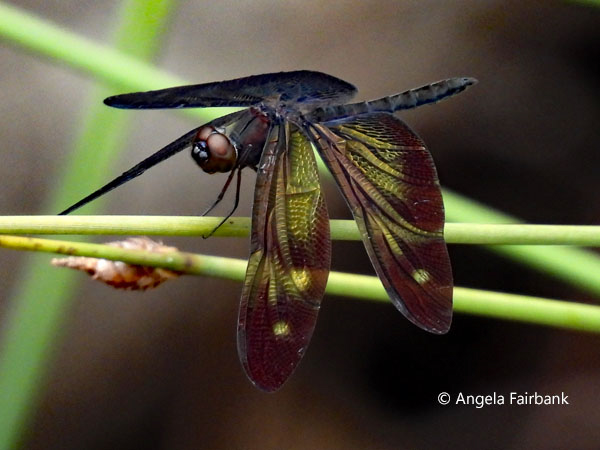
  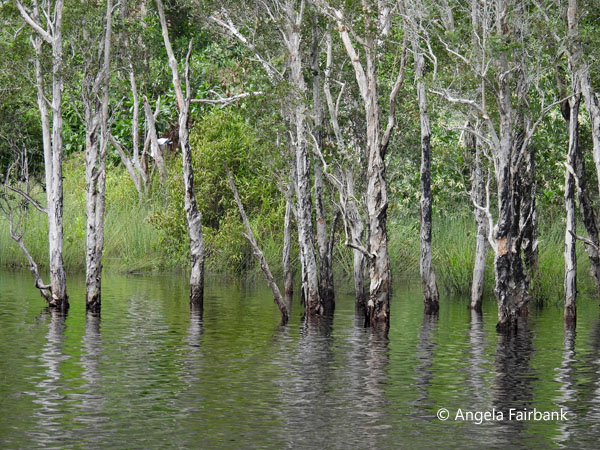 Our final stop, before reaching the highway back to the capital and the airport, was Taman Rekreasi Hutan Luagan Lalak or Luagan Lalak Forest Recreation Park, containing a large saltwater lake with a boardwalk connecting three over-the-water gazebos, from which middle-aged men were fishing and catching striped snakehead (Channa striata). Panels along the boardwalk indicated other wildlife found at this lake, including hornbills, saltwater crocodiles, Brahminy kites, Sunda pangolins, red langurs, flying lemurs, and more. The best I could come up with photography-wise was this rhyothemis aterrima dragonfly.
   Finally, I'll explain the final photos of this set, which are of the King and Queen (or Sultan and Sultana) of Brunei, and which were displayed in the Singapore Airlines cum Royal Brunei Airlines business lounge at the Brunei airport. Hassanal Bolkiah Muiz'zaddin Wad'daulah (born July 15, 1946) is Sultan of Brunei, reigning since 1967. He has also served as Prime Minister of Brunei since its independence from the British rule in 1984. He is among the world's few remaining absolute monarchs and is the 29th sultan to ascend to the Bruneian throne, following the abdication of his father in 1967. The Sultan has been ranked among the wealthiest individuals in the world. As of 2023, Hassanal Bolkiah is said to have a net worth of $50 billion. He is the world's longest-reigning current monarch and the longest-serving current head of state. On October 5, 2017, Bolkiah celebrated his Golden Jubilee to mark the 50th year of his reign. He has been married three times: his first wife, the current queen, is a first cousin. They are still married. He also married a flight attendant and a TV anchor but is now divorced from both. He has a total of 12 children from his three wives: five sons and seven daughters.
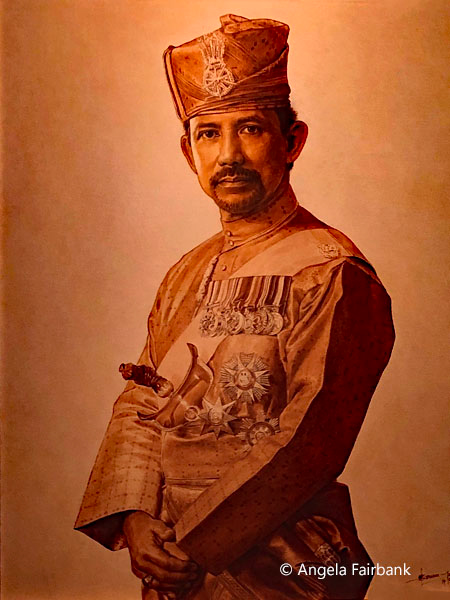  My first flight on Singapore Airlines, in Business Class, was short but included a nice meal and I arrived in Singapore at 6:00 p.m. with an eight-hour wait before my next flight. I was advised to go through customs, which meant filling out another Singapore arrivals card, and picking up my bag since I would then be travelling on a different airline, Ethiopian. (There had been no Ethiopian Airlines counter in Brunei.) I managed to do some work on my computer and briefly visit the Business Lounge in the Jewel before returning to the Ethiopian check-in desk about four hours before the flight and going quickly through immigration and into the Ethiopian Airlines-related business lounge to charge my phone and relax until my next flight was ready to leave.
Monday, January 5: Singapore - Addis Ababa, Ethiopia - Djibouti, Djibouti
My flight to Addis Ababa left around 2:00 a.m. in the morning and I had a comfortable night sleeping on a flat bed in business class, a tolerable meal, and the ability to watch two movies on my individual TV screen. Arriving in Addis at 6:00 a.m. local time, I managed to follow the correct path to international flights, only being required to pass my hand luggage through screening. I then found the business lounge and avoided eating or drinking anything there for about 3 hours as I awaited my next flight to Djibouti City. (The reason for my avoiding food or drink here was because I had had a very bad case of food poisoning the last time I had visited and eaten at Addis Ababa airport's business lounge and had been vomiting the entire voyage back home to Vancouver.) I was then called onto my next flight, where I was also seated in Business Class. In fact, there were only four of us, although there was capacity for 12. I accepted the flight attendant's offer of a snack and drinks on the flight. Around 11:00 a.m., I arrived in the Republic of Djibouti, (my 147th UN country), located in the Horn of Africa, and bordered by Somalia to the south, Ethiopia to the southwest, Eritrea to the north, and the Red Sea and the Gulf of Aden to the east. This country has an area of 23,200 km2 (8,958 mi2). Djibouti is near some of the world's busiest shipping lanes, controlling access to the Red Sea and Indian Ocean. It serves as a key refuelling and transshipment centre and the principal maritime port for imports from and exports to neighbouring Ethiopia. Djibouti is a multi-ethnic nation with a population of 1,066,809 at the census held on 20 May 2024 [and thus] the smallest [country] in mainland Africa. French and Arabic are its two official languages, [while] Afar and Somali are national languages. Somalis and Afar make up the two largest ethnic groups, with the former comprising the majority of the population. Both speak a language of the Cushitic branch of the Afroasiatic languages. About 94% of Djiboutians adhere to Sunni Islam, which is the official religion and has been predominant in the region for more than 1,000 years. [However, although] Arabic is of religious importance, French serves as a statutory national language. It was inherited from the colonial period and is the primary language of instruction. Around 17,000 Djiboutians speak it as a first language. Immigrant languages include Omani Arabic (38,900 speakers), Amharic (1,400 speakers), and Greek (1,000 speakers). Having been seated in Business Class, I was one of the first at immigration and the police easily accepted my e-visa and stamped my passport without any fuss. However, I then had to wait for my suitcase, which was one of the last to arrive on the conveyor belt, despite its bright red 'Priority Luggage' label. After then putting all of my bags through an Xray, I came into the arrivals hall and proceeded toward the taxi stand. Someone found me a taxi, and I was very correctly brought to my hotel. I was greeted profusely on my arrival at the Atlantic Hotel by its front office manager, Mohamed, and taken personally by him to my large hotel room on the third floor, its aircon and ceiling fan both whirring at full blast. A few minutes later, there was a knock at my door (despite my having hung the 'Do Not Disturb' sign on the door handle), and a handsome young man greeted me, asking if he could come in. Suspicious of his intent, I asked who he was and he said he was my guide for my tour starting tomorrow. He gave me his name, Souheb, which matched the information I had received from the British tour company, Native Eye Travel, and gave me his WhatsApp number for communication, which also matched. (Well, you never can be too careful ... and to give me credit, I wasn't expecting to see him until tomorrow since I had arrived in Djibouti a day early.) Nevertheless, I appreciate his diligence. He has also offered a city tour tomorrow after he has picked up the other people on the tour, which apparently involves three trips out to the airport for him! Although my guide had told me walking around the city in the daytime was safe, after bidding him adieu, I decided to work on my book translation today, as well as process my photos from yesterday. I then had a few snacks from my suitcase and got an early night's sleep. Tuesday, January 6: Djibouti City (Ville de Djibouti in French), Djibouti
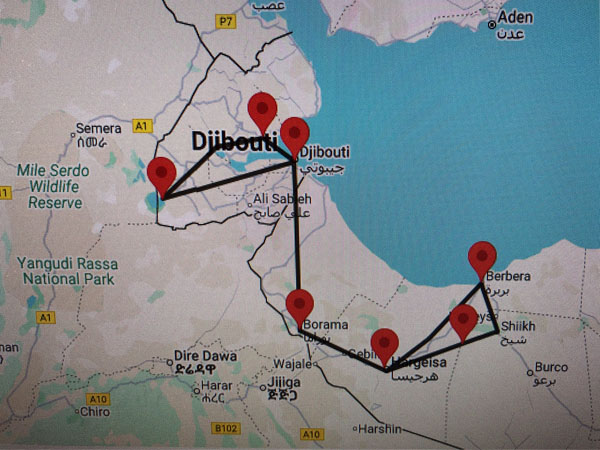 And ... “tucked away in the Horn of Africa, Djibouti is one of the smallest countries on the continent and receives very few visitors. A French colony until 1977, it was one of the last African nations to gain independence. Djibouti's main asset is its port, providing an outlet for landlocked Ethiopia to send goods across the Red Sea and Indian Ocean, and Djibouti City is the country's liveliest hub, [despite it being] in a country with a traditionally nomadic population. The capital is a fascinating mix of African, Asian, Arab, and European influences and is divided into [African and European quarters]. It is small enough to explore by walking around and although there are few traditional sights, the main appeal is soaking up the atmosphere of this cosmopolitan little city, where French legionnaires mix with nomadic Afar tribesmen, and women dress in outrageously colourful robes. Djibouti City has an allure that's hard to put your finger on” (but, I ask myself, can one actually put a finger on something as intangible as allure?) As Souheb was busy for most of the morning picking up tourists for our trip, I worked on my travelogue until he contacted me saying that he had picked up six guests and we were meeting in the lobby at 1:45 p.m. to go out to a restaurant for lunch. We are a group of ten: a Dutchman, two British women (one of whom has been to more countries than I have), a couple consisting of a British man and a Singaporean woman, who has also likely been to more countries but isn't bothering to count them, and a younger American man from New York. At dinner, we were also joined by another two women traveling together, a Canadian from Toronto and a Brit. There is one more British man we haven't met yet because his flight doesn't arrive until 11:00 p.m. tonight. Petitioned by beggars on the way there and back, we survived our lunch (although I wasn't all that impressed with it) of grilled fish with all its bones and flat bread (no vegetables except salad in sight, which Souheb swore he saw being washed in mineral water, nevertheless I didn't want to take any chances). Before having a break of about an hour and a half, during which I finished reading one book and started another, we had a meeting where Souheb explained our itinerary for the next three days (yes, we are in Djibouti for a very short time, but as mentioned above, it is a small country) and told us that since Israel recognized Somaliland as a country last month, it's possible we may not be able to get into Somaliland via our original land border and instead may need to either fly in (plan B) or go by land via Ethiopia (plan C, which means getting an e-visa for that country too) or (plan D) via Somalia (which also entails getting an e-visa.) We shall see what the situation is like in four days time but this would all imply additional costs for us passengers. We then met again at 5:00 p.m. and went out for a short walk to see the 'I love Djibouti' sign, and the Independence Square monument, celebrating independence from France in 1977 and featuring an Afar man. As mentioend above, Somalians and Afar are the two main ethnic groups here in Djibouti and so far they are getting on together due to a policy of sharing information about each other. Souheb explained the different ways the males of these two groups tie their skirt around their waist. Some elderly female influencer was recording a video on the steps of the statue while we were there and miming to a song. Flocks of green parrots were also flying overhead. We then walked over to the African district of Djibouti City, which was noticeably more crowded. Several people called out hello to us or Happy New Year in English or French as we headed to the market and its mosque. It was at that point we heard the call to prayer, so Souheb dropped us off at a souvenir shop while he went to pray and some of us also browsed the French bookshop across from our hotel. We met again at about 6:30 p.m., after Souheb had prayed, and decided to eat western dishes at the hotel restaurant. I had smoked salmon spaghetti, which was surprisingly very good. I got back to my room 8ish and worked on my photos and travelogue, getting to bed at a reasonable hour. 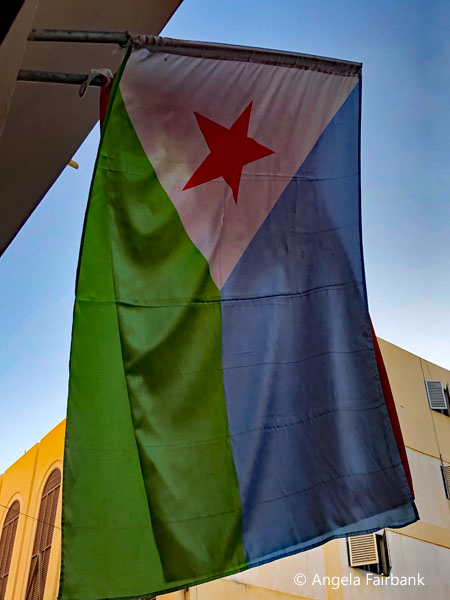 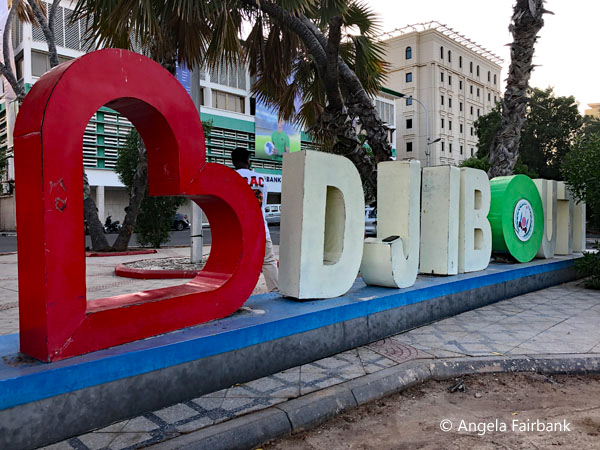 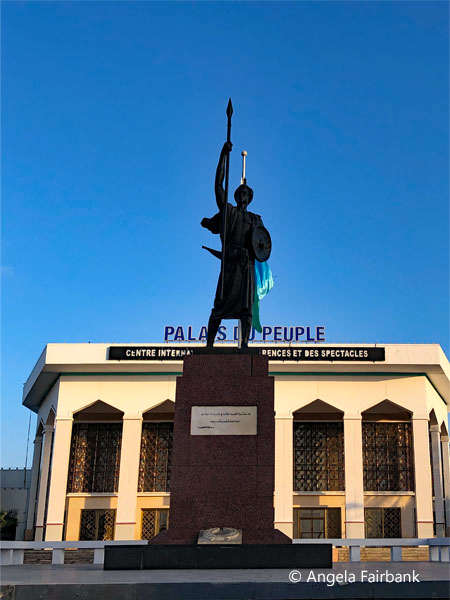 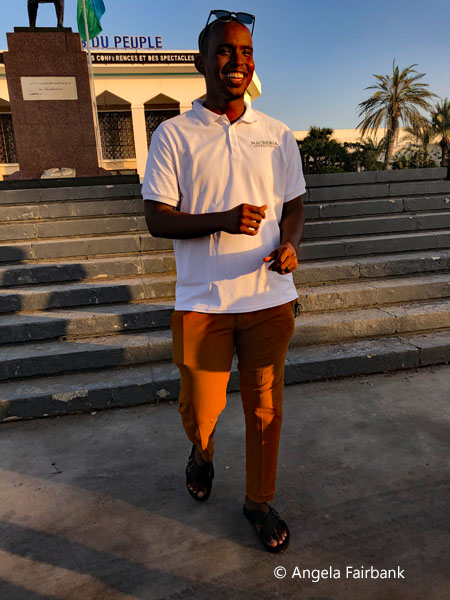 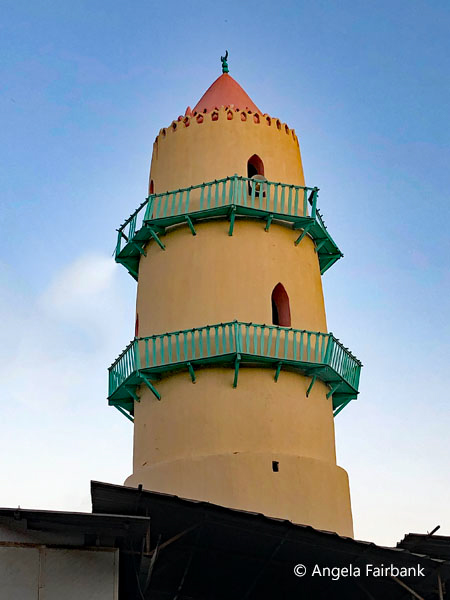 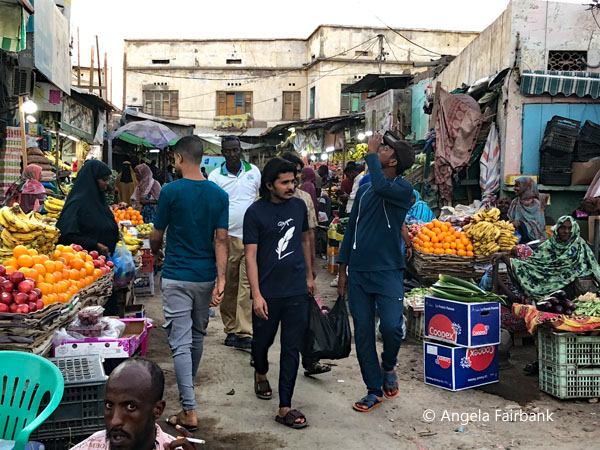 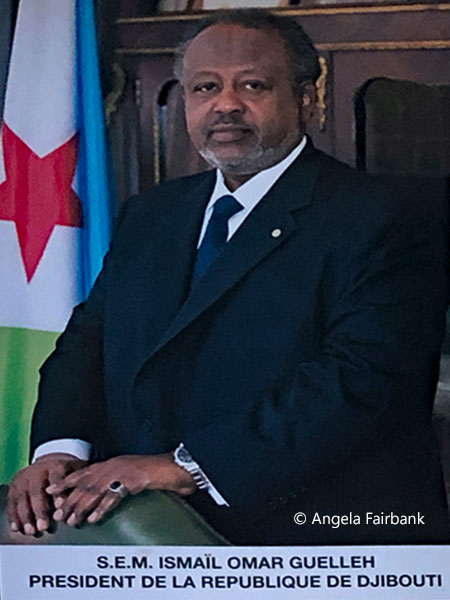 Wednesday, January 7: Djibouti City - Lac Abbe, Djibouti
Today our ultimate goal was to see the extraordinary landscape of Lac Abbe, a desolate salt lake situated approximately 150-200 kilometres southwest of Djibouti City, surrounded by hundreds of limestone chimneys, some up to 50 metres high, and various hot streams emitting sulphurous gas. It holds the distinction of being one of the most desolate places on Earth and is located on the border between Ethiopia and Djibouti. Nomadic Afar people use the lake to gather salt, although it is also full of birdlife, with flamingoes, pelicans, and ibis, among other species. As the itinerary hinted, it was quite awe-inspiring scenery. But I am getting ahead of myself. 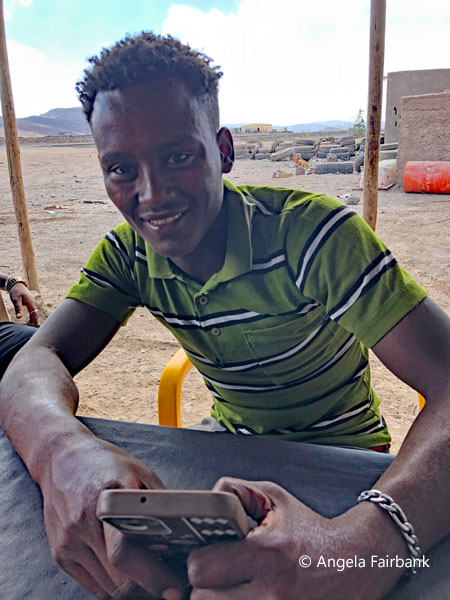     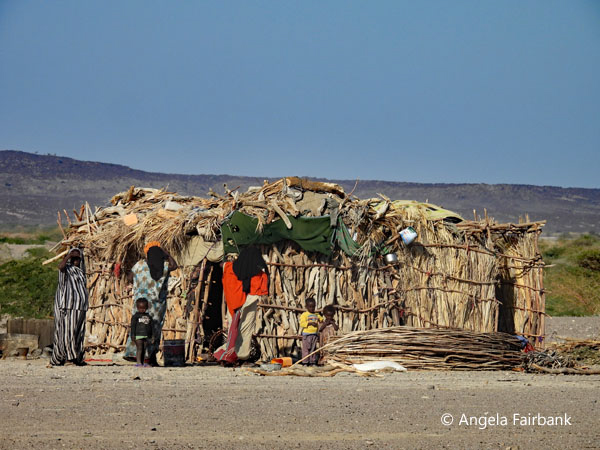  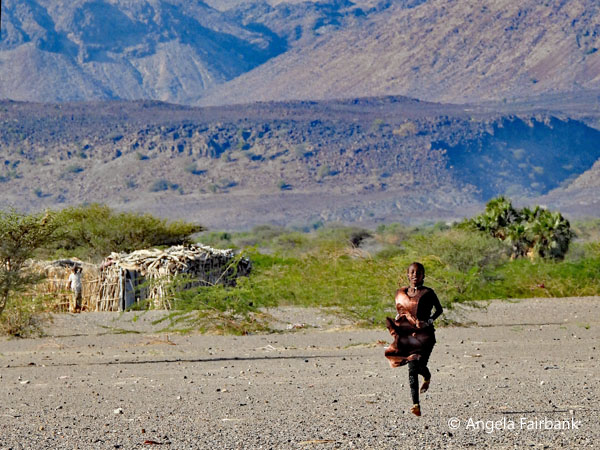  Checking out of our hotel this morning after breakfast, we separated into four Land Cruisers where I managed to get into the lead car with one of the British women and our guide; a very lucky choice for me as I was able to pick Souheb's brains for more insight into his Somali culture, Sunni Muslim beliefs, where Mohammed is Allah's prophet, as opposed to Shia Muslim ones, where Ali is Allah's prophet, and country as we both sat in the back seat and were driven by the lead and oldest driver, Hassan, an Afar. Although both Souheb and Hassan speak French and English, I immediately asked them both for local vocabulary in their respective languages so as to interact better with the locals. Below is the list I made:
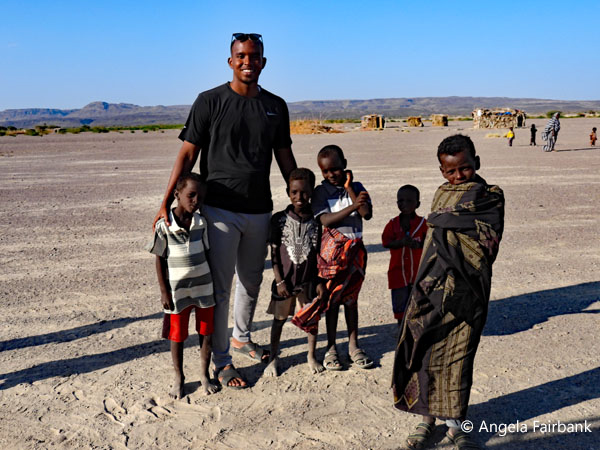
Our first step was to change Euros or USD into local currency since there would be little chance to do so outside of the capital city. I felt intimidated trying to take any people photos here but was assured it would be much, much easier once we were outside of the city. In any case, once we had ready local cash in hand we set off for a grocery story where I was able to buy souvenirs: a bracelet, a t-shirt, and a fridge magnet and a few drinks for the road. Then we headed for Lake Abbe, located southwest of Djibouti City as previously mentioned. Our cars first drove toward the large port, where we passed dozens of trucks laden with goods for Ethiopia. Our first stop was for coffee (Ethiopian) at a small café in the middle of nowhere, it seemed, complete with a squat toilet for our use and a cup of coffee for those of us who wanted it. The attraction here for me, however, was the local patrons who were visiting the cafe. At first I thought they might be Somali or Afar, as mentioned above, the two main language groups here, so as soon as I approached the locals sitting at tables outside, I tried out 'good morning' in both languages but was only met with blank stares. On being told by Souheb inside the small building that the people sitting outside were Ethiopian, I went back and said in my best Amharic, Amaseganalo, which is not 'hello' but rather 'thank you', which resulted in the smiles I was expecting. Having broken the ice, I then proceeded to ask if I might take some photos of them and they were happily obliging, hence the first three photos for today, in some instances taking photos of me in return. The fourth photo is a shot at the same café of our four drivers. Hassan is on the far right. And then I got stoned...
 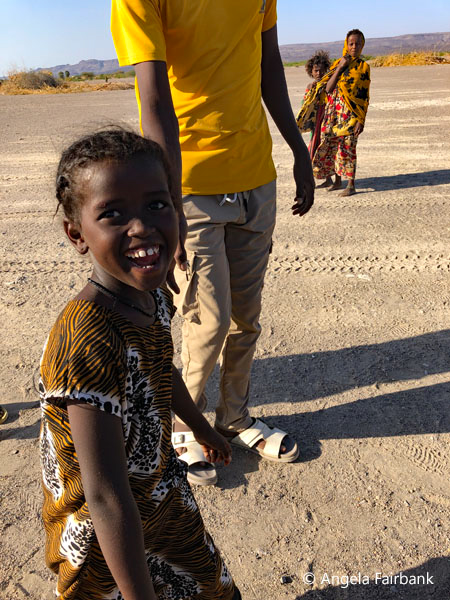 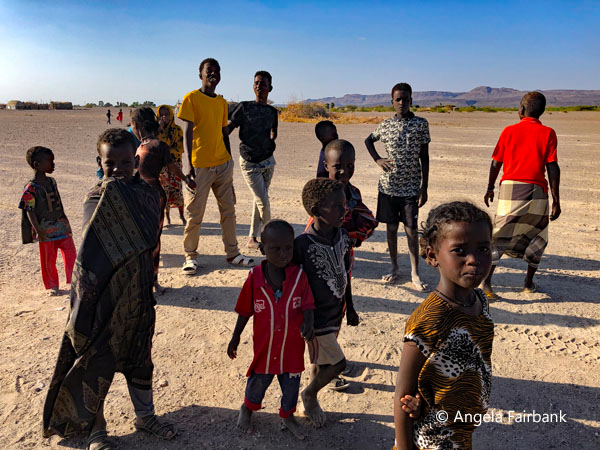 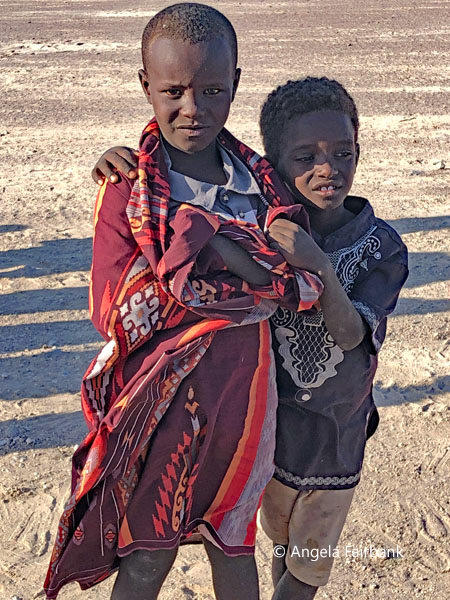  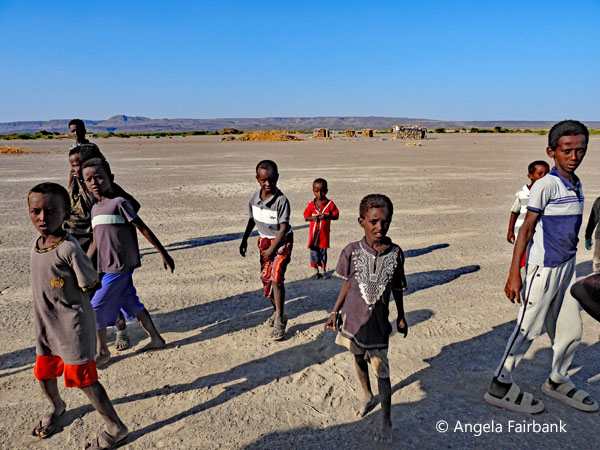   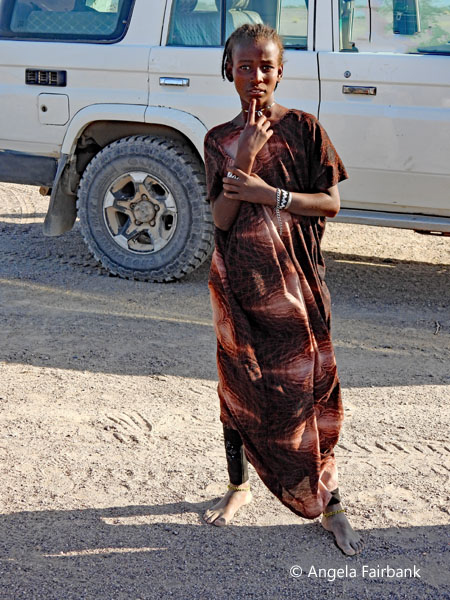 No, it wasn't what you might think ... although these Ethiopians were probably selling Khat (Catha edulis), a flowering plant native to eastern and southeastern Africa and cultivated by farmers. The leaves of Khat are chewed as a recreational stimulant because it contains the alkaloid cathinone, a “stimulant which causes greater sociability, excitement, a mild loss of appetite, and mild euphoria.” Among communities from the areas where the plant is native, khat-chewing has historical relevance as a social custom, especially among men, dating back thousands of years, analogous, but slightly different, to the use of coca leaves in South America's Andes Mountains or the betel nut preparations in South Asia. Since 1980, the World Health Organization (WHO) has classified khat as a 'drug of abuse' that can produce psychological dependence, although it does not consider khat addiction to be a serious global problem. No, it was after driving away from the café, only mildly caffeinated, that I asked our driver to stop so I could photograph two local women and their donkeys at a well. The women were filling plastic yellow contains with water to be carried by these animals. I had missed a previous opportunity to do so and had requested that the next time we saw such an event happening we stop to photograph. Well, no sooner had Hassan stopped the car on the opposite side of the road and I had opened my window to take the picture (far enough away, mind you, that the women's faces would not be visible) that the side of the car I was on was struck by a rock, thrown by one of the women. This action shocked not only me but also our guide and drivers to such an extent that they all got out to find out why the woman had done this. When Souheb returned to the vehicle, he explained that this was in no way normal behaviour and that the rock had been thrown by a woman who, her female companion explained, was not right in the head. It's not certain what had caused her unexpected action, but Souheb apologized many times and said again it was unusual behaviour and should not stop me from photographing Djiboutian people in the countryside in the future. The fact that he and all four drivers had gotten out of their cars to see what had happened and why, he said, shows that it was not at all a usual occurrence. The woman had apologized for her action, and we were able to continue on our way. Photo 5 shows the two women in question before the rock was thrown and, as you can see, their faces are not visible anyway.
 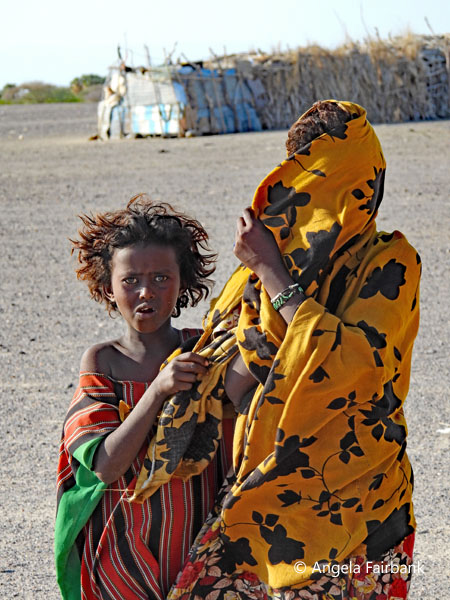 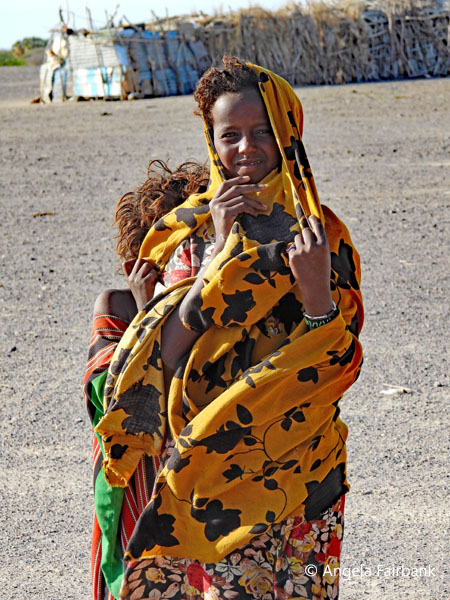 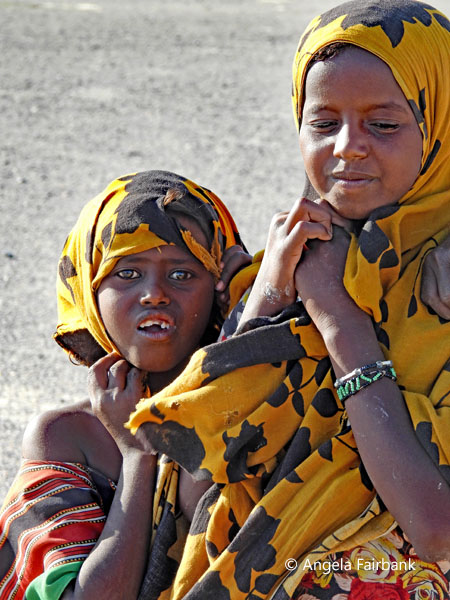   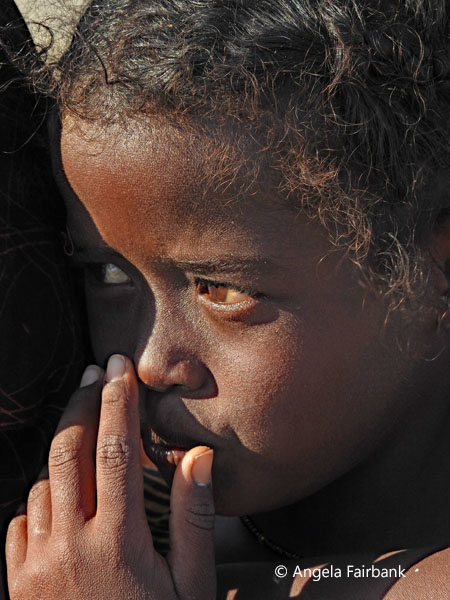 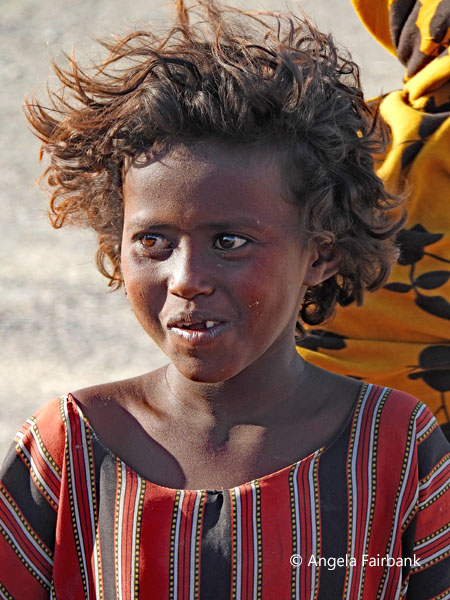 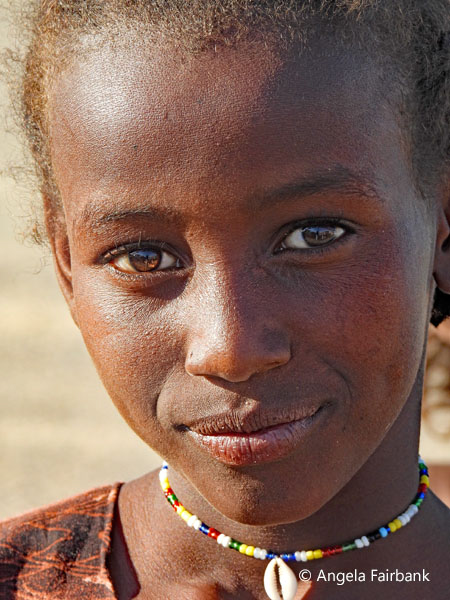 A few minutes later, we stopped in a typical Afar village, the Afar being nomads and therefore moving their huts seasonally to wherever there was fodder for their livestock. As you can see, we were most welcome, children running to see us, and curious faces coming right up to us. After a while of our interacting with them, they relaxed enough to want to be photographed. With help from Souheb and the four drivers, the atmosphere was made more enjoyable for all of us, and in the end, we passengers were able to get some great shots, including this one young woman with a goat in her arms slightly up the road a bit.
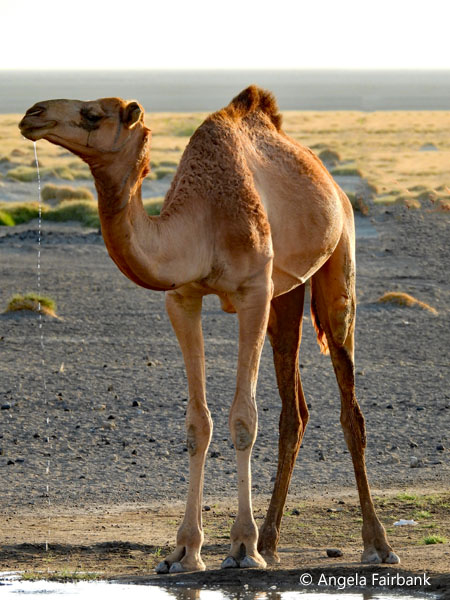
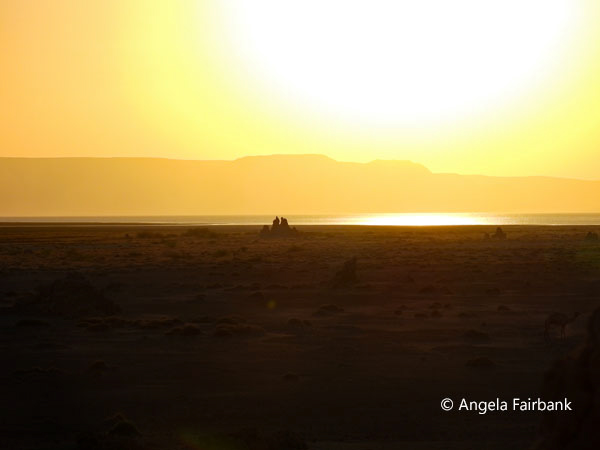
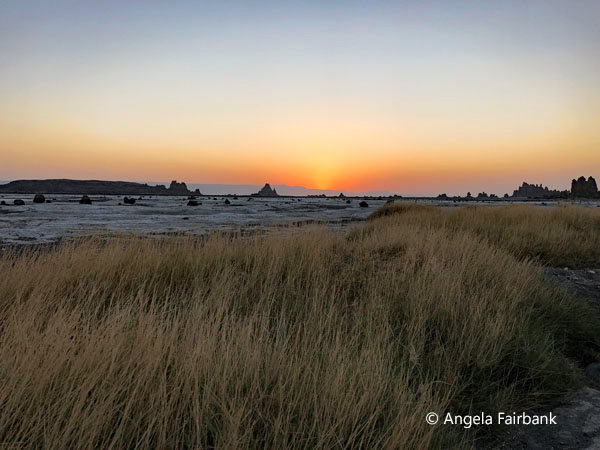
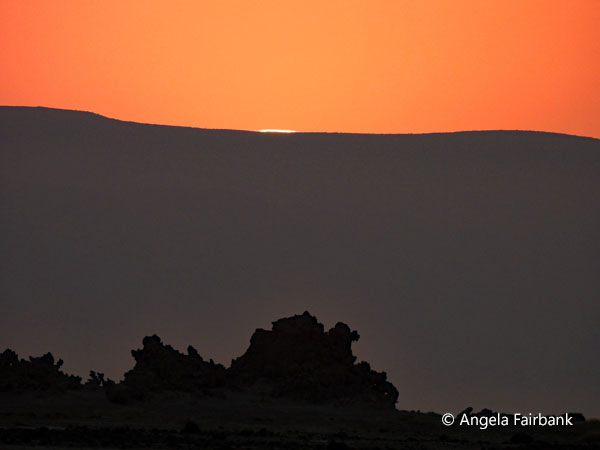
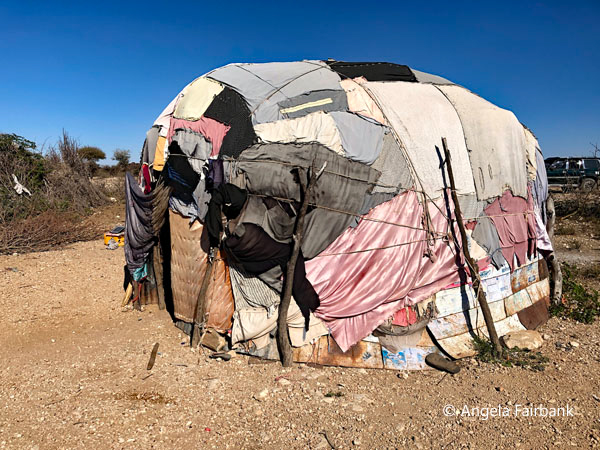
 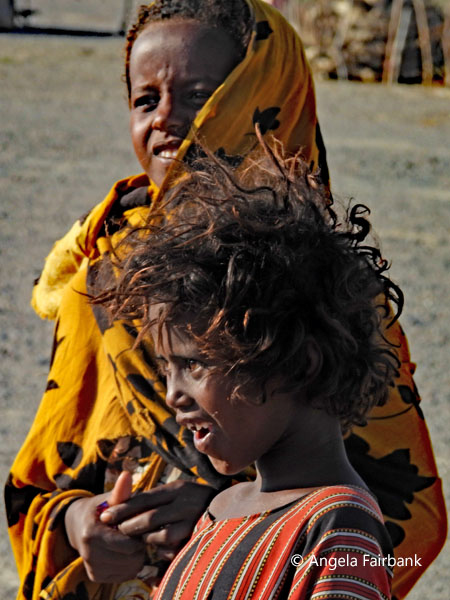 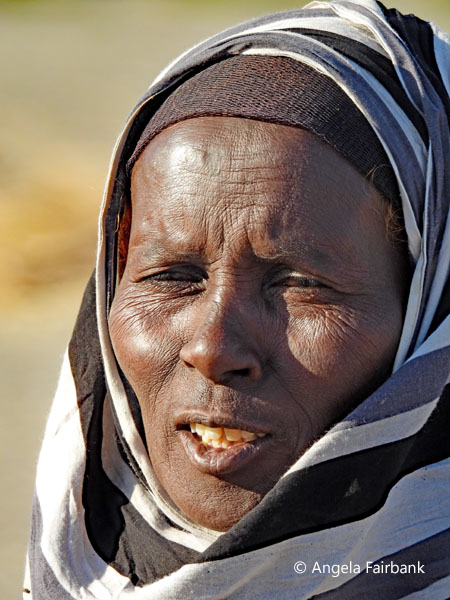   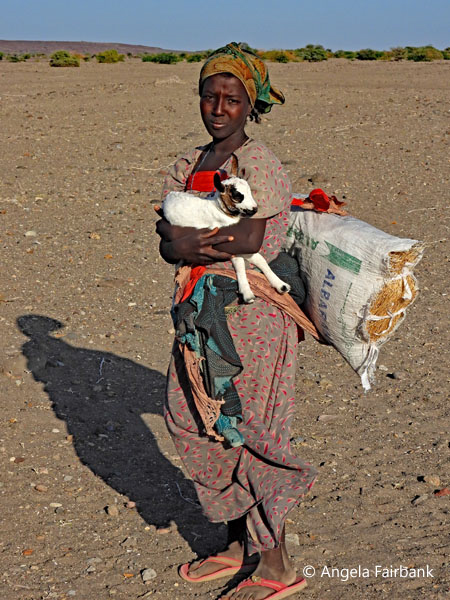   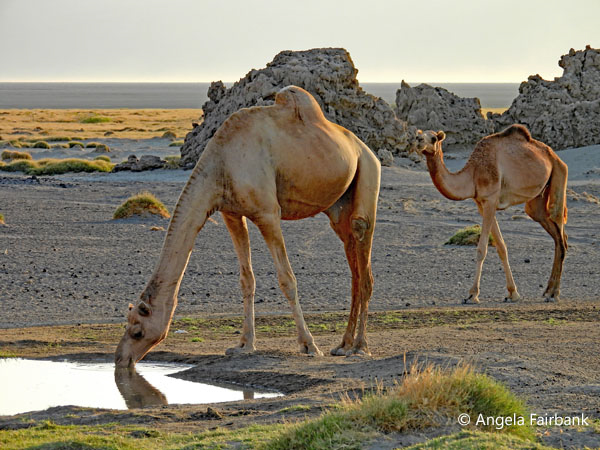 After a lot more driving and a tasty lunch stop, plus the use of its toilets, along the way at Hotel Gobaad in the town of Dikhil, we finally reached the area of Lac Abbe, where we saw our first wildlife, a Dorcas Gazelle (Gazella dorcas), Warthogs (Phacochoerus africanus) and camels, the latter which came to drink at a small water hole, filled with run-off from a sulphurous stream assumed to be cool enough to drink from ... although higher up said stream, the water had been emitting sulphurous steam, and when Souheb dipped a small plastic bottle into said stream, it melted and became deformed. Perfectly timed by our tour guide and drivers, we were able to watch the sun set here behind the curious shapes of the limestone chimneys. Once the sun had disappeared over the horizon, we were issued with head torches (on loan, we learned later, although our drivers had presented them to us initially as gifts!), and driven to our camp for the night. Reminiscent of the gers and yurts I had slept in in both Mongolia and the Stans in 2025, these were domed dwellings containing two or three metal beds with mattresses, blankets, sheets, and pillows. I had one domed hut to myself, rather worried that there was no key with which to lock it, no bolt either, and the only object keeping the door closed being a large rock. I reinforced the door with my large suitcase after receiving reassurances from Souheb that no one would bother me during the night. After having said that, one of the British men in our group suddenly pushed open the door into my hut, but being the gentleman he is, apologized, stating his miscalculation regarding his own hut, which was next door. There being no numbers on the huts, I memorized the look of my door, so as not to become confused and make the same mistake with his hut, and managed to find the outdoor sitting area where we had our dinner. We then got an early night as it was pitch dark and the toilet block was very poorly lit, hence the need for the head torches (and some of the toilets did not even flush). All in all, I would call it a rather dodgy camp. On the way out the next morning, Souheb told us the owners were planning a total reconstruction with geodomes ... but once again I'm getting ahead of myself.
         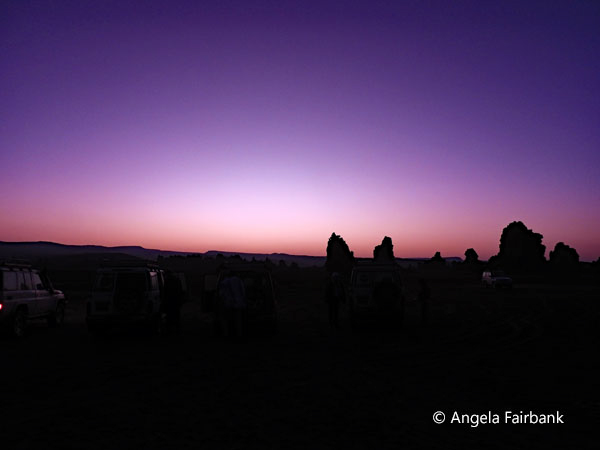 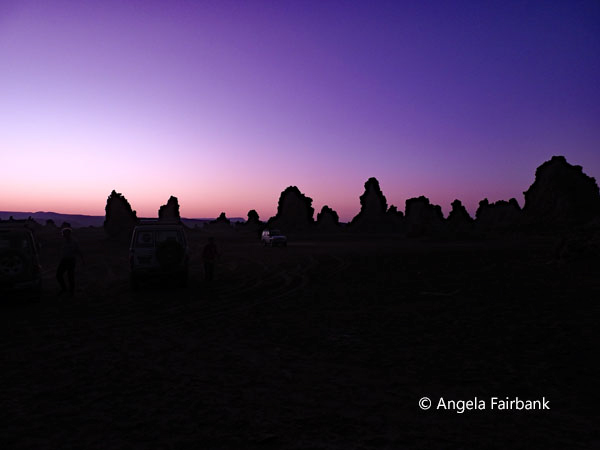 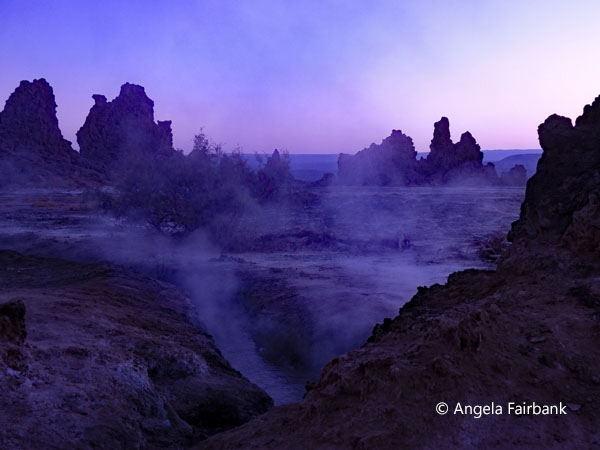 Thursday, January 8: Lac Assal - Tadjourah, Djibouti
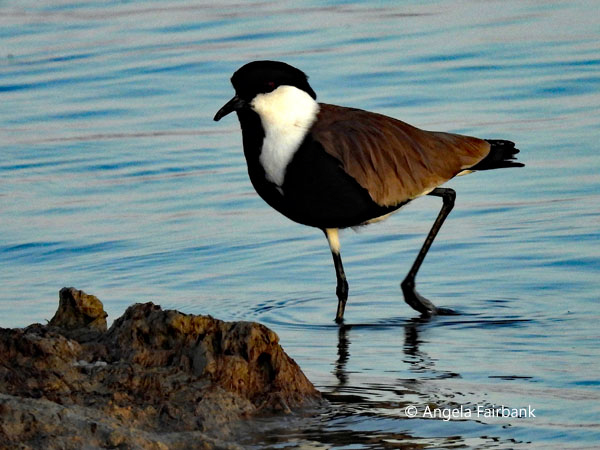
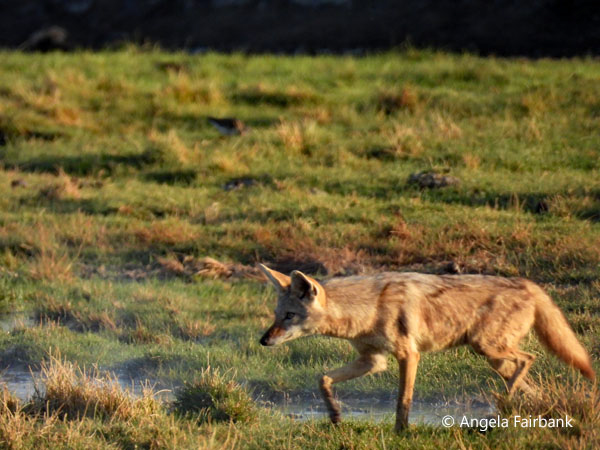
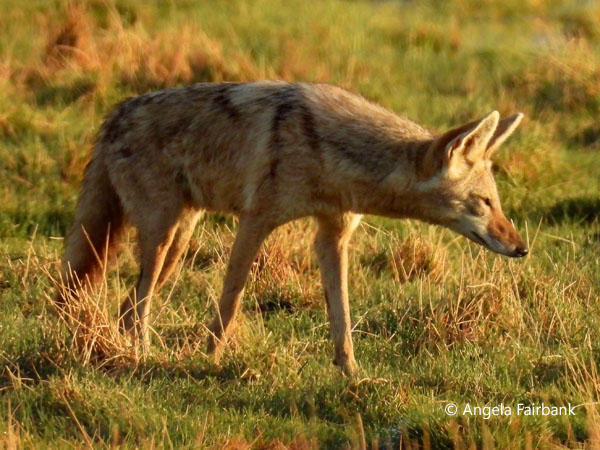
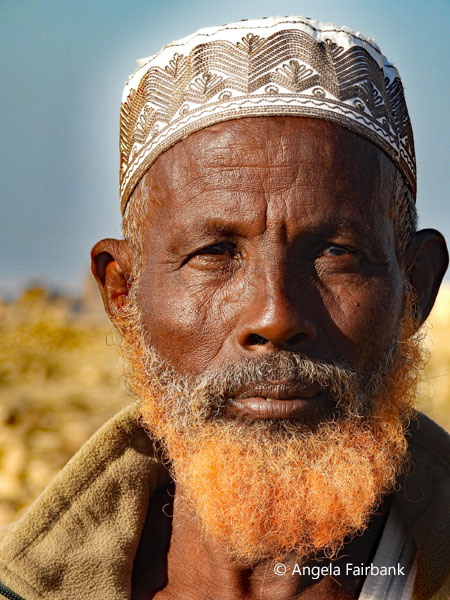
We were up early so we could drive out to the lake again but to a different part and this time experience it at sunrise. This meant we were also able to photograph the promised birdlife, including Great Egrets (Ardea alba), Spur-winged Lapwings (Vanellus spinosus), Lesser Flamingos (Phoeniconaias minor), Black-winged Stilts (Himantopus himantopus), Great White Pelican (Pelecanus onocrotalus), among others, and this African Wolf (Canis lupaster) formerly known as the African Golden Jackal. It was another amazing experience and despite the terrible lodging, well worth the visit. We returned to our lodgings for breakfast. The gentleman with the red beard you will see among this group of photos for today was working at the lodgings we were staying at and, intrigued by his hennaed whiskers, I requested the honour of photographing him. He asked me to wait, got cleaned up, donned a hat, and changed his clothes for the shot! He is the only person so far who has asked me for compensation, so I gave him a few coins of local money I probably wouldn't have found another use for.  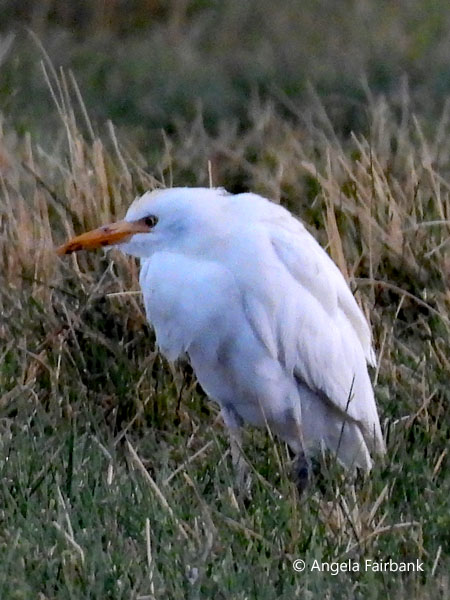    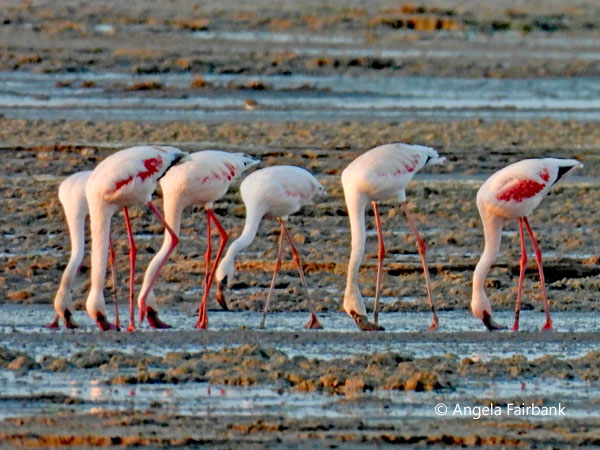 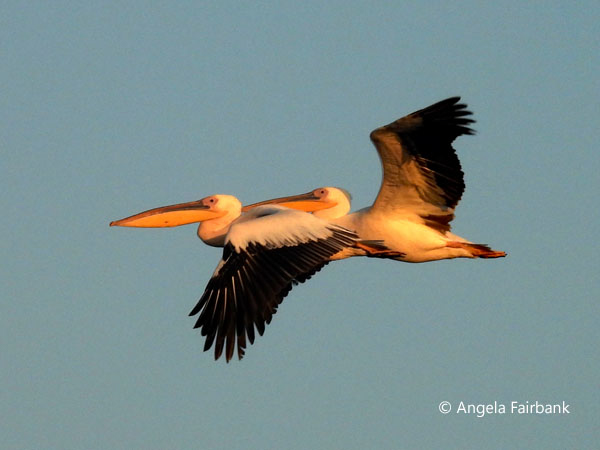 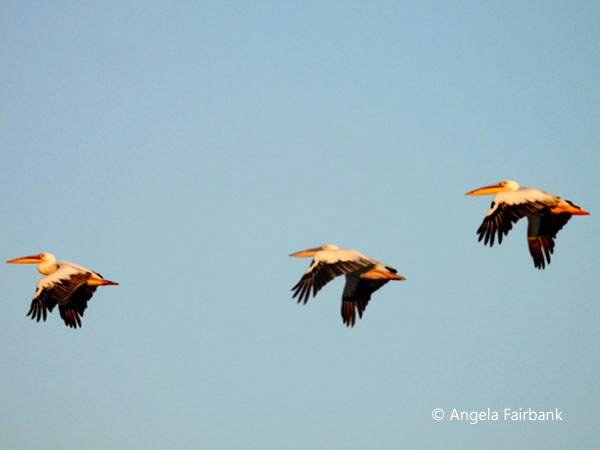 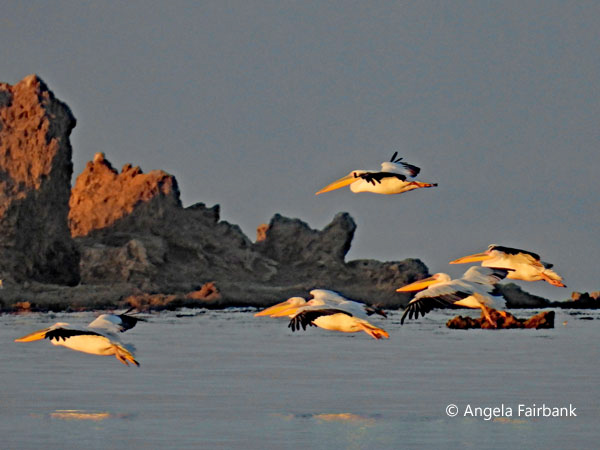 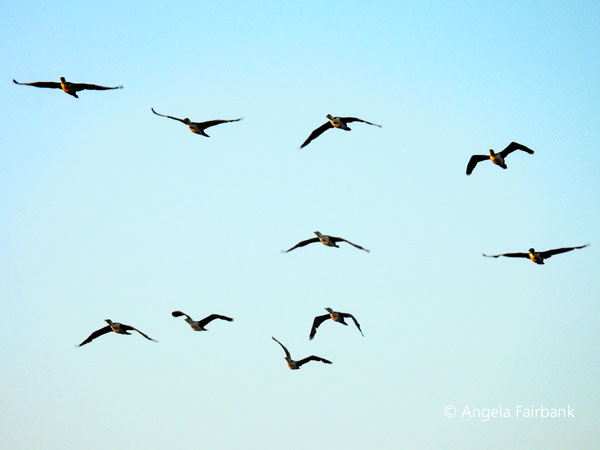  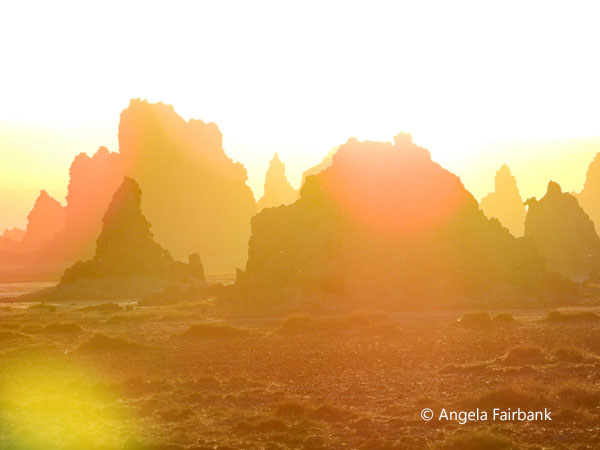 We now headed to Lac Assal, situated in central-western Djibouti in a closed depression at the northern end of the Great Rift Valley and roughly 100 km northeast of Lac Abbe. These two bodies of water are connected by a route passing through the Dikhil region, with the roughly 90km journey typically taking around 4-5 hours by Land Cruiser, crossing harsh, rocky, and arid terrain. This lake is the lowest point in Africa at 155 m (509 ft) below sea level, and the third-lowest point on Earth after the Sea of Galilee and the Dead Sea, as well as the fifth most saline body of water in the world (up to 40%). The salt flats contrast with the black lava fields and there are numerous large crystal formations dotted around. The lake is fed by hot saline springs making it unique among salt lakes because all others are fed by streams and rivers. What's more, it has no outlet, contributing to its extremely high level of salinity.
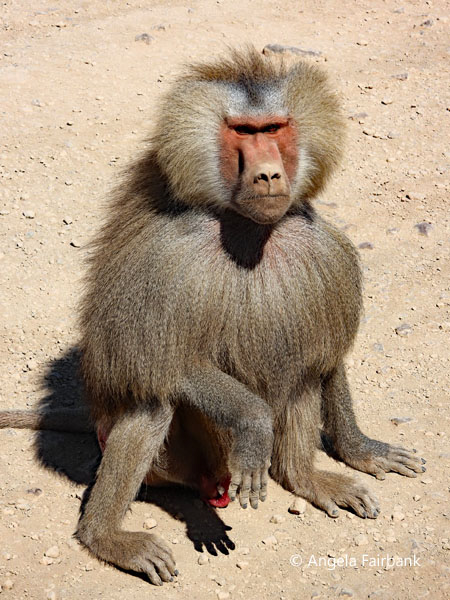
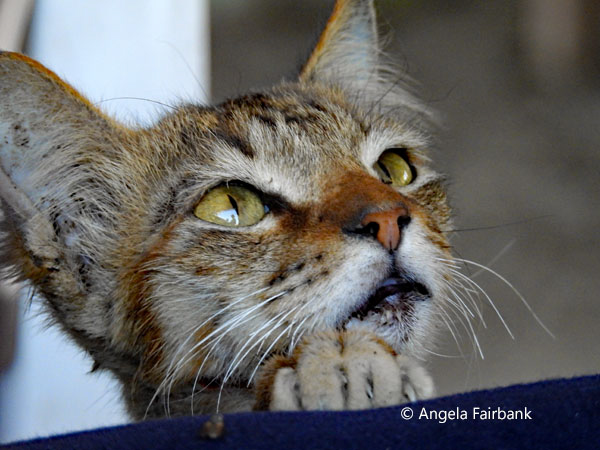
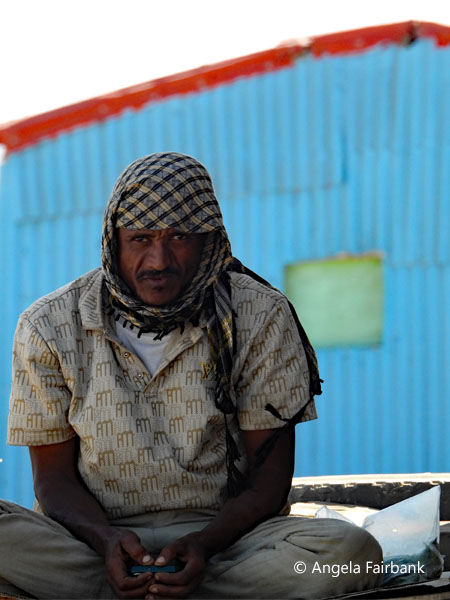
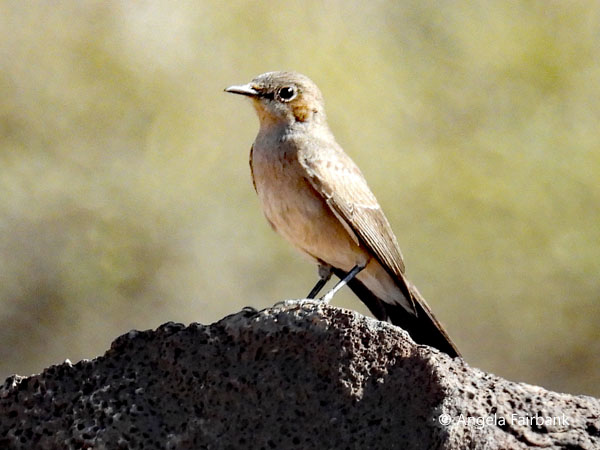
       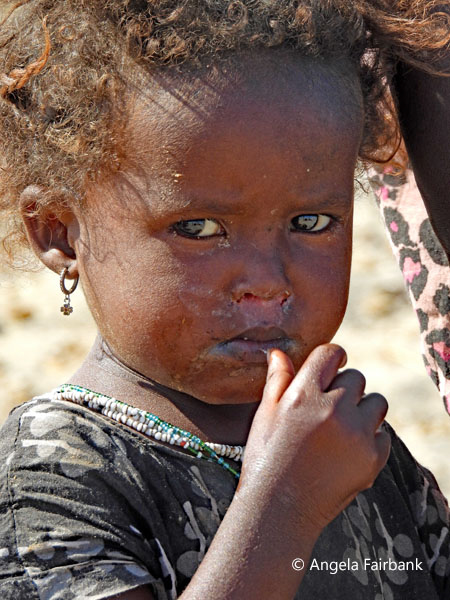     Before getting there, we made another Afar village stop, featuring women and children, as well as baby camels. We stopped for lunch at the same hotel in Dikhil as yesterday, ordering sandwiches to take on the road with us. These street scenes photos are from that town. On our exit from Dikhil, we came across this troop of Hamadryas or sacred baboons (Papio hamadryas) crossing the road. Bold creatures, they came right up to our vehicles and even sat on the roof and hood/bonnet of ours. What a great opportunity for some close-up shots of this alpha male. We then stopped once again in the afternoon at that same Ethiopian café as yesterday for another cup of coffee and some photos of new patrons. This young women in orange was selling khat. I asked about the green stuff on her face, and she produced a bottle of it from under her clothing to show me. I take it that just like women in Madagascar and Mayotte, among others, that I have photographed, it is a type of natural sun protection. This friendly kitten was also wandering around among the tables, clearly looking for handouts and some petting. We also stopped at a canyon reminiscent of Arizona's Grand Canyon, where I photographed these two Pied Wheatears (Oenanthe pleschanka) and a White-crowned Wheatear (Oenanthe leucopyga).
   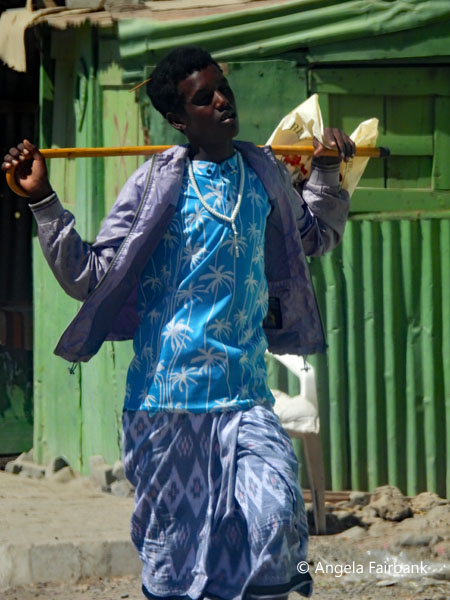         Shortly after the previous stop, we came to an overview of the sea, and soon after that, Lac Assal itself, with its picturesque whiteness and young Afar men selling packages of salt as well as art made from salt. After sunset, we arrived at our lodging for the night in the town of Tadjourah, our most comfortable lodgings so far outside of Djibouti City. I broke out a can of gin and tonic to celebrate the trip so far. (Unfortunately, I ended up forgetting about the two remaining cans in the cooler with the driver, Hassan, who, as a Muslim, does not drink! Well, I hope someone was able to enjoy them eventually!)
         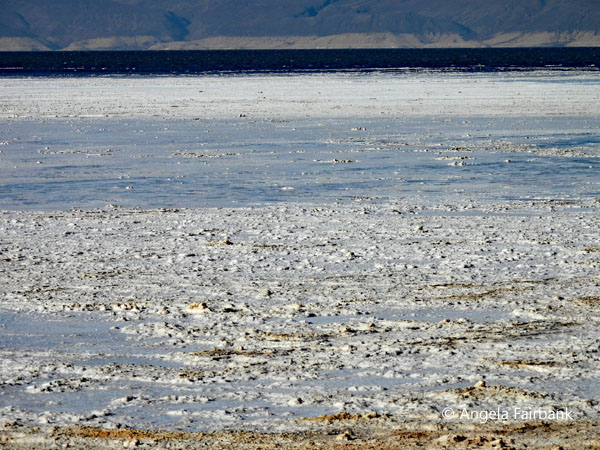 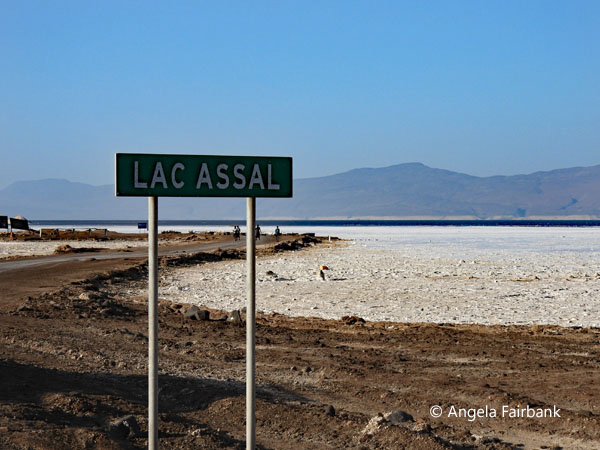 Friday, January 9: Tadjourah - Djibouti City, Djibouti
As I was eating breakfast this morning, one of my travel companions commented that there was an ostrich poking its head into the dining room behind me. Sure enough, he was right. Souheb told us it was a pet Common ostrich (Struthio camelus), so I went back to my room to grab my camera. It was quite tame and seemed to understand me as I asked it to stop and look at me as I photographed. It was interesting to look at it up close--I believe I have never stood this close to an ostrich without there being at least a fence between us as they are usually unpredictable in their behaviour--and see its pterodactyl-like body, legs, and feet. When it drew back its wings, it looked like plucked fowl with its chicken-like bumpy white skin and the bones on the inside of its wings. 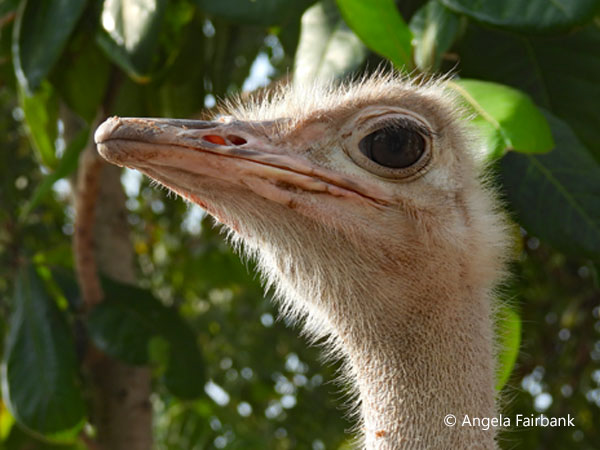  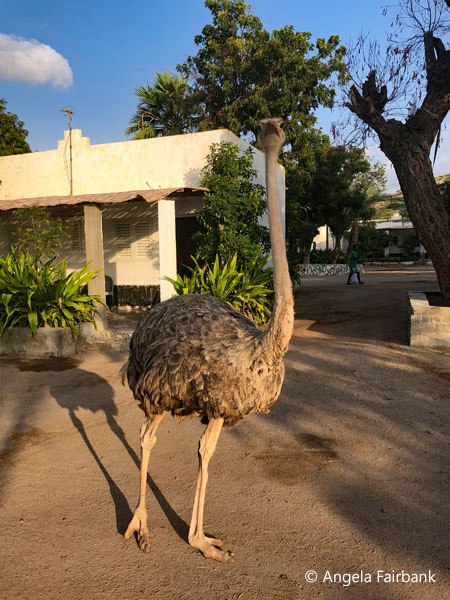   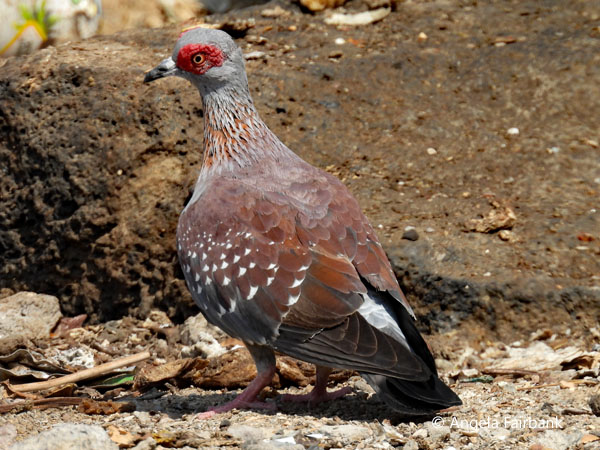    In any case, we had to pack up and get back into our jeeps because we had made a unanimous decision to return to Djibouti via a 1-hour ferry ride as opposed to about 4 hours by road, despite it costing an extra USD21 for each of us. Although this meant we had to catch the noon ferry, we still had time to visit Plage Blanche, a beautiful beach where only a few of us swam, but which actually contained not-yet-seen wildlife we could photograph. The British woman with whom I was sharing the car said she had seen a pink-spotted chameleon, which I found hard to believe, but I looked it up later and found that the Spurless Basilisk Chameleon (Chamaeleo calcaricarens) does in fact live in Djibouti but of course by the time I turned my head to look at it, it had scurried into the rocks, so needless to say I did not get to photograph it. However, there was a Red-veined dropwing dragonfly (Trithemis arteriosa) flying around and settling on the patio, and behind the main hotel building, I photographed a Speckled Pigeon (Columba guinea) and a Spotted Ground Squirrel (Xerospermophilus spilosoma), and saw, but did not have the chance to photograph, Rock hyraxes (Procavia capensis).
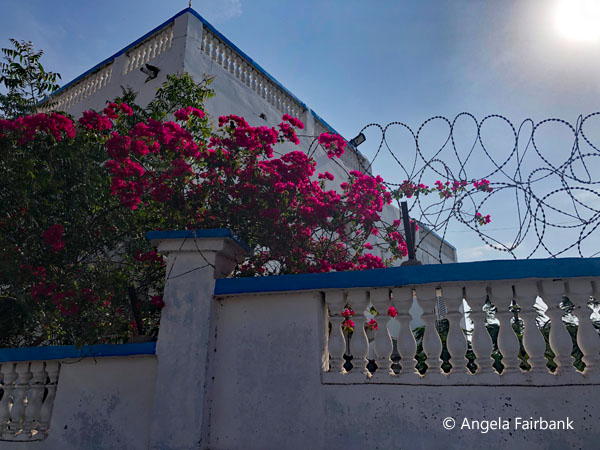
         However, perhaps my best memory from this beach was hearing North American English spoken and learning that the lovely young woman in full Muslim swimming gear (called a Burkini) emerging from the water after swimming in the sea with her aunt, was actually born in Canada, and was in her fourth year in IT studies at the University of Ottawa. She was visiting Djibouti because her aunt lived here and she had accompanied her grandmother to sign some documents in Djibouti City. I sorely regret not having asked to take a photograph with her so I could show you just how beautiful she was. We then left the beach and returned to Tadjourah with its white-washed buildings, some of which date back to the Ottoman era. Here we walked through the market, where we were not allowed to photograph, and along the waterfront, meeting people, and then down an alley between houses, where we photographed some children, who all seemed to think it was cool to be photographed while making a peace sign with their fingers. I'm not sure why. We ended up at a coffee place on the street near a police station where we chatted to the locals for a while and drank coffee. The coffee place was a fairly dodgy set-up on the street, with the lady washing used cups in a pan of water, but we survived the local experience, nevertheless!
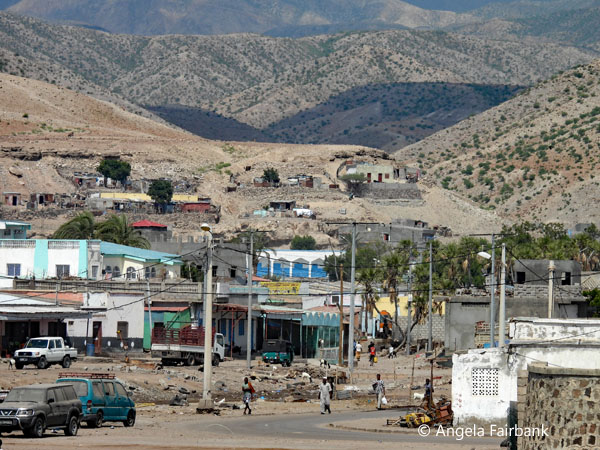
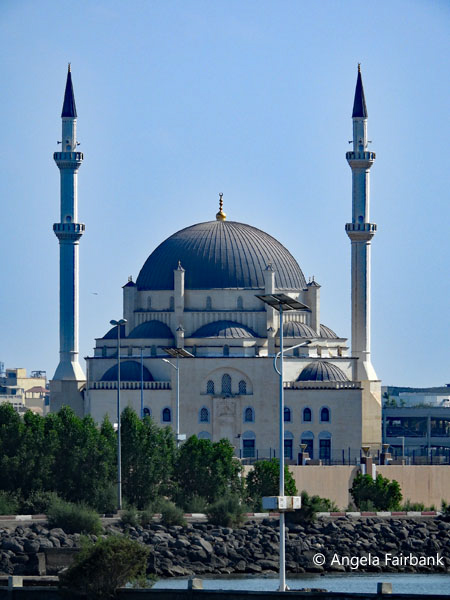
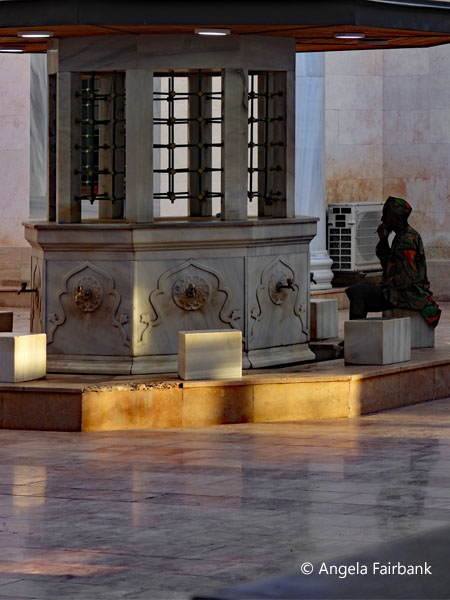
         Then it was time to get back into our Land Cruisers and drive to the terminal (where I photographed this Sooty Gull (Ichthyaetus hemorichii) and board the car ferry. Once we were onboard, it was over an hour before the vessel actually left the pier, although no explanation was ever given to us for the delay. Meanwhile, I photographed people washing themselves and their clothes, boys swimming, people fishing from the pier, etc. as you will see here. The ferryride itself was uneventful, and I spent most of it reading a book, either outside where the breeze was rather strong, or inside where the air conditioning was too strong. We were not given lunch, although our drivers and Souheb managed to share a meal containing rice among themselves, eating it by hand on the floor of the ferry. After a much later lunch of sandwiches at our original hotel, some of us went out with Souheb again to visit first the Catholic Cathedral, Our Lady of the Good Shepherd, built in the second half of the twentieth century--although we could not get inside as it was closed-- and then Abdülhamid II Mosque, the largest mosque in Djibouti. Constructed in the Ottoman style on reclaimed land, it has a capacity of 6,000, was inaugurated in 2019, and has two 46-metre-tall (151 ft) minarets as well as a central dome with a height of 27 metres (89 ft). We had originally seen this building from the ferry as you will notice from my photos. We were not sure we would be allowed in as it was a Friday, but it was late in the afternoon and apparently the main prayer session was over, so Souheb accompanied us women to the door of the women's entrance while with two of our men he entered the men's entrance. From the photos I took inside, I found it not dissimilar from others I had seen. Once again, as had been the case on our first venture into this city, green parrots were flying overhead. After returning to the hotel, Souheb took me to the market again to help me purchase a suitcase because my zipper had broken on my current one a couple of days ago, and it would definitely not survive the rest of my journey. We found a suitable replacement at a store owned by Yemenis. As a tour group, we then had our final dinner in Djibouti at an Indian restaurant, which was rather good, and said good-bye to our younger-than-the-rest-of-us American passenger, who had only managed to get enough days off work to travel with us for these four days.
    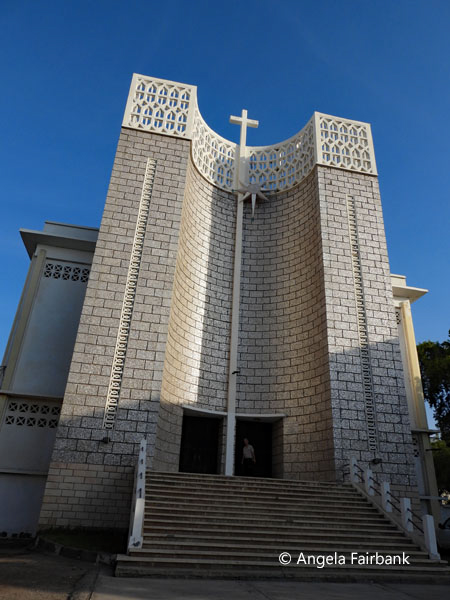 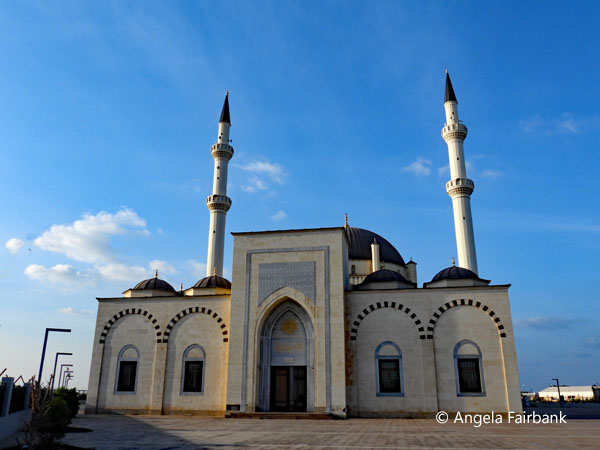 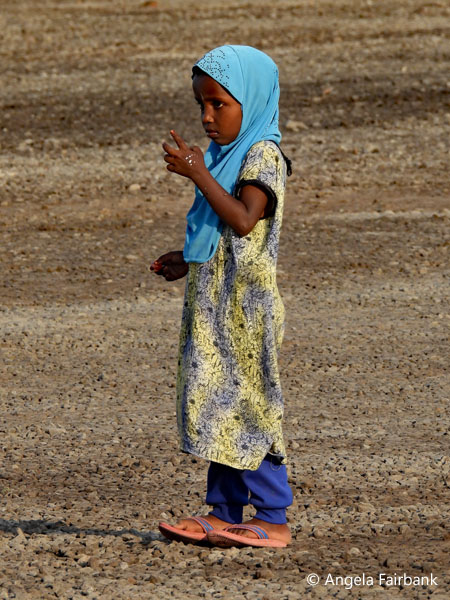 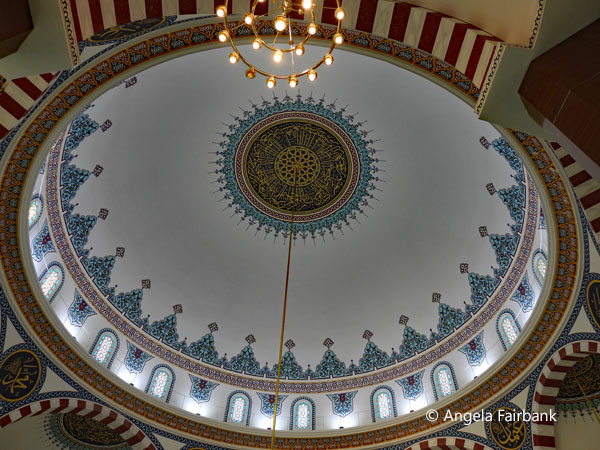  Saturday, January 10: Djibouti City, Djibouti - Borama, Somaliland
The tour itinerary for our next country reads as follows: “An overland journey through harsh, barely inhabited deserts takes us to the unrecognized country of Somaliland, a low-key, laid-back place that couldn't be more different from neighbouring Somalia. Here we discover some of the most impressive rock art in the world at Las Geel, barely known to the outside world, and the historic buildings of the Red Sea port of Berbera. The joy of traveling here is to feel like you are treading new ground as few people ever make it to Somaliland, and of course the friendly, welcoming people who are pleased to have visitors to their home. We explore the markets of Hargeisa, venture further afield to the rock art of Dhagax Khoure, and travel into the mountains at Sheikh, before returning to the capital to the end the trip. This is a wild and untamed land, home to nomadic communities who have barely changed in centuries, and travel here is not for everyone--creature comforts on occasion can be few and far between. But for [Africa enthusiasts] looking to visit a truly authentic, traditional part of this ever-enchanting land, its rewards are great.”    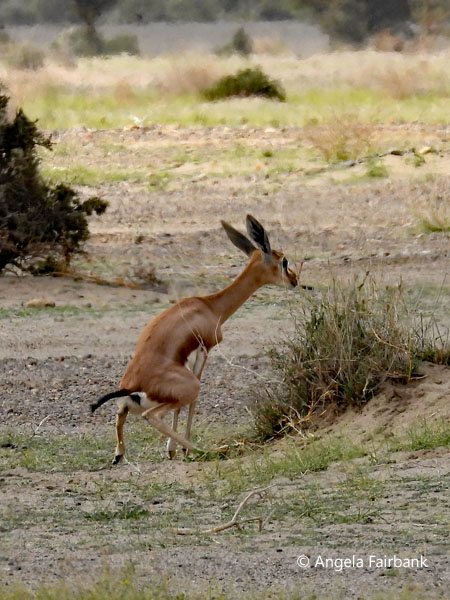   Today's tour itinerary description is simply “a long day's drive after crossing the border [which was actually surprisingly close to Djibouti City] into Somaliland” (UN country number 148 for me). Despite our fears caused by Souheb's announcement four or so days ago that it might not be possible to cross here due to Israel's recent recognition of Somaliland as a legitimate state, in actual fact, there was no problem for us to enter, as originally planned, via the land border. What was sadly unfortunate for us passengers is that after Souheb had stepped away briefly, we thought, from our group so as to arrange the transportation of our luggage across the border separately from us (and we subsequently left to walk across the border ourselves), we found ourselves without him at the Djibouti immigration building and were only told at that point that Souheb had not been allowed (contrary to previous cases) to accompany us to the Djibouti border building. This meant we never got the chance to say good-bye to our excellent, 23-year-old Djibouti guide, Souheb, in person. (We had said good-bye to our drivers last night upon our arrival at our hotel and had a van and new driver this morning). He did a very capable job of keeping us all safe, despite his youth, and getting us to all the places on our itinerary--even keeping at bay one drunk local in the market in Tadjourah, who I believe was protesting the fact that we foreigners were there (although perhaps that was not the full story). We learned from Souheb later that the inebriated, protesting man in question had been arrested by the police for being 'drunk and disorderly.' I also recall at one point that he pointed out to me two Ethiopians in the street--I forget where exactly--consisting of a young boy of about 10 holding onto his grandfather's left arm as a single police officer held onto the elderly man's right arm (no handcuffs and a very calm process) as he led them to a police van. Of course we do not know the reason for his arrest, but it was all done very quietly. I might not even have noticed had Souheb not drawn my attention. Sometime during the trip, I learned that his parents were in their early 60s, that his father had had 7 wives in total, Souheb's mother being his father's first wife. Of his father's 25 children, the oldest was Souheb's oldest sister, aged 31, and the youngest, also a girl, was born about two weeks ago.
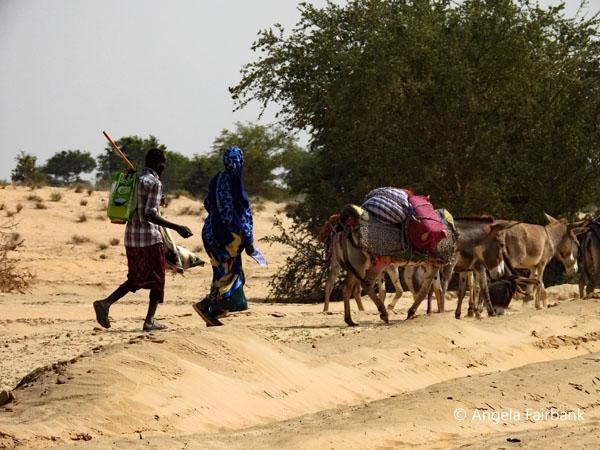
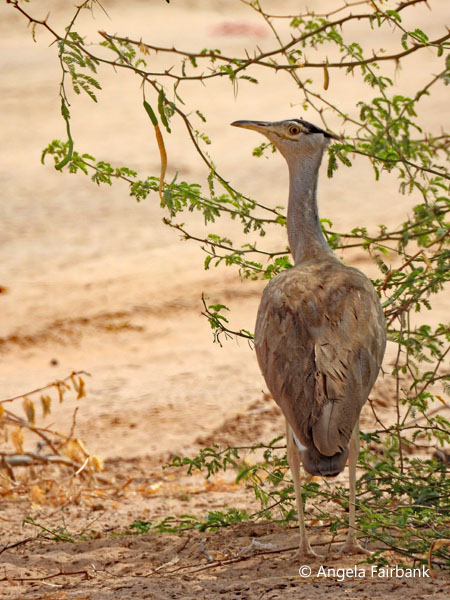
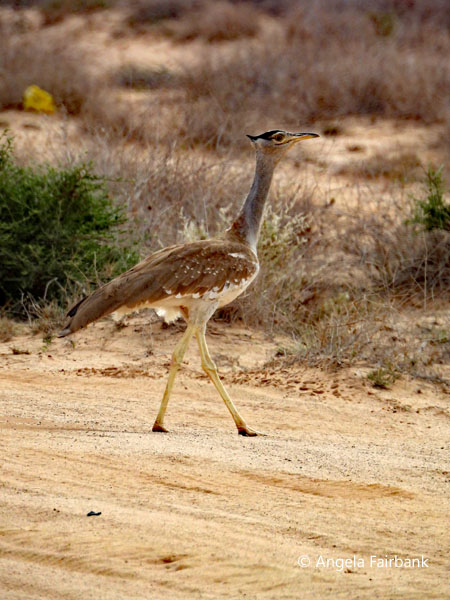
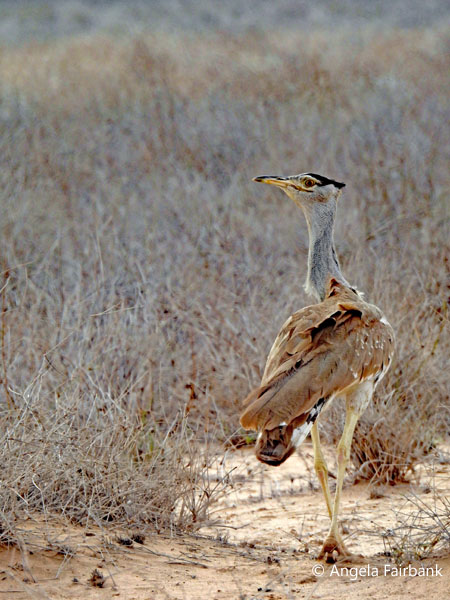
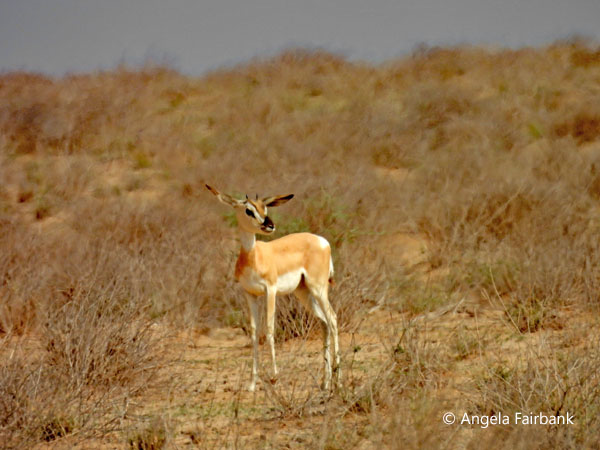
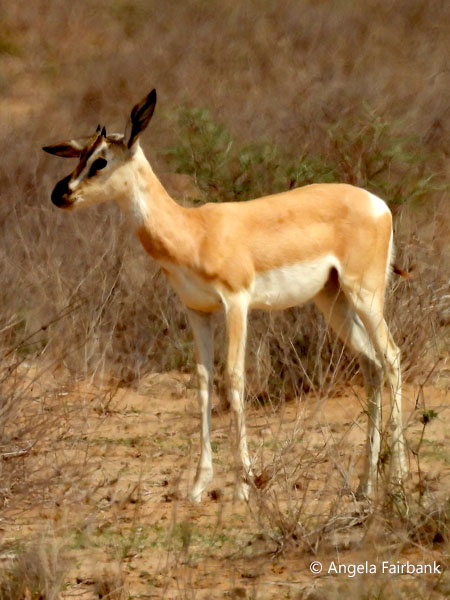
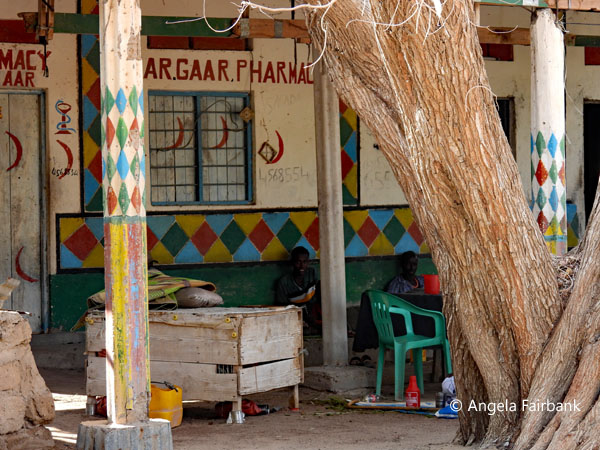
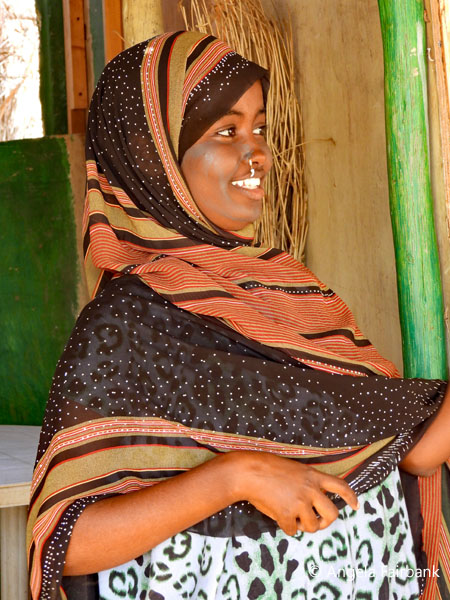
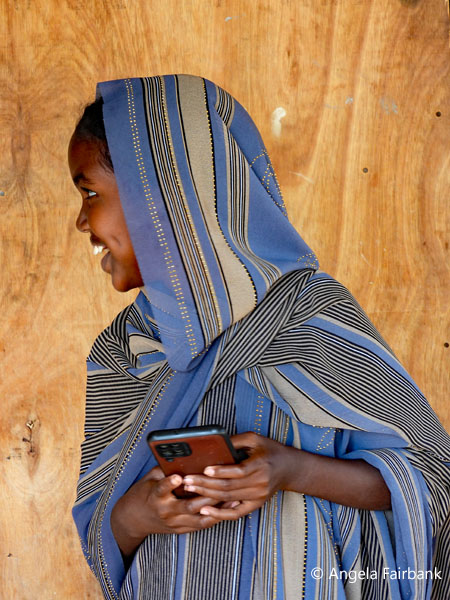
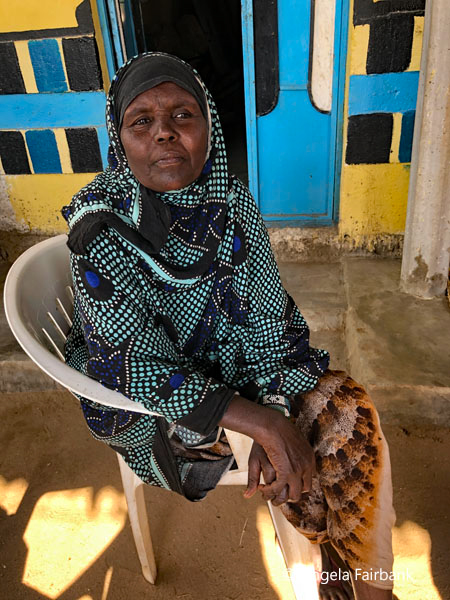
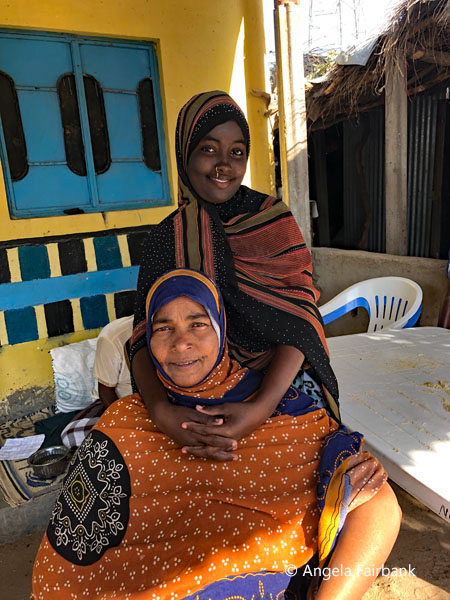
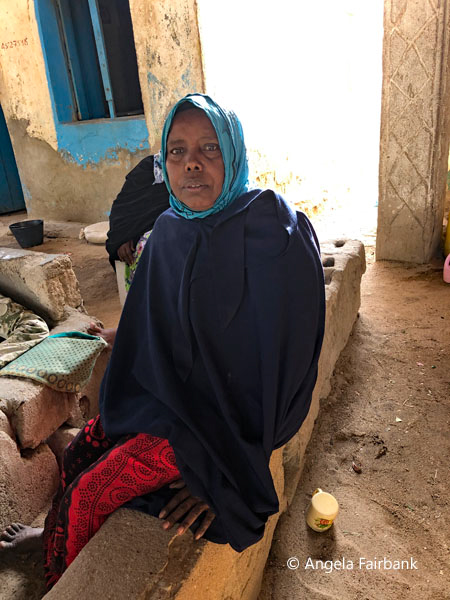
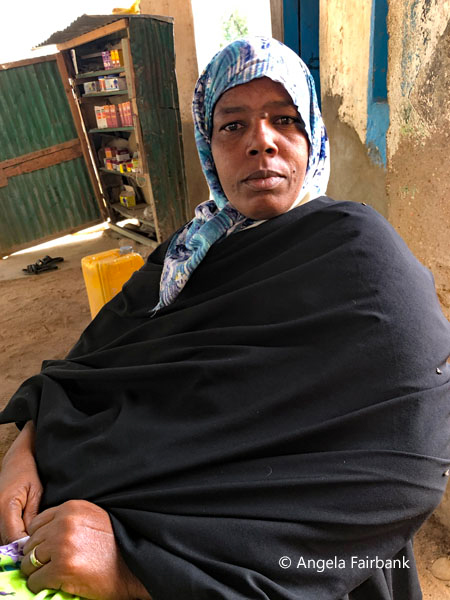
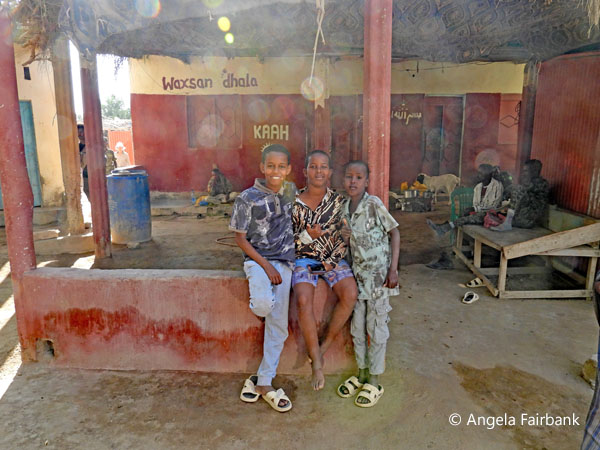
All that aside ... we were able to have one of his colleagues, who did have the authorization to accompany us as we went through the formalities to exit Djibouti and enter Somaliland, carry our tips back to Souheb, much to our relief, and through our WhatsApp group, Souheb was able to confirm receipt. Reaching the Somaliland side, we purchased our visas for this country on the basis of pre-registration by the local travel company and by showing the border officials our letters of invitation. A short walk further after exiting the Somaliland immigration building, we met our new guide for this country, Abdy, short for Abdinasier, a slender, smiling young man with an afro, also a Muslim, and a Somali by ethnicity. We piled into new Land Cruisers, which once again numbered 4, three for us tourists as we were now down to a total of nine, and one extra Land Cruiser, which Abdy drove, containing our two accompanying bodyguards, bearing rifles. My car, driven by Ahmed, consisted of the British man who had inadvertently burst into my hut at Lac Abbe, and the British woman with whom I had shared the Land Cruiser in Djibouti. We were told that the drive to Borama, located about halfway to the capital of Somaliland, Hargeisa, from the border, through remote, sandy deserts, would be long. However both of my Land Cruiser companions were good wildlife spotters, which included a Dorcas Gazelle (Gazella dorcas), an Arabian bustard (Ardeotis arabs), and a Sömmering's Gazelle (Nanger soemmmerringii). We also stopped in a village where the houses were brightly decorated in colourful paint, and the children were just as curious about us as we were about them. Abdy provided coffee in a flask and cups for us, but I was more in need of a toilet first, so he asked one young woman if she could take me to her family's toilet. The young lady in her bright red clothing obliged and led me through a gate and inside her yard to an outhouse containing a squat toilet. As you will see the people here were very photogenic, and I even got some of the older ladies to smile, something that is not always as easy as it is with children, but my Somali vocabulary learned in Djibouti once more helped break the ice.
      And now for some information about the Republic of Somaliland, an unrecognized state in the Horn of Africa, located on the southern coast of the Gulf of Aden and bordered by Djibouti to the northwest, Ethiopia to the south and west, and Somalia to the east. Its claimed territory has an area of 176,120 km2 (68,000 mi2) with approximately 6.2 million people as of 2024. The capital and largest city is Hargeisa.
      Various Somali Muslim kingdoms were established in the area during the early Islamic period, including, in the 14th to 15th centuries, the Zeila-based Adal Sultanate. In the early modern period, successor states to the Adal Sultanate emerged, including the Isaaq Sultanate, which was established in the middle of the 18th century. In the late 19th century, the United Kingdom signed agreements with various clans in the area, establishing the Somaliland Protectorate, which was formally granted independence by the United Kingdom as the State of Somaliland on June 26, 1960. Five days later, the State of Somaliland voluntarily united with the Trust Territory of Somaliland (the former Italian Somalia) to form the Somali Republic. The union of the two states proved problematic early on, and in response to the harsh policies enacted by Somalia's Barre regime against the main clan family in Somaliland, the Isaaq, shortly after the conclusion of the disastrous Ogaden War, a 10-year war of independence concluded with the declaration of Somaliland's independence in 1991. The Government of Somaliland regards itself as the successor state to British Somaliland (while Djibouti is the successor to French Somaliland and Somalia, the successor to Italian Somaliland).
      Since 1991, the territory has been governed by democratically elected governments seeking international recognition as the government of the Republic of Somaliland. The central government maintains informal ties with some foreign governments, who have sent delegations to Hargeisa; Somaliland hosts representative offices from several countries, including Ethiopia and Taiwan. However, as of 2010, Somaliland's self-proclaimed independence had not been officially recognized by any UN member state or international organization. It is the largest unrecognized state in the world by de facto controlled land area. It is a member of the Unrepresented Nations and Peoples Organization, an advocacy group whose members consist of indigenous peoples, minorities, and unrecognized or occupied territories. Following the Las Anod conflict that emerged in 2022, Somaliland lost control of a significant portion of its eastern territory to pro-unionist forces, which established the SSC-Khatumo administration.
      Many people in Somaliland speak at least two of the three national languages: Somali, Arabic, and English, although the rate of bilingualism is lower in rural areas. Article 6 of the Constitution of 2001 designates the official language of Somaliland to be Somali, although Arabic is a mandatory subject in school and is used in mosques around the region, and English is spoken and taught in schools. The Somali language is the mother tongue of the Somali people, the nation's most populous ethnic group. It is a member of the Cushitic branch of the Afro-Asiatic language family, and its nearest relatives are the Oromo, Afar, and Saho languages. Somali is the best documented of the Cushitic languages, with academic studies of it dating from before 1900. Northern Somali is the main dialect spoken in [Somaliland, while] Benadiri Somali ... is the main dialect spoken in Somalia.
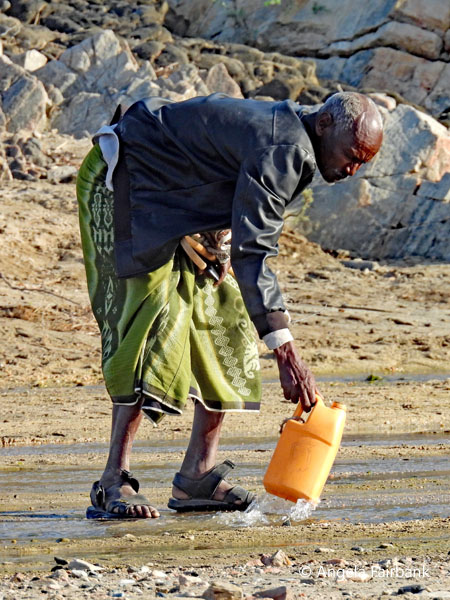   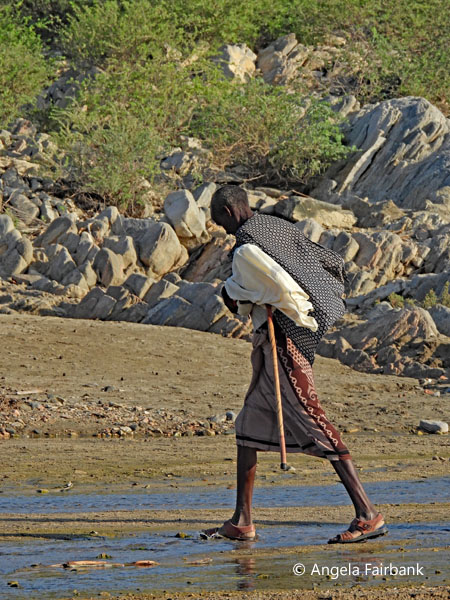  These last few photos come from an almost dry riverbed where our Land Cruisers stopped in the late afternoon so that our guide and drivers could pray. I watched from the back seat of the car, fascinated, as one driver went through the entire ritual of ablutions, just as I had listed in my write up for Brunei above, and matched the description of prayer recited to me by Souheb during one of our drives through Djibouti. Apparently, he told me, there are specific Islamic rules for prayer while traveling, which allow for easier, shortened, and combined prayers, typically for distances over 88 km (55 miles). Also, should no clean water be available for ablutions, for instance, if you should happen to be in a desert, you can perform a dry or symbolic purification using clean earth, sand, or stone! Souheb was a deep well of information about the Muslim faith, so I appreciate his taking time to explain it all to me. So as not to embarrass our driver, I have not posted the photos of him in the various parts of his ritual, but I watched as he gathered water from the stream in a small water bottle, then sat down in the dry part of the riverbed away from the others, washed his hands, washed out his mouth, washed his face, washed his forearms, removed his shoes and socks, washed his feet, put his socks and shoes back on, and then prayed standing up, bowing, his hands on his knees, then getting down on his knees and leaning forward to touch his forehead to the ground, sit back up on his knees, leaning forward to touch his forehead to the ground once again, etc. I then noticed Abdy doing the same a further distance away. Meanwhile, I photographed a couple of men, who approached from one side of the riverbed to the other, up the hill from which a young woman was sitting watching from a clump of rocks with her two children. As the late afternoon progressed, along with our drive, we watched the sun set from atop mountains and caught another creature clambering through the undergrowth--alas, by now, the light being too dim to photograph it properly, but from the few imperfect shots I got, I believe it was a Bat-eared Fox (Otocyon megalotis virgatus). We finally arrived late at Rays Hotel in Borama, which was comfortable enough, but we had to wait ages for our dinner at the hotel restaurant, after which I immediately called it a night, saying Habeen wanaagsan (good night in Somali). The final shot above is from the hotel with its orange colour theme but taken the next morning in the sunshine.
Sunday, January 11: Borama - Dhagax Khoure - Hargeisa, Somaliland
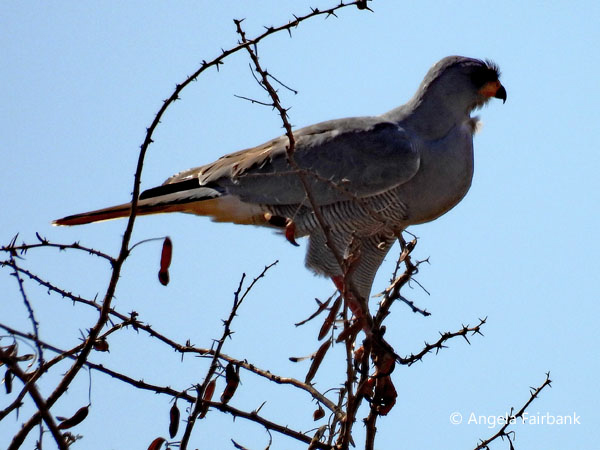
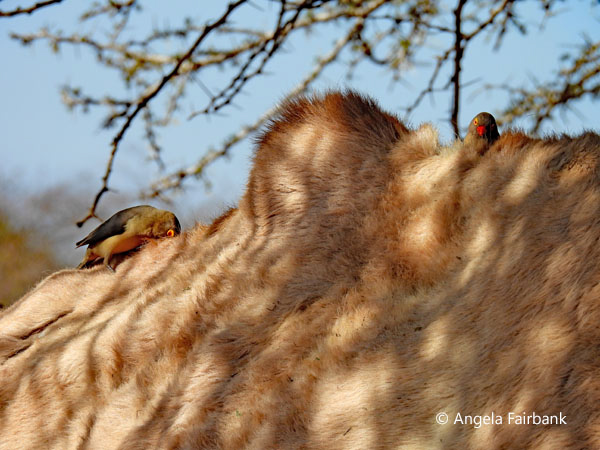
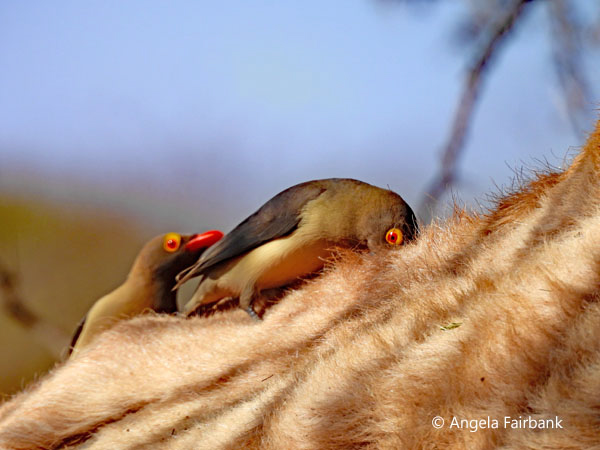
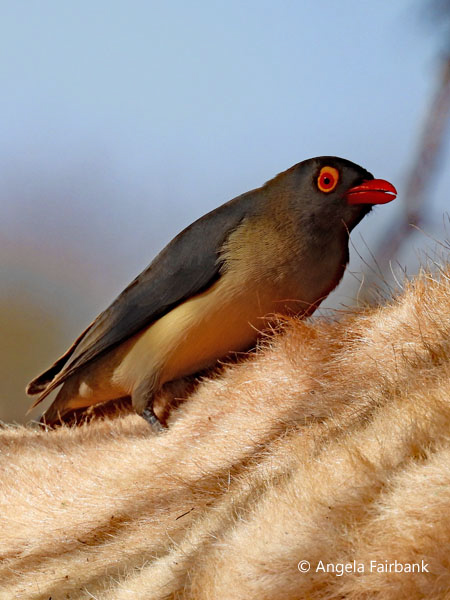
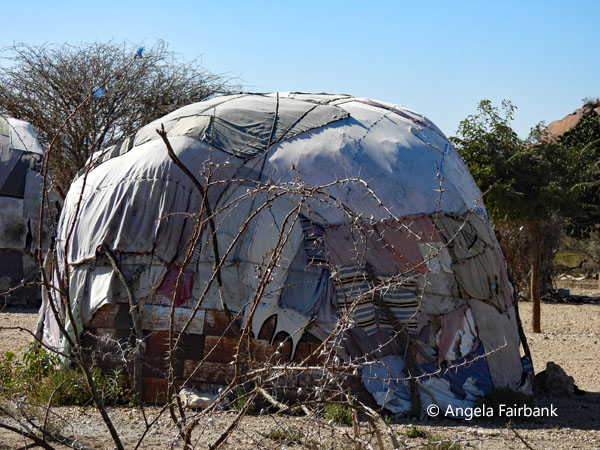
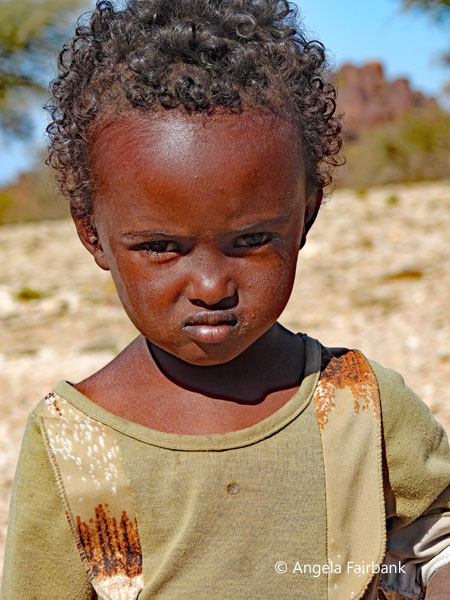
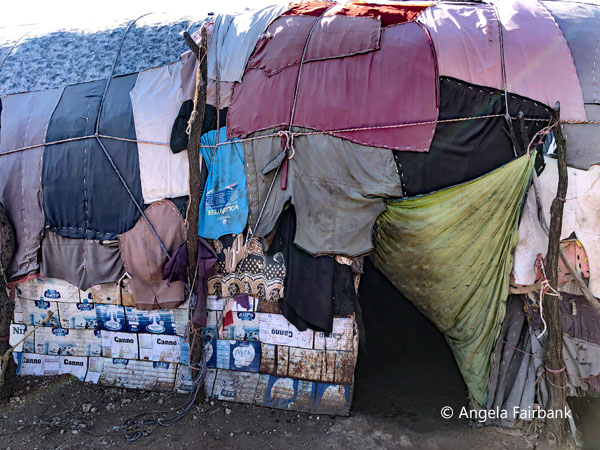
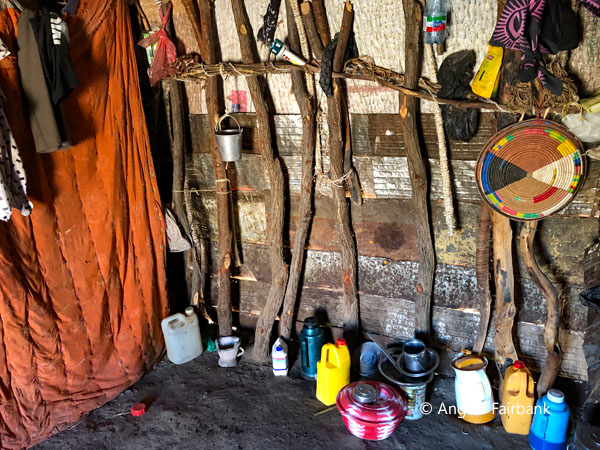
The first photo in today's collection is the Somaliland flag. After a rather nice breakfast that included some delicious plain yoghurt, we checked out of our hotel. As I awaited the drivers and vehicles to arrive, I browsed the shops that were part of the hotel complex, learning that the three parts to a Somali woman's wardrobe are the headscarf (hijab), long robe (abaya), and veil (niqab). Finally, we left in our respective Land Cruisers for Amoud University, a comprehensive public university populated by 6,000 plus students at 14 faculties. We were first shown the library outside of which we happened to bump into the University's Director for Public Relations. He welcomed our visit and gave us a short background on the university. The older woman in beige in photo number 4 is the librarian (or perhaps a librarian). The two soldiers are our two bodyguards. The red-eyed black bird on the wire was continually making an interesting noise, and I later looked it up and discovered it was a Fork-tailed Drongo (Dicrurus adsimilis), also known as the African Drongo. We met some of the students here, who were reluctant to be photographed at first but finally agreed as long as I was in the photo too.     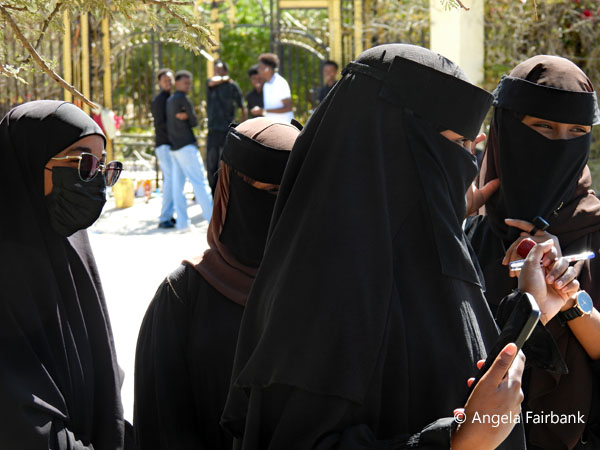  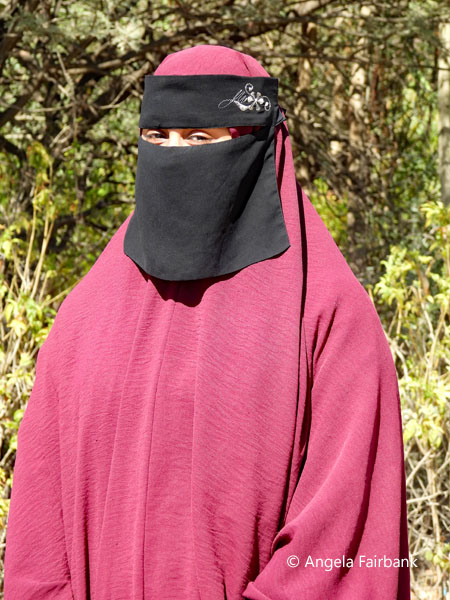 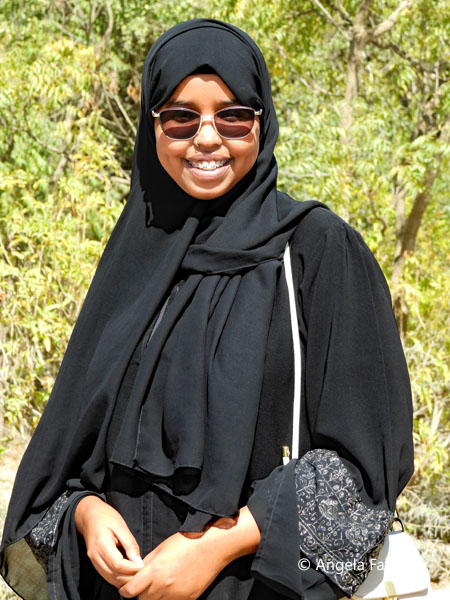 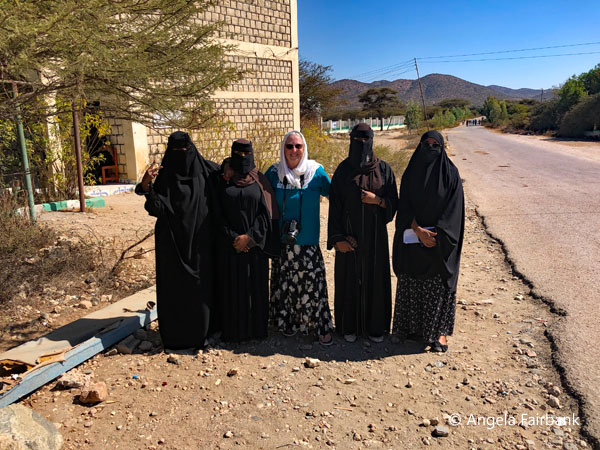 During our drive through one town, I was able to photograph some high school students who wore a uniform of white and black. Lunch (and toilets) were provided at a hotel, where the chief cook, a small (well, shorter than me) Somaliland woman, came up to our table and told us she had been married to an American man and her children were all in the USA, while she had come back to her homeland to open up this hotel and restaurant. Impressed, I asked to take a photo of her but instead agreed to take one with her. As we continued southward to Hargeisa, the capital, we started seeing tall pinnacles of termite mounds, as well as interesting birds, such as the Eastern yellow-billed hornbill (Tockus flavirostris), an Eastern Chanting Goshawk (Melierax poliopterus), also known as the Somali Chanting Goshawk, several Red-billed Oxpeckers (Buphagus erythroryncha) on the back of a camel, and more Speckled Pigeons (Columba guinea). We also began seeing some typical Somaliland homes, over which colourful cloths had been tied. We were invited into one home and were given a tour inside and out. The children here did not appear to be used to foreign tourists but allowed us to photograph them, nonetheless. The family was also the owner of a loudly complaining young camel inside a pen and a couple of healthy-looking donkeys.
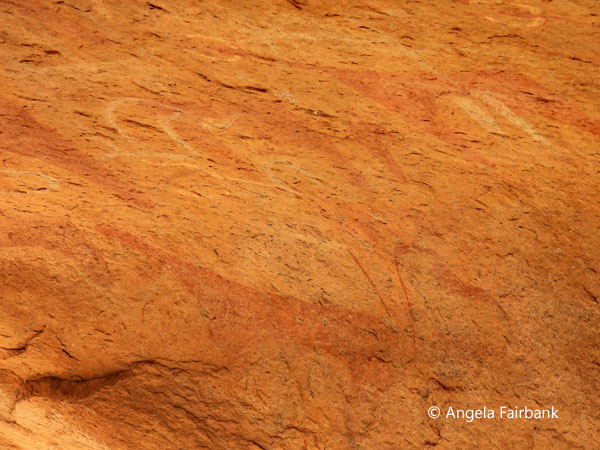
 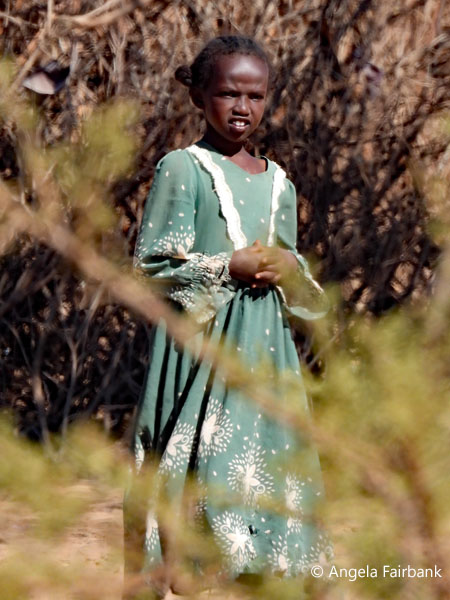        Little did we realize that metres from this home was our goal for today, Dhagax Khoure, one of Somaliland's most important sites for rock art and situated amidst splendid hills composed of large boulders emerging from desert plains. Although not as impressive as the better-known Las Geel, which is on our itinerary for another day, Dhagax Khoure holds some stunning rock art, with numerous images of cows, hunters, giraffes, and other animals tucked away under overhanging rocks and in caves. We had about an hour climbing up to a number of different caves and rock structures as well as a lookout from where, in the distance, we could see a troop of Hamadryas baboons leaping over the countryside through bushes and trees. One alpha male had a mane of very white hair and several of the females were carrying their young on their backs.
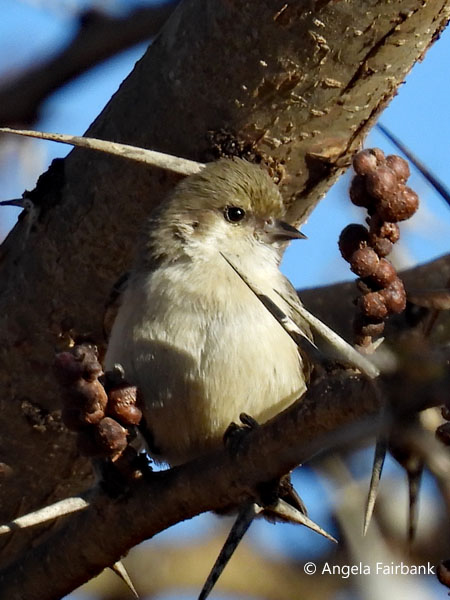
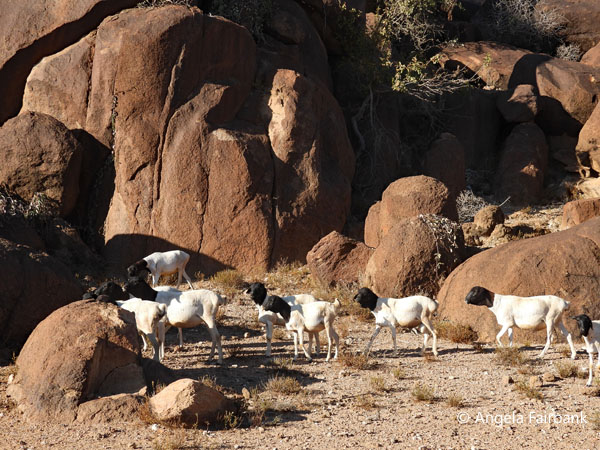
         Due to the climbing involved, which wasn't easy in my long skirt, I was grateful for our bodyguards who offered me a hand now and then. I came down the rocky hill before the others and was mesmerized by all the small chirping birds in the thorn trees. I found out later that these were Somali crombecs (Sylvietta isabellina). As we left the area of these boulder hills, I managed to get a good shot of some endemic yet ubiquitous black-headed sheep. Looking up this species later, I found this information: “Somaliland black-headed sheep (Ovis aries), also known as Somali sheep or Berbera Blackhead, is a hardy, fat-rumped hair sheep breed indigenous to the Horn of Africa, characterized by a white body and black head. Raised primarily for meat, these animals possess heat-tolerant, self-shedding coats and can survive with minimal water, making them crucial for the regional economy and exports.” On our way from here to Hargeisa, we spotted one more bird that I was able to photograph, the Crowned Lapwing (Vanellus coronatus). Once again we arrived at our hotel after dark, but it was a nice hotel where we would be for two nights, plus we would be back here on our last night in Hargeisa at the end of our tour. In the evening, we all took a stroll through the downtown area, visiting first the civil war memorial, complete with a Russian Mikoyan-Gurevich MiG-17 fighter jet, positioned on a pedestal in Freedom Square. Installed in the 1980s, it commemorates the victims of the Somaliland Civil War, specifically, the bombing of the city by the Somali Air Force, representing a symbol of resilience. Artillery shelling of Hargeisa started on the third day of the fighting in late May 1988 and was accompanied by large-scale aerial bombing of the city carried out by the Somali Air Force (SAF) aircraft, which “took off from the Hargeisa airport and then turned around to make repeated bombing runs on the city.” The scale of destruction was unprecedented; up to 90 percent of the city (then the second largest city in Somalia) was destroyed. We then walked to the market area, passing stalls selling khat, natural toothbrushes, and more, on our way to our restaurant where we all had seats on a balcony facing the market so we could watch its activity. When I got back to my room, I put out several t-shirts as well as my one pair of jeans to be washed by the hotel's laundry tomorrow.
       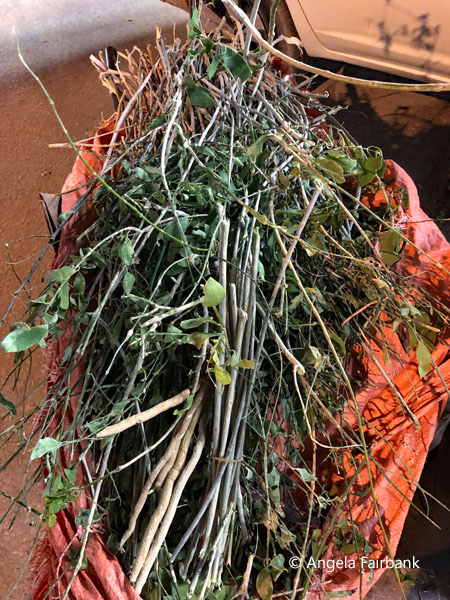 Monday, January 12: Hargeisa, Somaliland
This morning, our aim was to visit the Cheetah Conservation Foundation so as to learn about the efforts made to protect the Cheetah (Acinonyx jubatus) species in the region. Panels in the information centre state that an estimated 200 - 300 cheetah cubs are poached and smuggled out of the Horn of Africa every year into Yemen via the Gulf of Aden and then distributed across the Gulf States to be illegally sold as pets. Yes, wild, exotic animals are in high demand in the Gulf States. Evidence suggests that most of these cheetahs have been sourced illegally from the Horn of Africa. CCF has been active in tracking the illegal trade of cheetah cubs since 2005, monitoring trafficking, and organizing confiscations with local authorities; training wildlife officers on the frontline of trafficking in the Horn of Africa and the Middle East; and training and teaching local Somaliland people in the proper care of confiscated animals. For every cheetah cub that arrives safely into care at CCF's Cheetah Rescue and Conservation Centre (CRCC), 3 to 4 die prior to confiscation. At this stage, reintroduction of confiscated cheetahs to the wild is not possible due to their poor health at the time of arrival into care and the continued care required to keep these animals healthy. Cheetahs generally live outside protected areas alongside farming communities that raise camel, sheep, and goats. As such, cheetahs and other predators are viewed as a threat to the livelihoods of these farmers and their families. CCF's Future Farmers of Africa training programs teach mitigation techniques and implements non-lethal predator control tools and livestock management techniques such as predator-safe corals/bomas. CCF aims to foster coexistence between farmers, cheetah, and wildlife supporting conservation outcomes. The CRCC has been developed to care for these confiscated cheetahs who have been rescued from the Illegal Wildlife Trade and Human-Wildlife conflict. CCF cares for these cubs in specially built cub enclosures adjacent to the veterinary clinic, as most cubs received at the CRCC are in very poor condition and require acute care. 1,800 acres in Geed-Deeble are now home to these rescued animals, with large 5-12-acre (2-5-hectare) enclosures providing a safe, natural environment for these cheetahs to grow and mature.      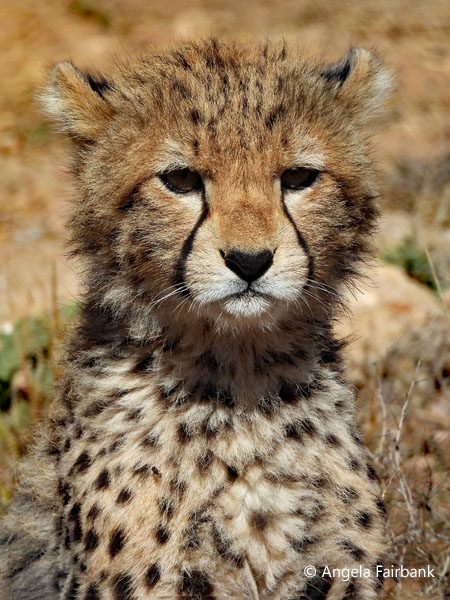  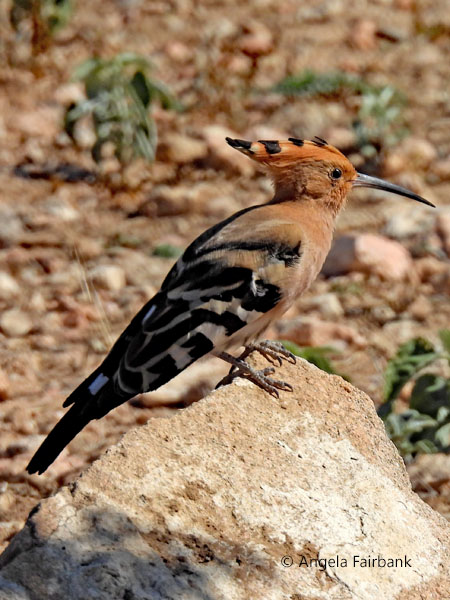  After chatting to the Canadian (from Ontario) veterinarian and South African Director, we were taken for a tour through the veterinary clinic to be introduced to the large volume of medicines and vaccines required to keep the animals healthy and the stores of meat they require to be fed. We were then led to the enclosure of rescued cubs, some of which you will see in my photos here. Then we got into our jeeps and were driven out to the larger enclosures containing the adults, where males and females had been separated from each other. Some super photography was possible despite the fences. Some of these animals were deformed due to their earlier history before becoming rescued as cubs but all seemed placid as they lay or stood in the shade of bushes and trees. Suffice it to say, I took a LOT of photos and had to whittle them down to these few posted here.
 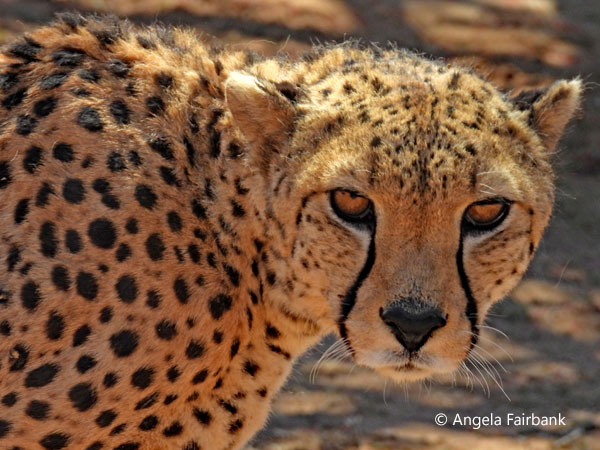 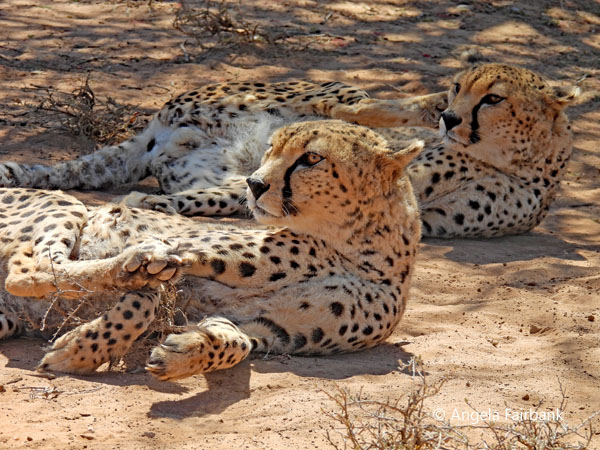  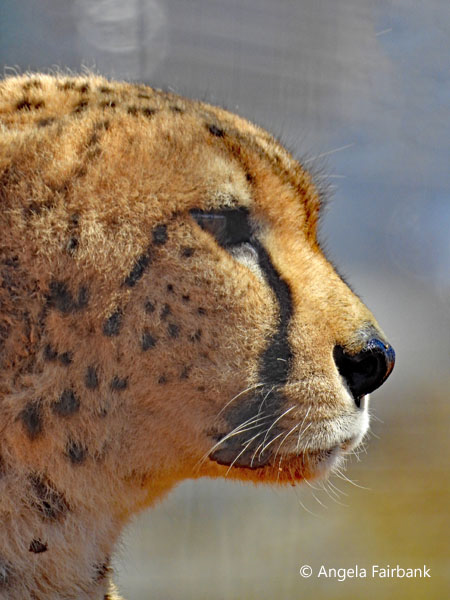   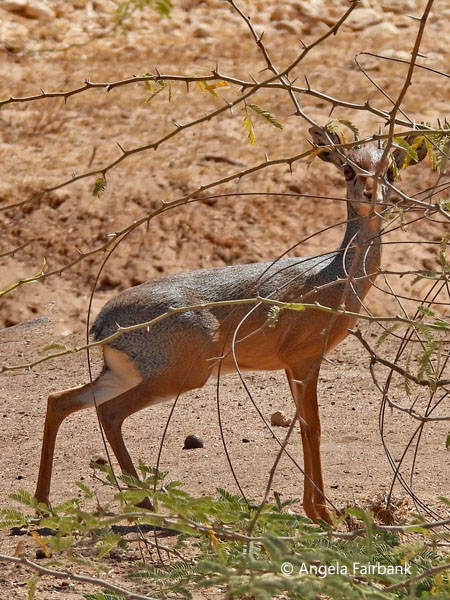   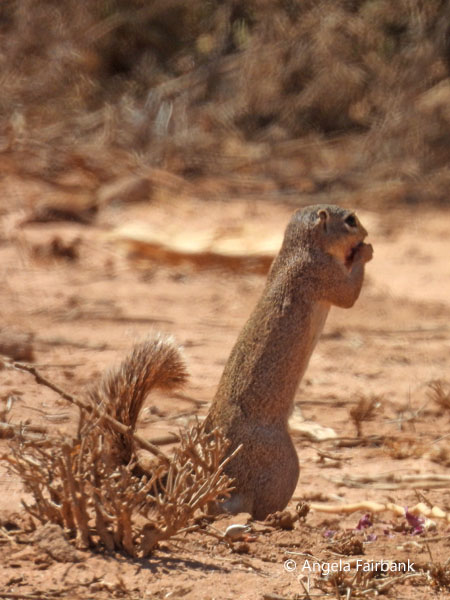 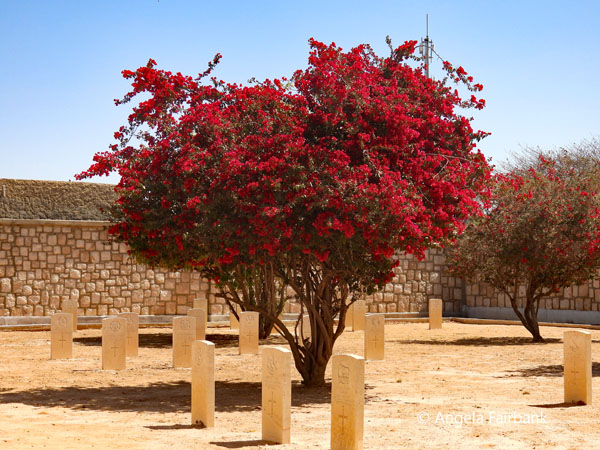 After a good couple of hours at the Cheetah Centre, some of us bought t-shirts to help support the cause. We then drove back to Hargeisa. Among the wildlife I photographed on the way to or on the way back from the centre are a Somali Kori Bustard (Ardeotis kori struthiunculus), a Crested francolin (Ortygornis sephaena), a White-bellied Go-Away-Bird (Crinifer leucogaster), a Brown-tailed Chat (Oenanthe scotocerca), an Eurasian or Common Hoopoe (Upupa epops), warthogs, a Silver Dik-Dik (Madoqua piacentinii), a Somali bee-eater (Merops revoilii), and an Unstriped Ground Squirrel (Xerus rutilus). We then had a brief stop at a cemetery of soldiers who had been killed in both World Wars at the request of one of the passengers. Next, we had an official tour of Hargeisa on foot, returning to the market and, specifically, to the moneychangers sitting in shaded kiosks with their huge piles of Somaliland shillings. We were told they abandon their bricks of shillings several times a day to go and pray and never find anything missing when they return. It just goes to show how little crime there is here.
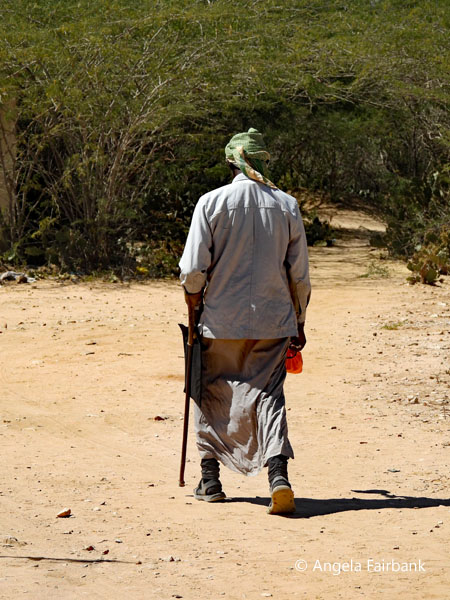  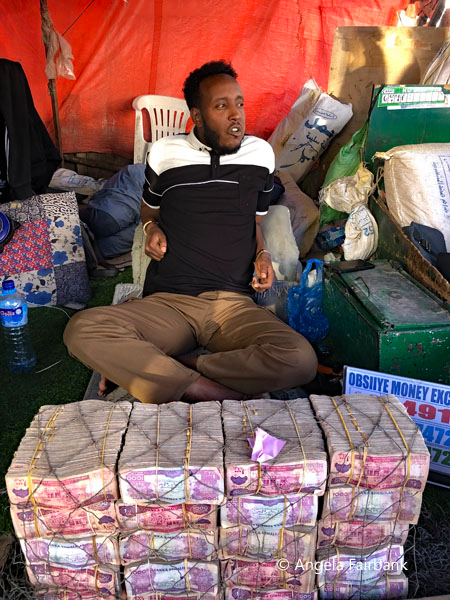 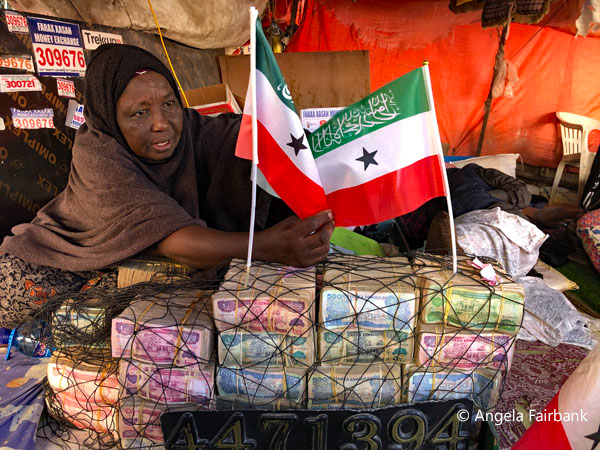 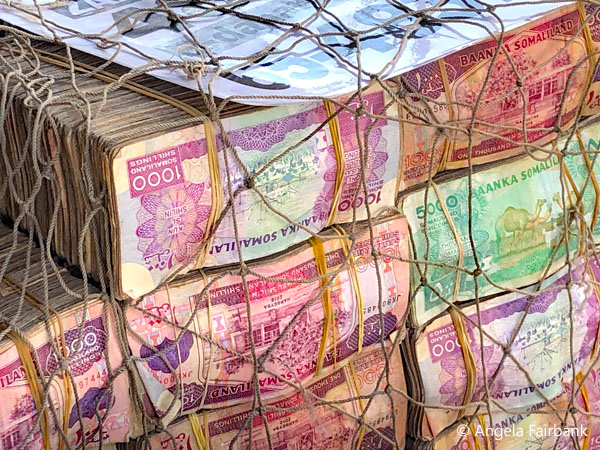   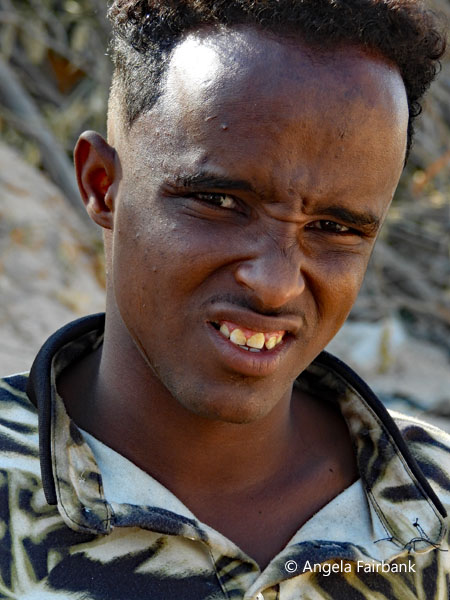 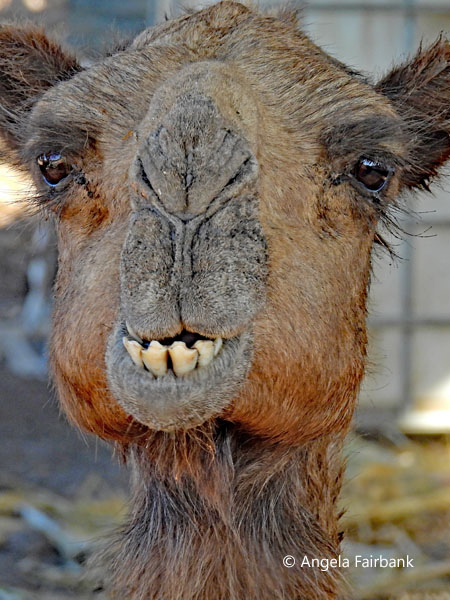 In the afternoon, we were driven through a somewhat more squalid area of Hargeisa, past an area of water, where I was able to photograph this somewhat wet Hamerkop (Scopus umbretta) and a wagtail as well as this young man who, seeing me photograph the birds from inside our jeep, insisted on my taking a photo of him and then ran off once it was done, not even asking to see it! Our destination this time was a camel farm. When we arrived, we were rather disappointed because all we could see were a few animals that did not look particularly healthy, especially one poor creature that was continuously braying perhaps in pain. However, as we stood around, a large caravan of healthy animals entered, and we were able to photograph them. I was hoping we might get the chance to milk a female camel but sadly that never happened. Instead, to our delight, the camel farm was also attractive to birds and we watched this Somali fiscal or Somali shrike (Lanius somalicus) on the roof of a camel stall, as well as this brightly coloured Superb Starling (Lamprotornis superbus), an absolute star of a bird as it stayed around for a while and I got quite a few shots of it. Here also, I photographed this Mourning Collared Dove (Streptopelia decipiens) and a Somali Starling (Onychognathus blythii), and closer to the city, a Hooded Vulture (Necrosyrtes monachus). When I arrived back at the hotel, I was told my laundry wasn't ready yet, but I should check back tomorrow morning. The beautiful face you see at the end of today's group of photos is that of our smiling breakfast waiter!
 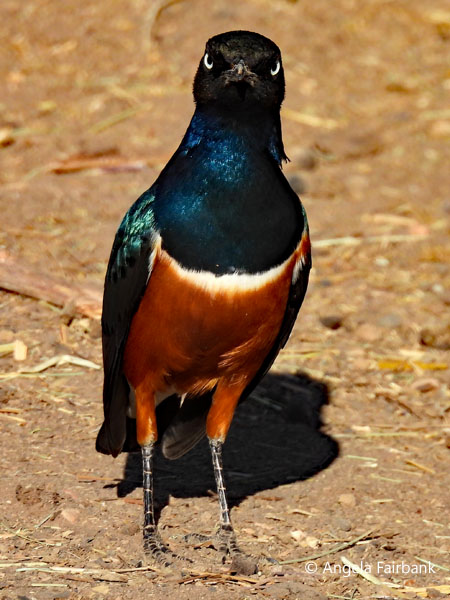 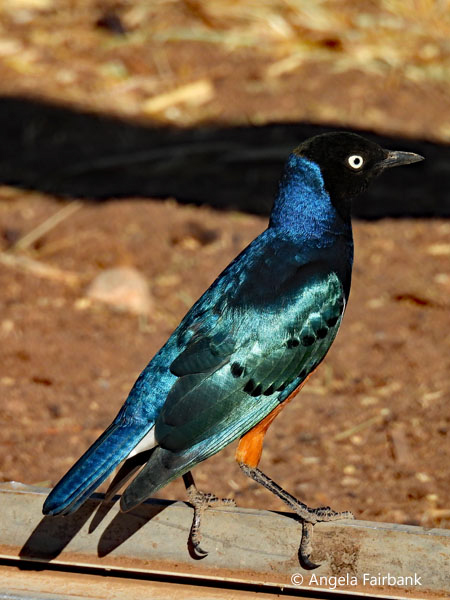     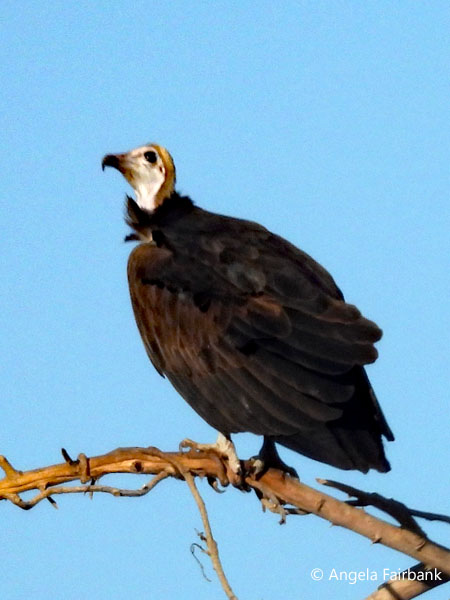  Tuesday, January 13: Hargeisa - Las Geel - Berbera, Somaliland
I was at hotel reception early to collect my laundry, but it still hadn't arrived. I explained I would need it imminently as our group was checking out in an hour but that I would check with them again after breakfast. I was hoping at least that I would be able to pack my clean clothes in my suitcase before we left, but as it happened they only produced them at the very last moment and there was no time to pack them so I took the plastic bag with me and tossed it into the back of our jeep. It was only on arriving at our hotel this evening that I discovered my jeans were not in the bag. I asked Abdy to enquire with the hotel in Hargeisa, but they insisted that the jeans had been in the bag. I checked three times to make sure but no, they had definitely disappeared into thin air. I am not that worried. Someone must have taken a liking to them, I suppose. They were not expensive and were nearing the end of their life anyway but that meant that instead of the jeans, I would have to wear my sweatpants on the plane back home--not very elegant for travel but warm enough to face the cold climate in Vancouver. 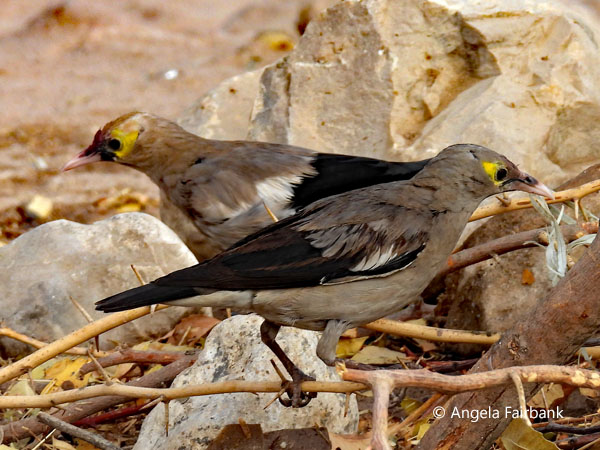 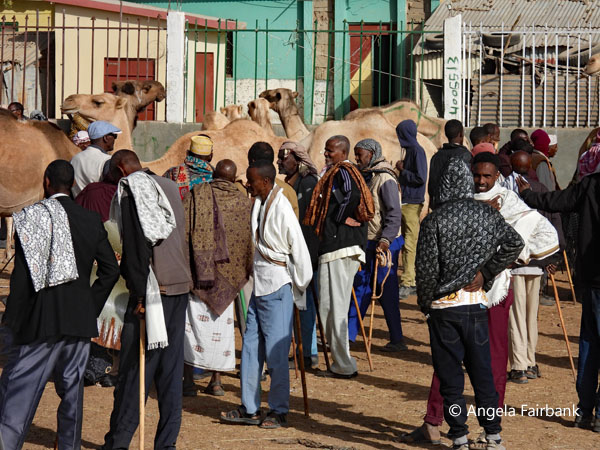 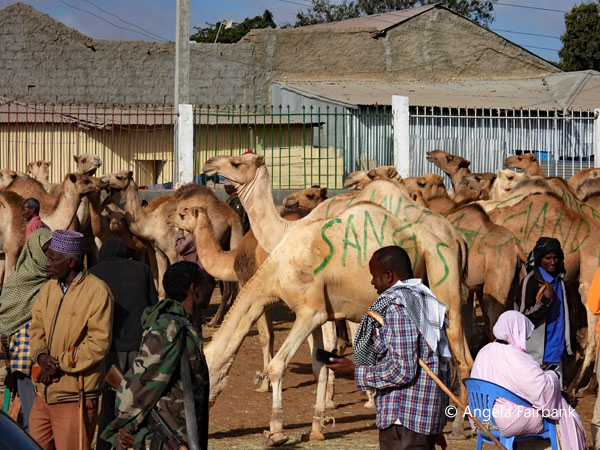 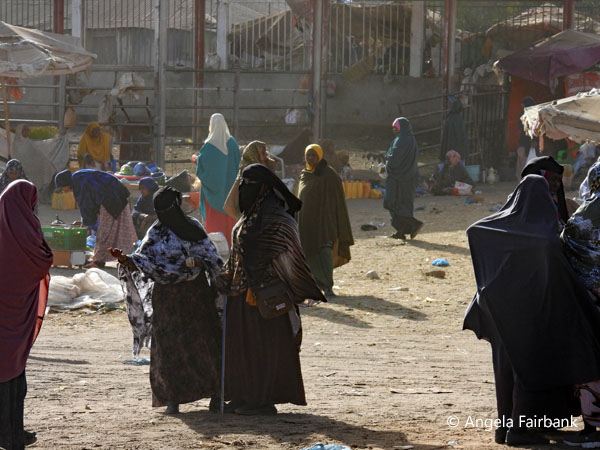   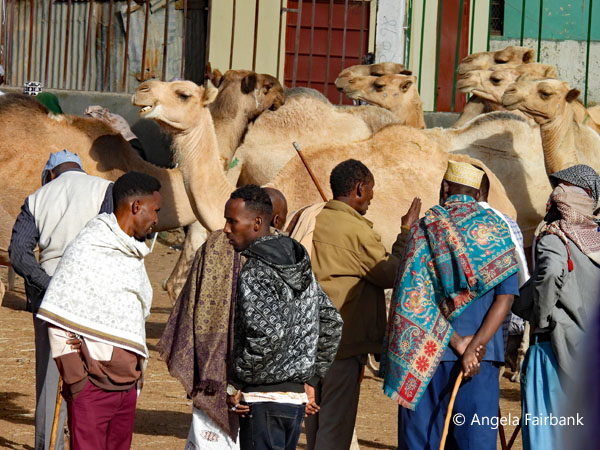  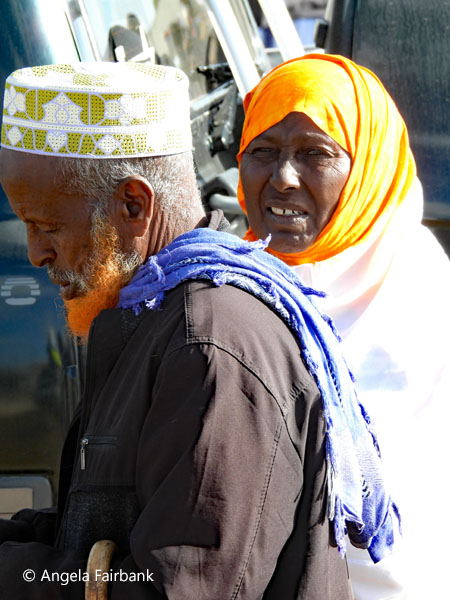 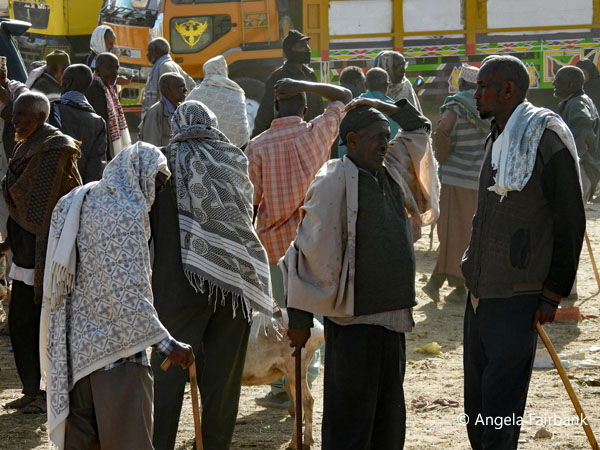   Before we left the hotel in Hargeisa, I was amused to see a sign on the hotel bottom floor entrance door to the parking lot displaying images of all the items not permitted to be brought into the hotel: knives, rifles, walking canes, pistols, cigarettes, grenades, and khat! Our destination this morning was to the busy livestock market on the outskirts of town, on the way to which I photographed these Wattled Starlings (Creatophora cinerea). What a fascinating scene of wheeling and dealing, not to mention meeting and photographing traders of camels, sheep, goats, and cows. Some of us would have been quite happy to stay longer than we did. According to Abdy, they used hand codes for price negotiation. I stood on a hillock of dry dung and snapped away to my heart's content. Several curious men came up to me, and I got photos with them. The trio of men you will see with me and whose names I have forgotten, were aged 67, 60, and 27 from left to right. One of our bodyguards was happy to take the photo and he later led me away to see the sheep, goats, and cows, where I met more people who were happy to indulge my desire to take their photos.
 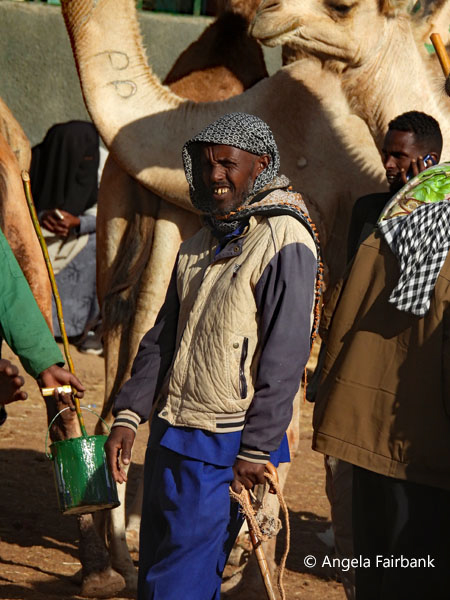  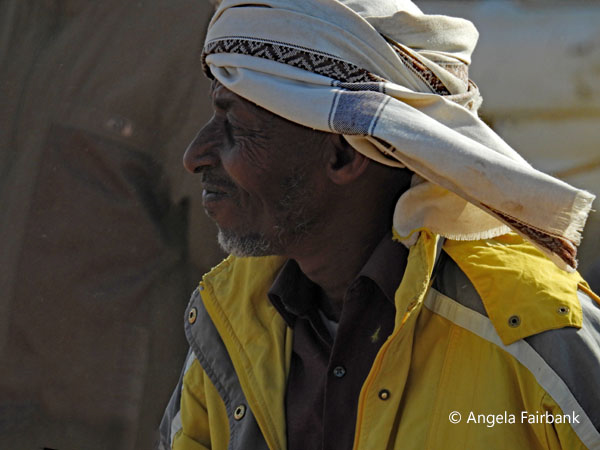    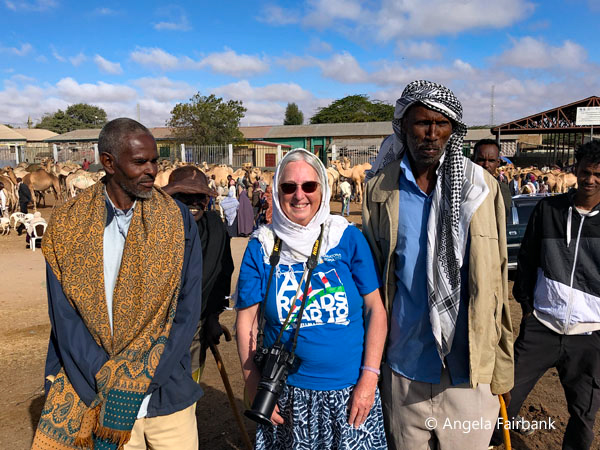 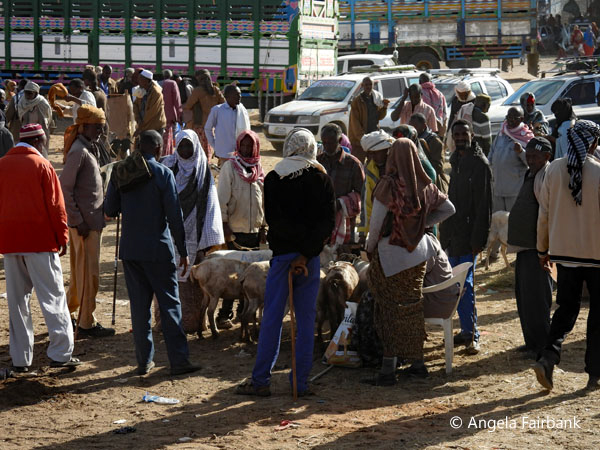   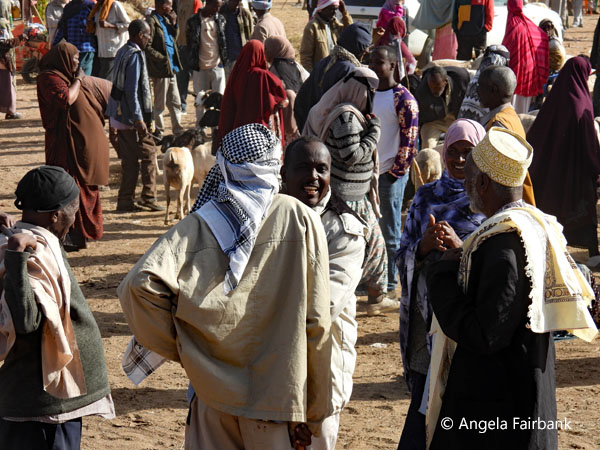    But tear ourselves away we were urged to do as we had a long drive ahead of us to Las Geel, which the trip notes describe as “one of the most important rock art sites in the Horn of Africa and with numerous well-preserved paintings in various different places. The quality of the art here is particularly good and Las Geel is a real highlight of the trip. Only revealed to the outside world a little more than ten years ago, the rock paintings of Las Geel rank among the best in all of Africa. Superbly preserved in caves and under overhanging rocks, the paintings consist of cows, dogs, and people as well as the odd giraffe here and there, and anywhere else they would be a major tourist attraction. With the handful of visitors Somaliland receives, you are almost guaranteed to have this enigmatic site all to yourself. No one has yet determined the age of the site: guesses range from five to ten thousand years, but the paintings remain a testament to the pastoral traditions of Somaliland's ancient inhabitants.” We first entered a museum about the local archeology and geology, containing interpretations about the figures themselves. It also had a government-issued sign on its wall banning the following items from the archeological site: various models of land mines, pistols, grenades, rifles, rockets, spears, and the like. We visited, I think, a total of 5 sites, including one with some kind of insect nest on the ceiling and another with what I was told were bat nests. The local guard, whom you'll see in one of the photos, complemented the rock art splendidly in his purple trousers (Sirwal). There were a couple of tricky climbs and consequently we had been advised to wear running shoes which had a better grip than my flip flops. The aforementioned, lovely man helped me, again in my long skirt, down one particularly precarious rock, solicitously making sure my skirt did not ride up my legs and potentially expose my thighs to all and sundry, although it was only our group including our bodyguards up there. Still, I appreciate his unexpected care. Surely not all men would think of taking that extra step to help a woman.
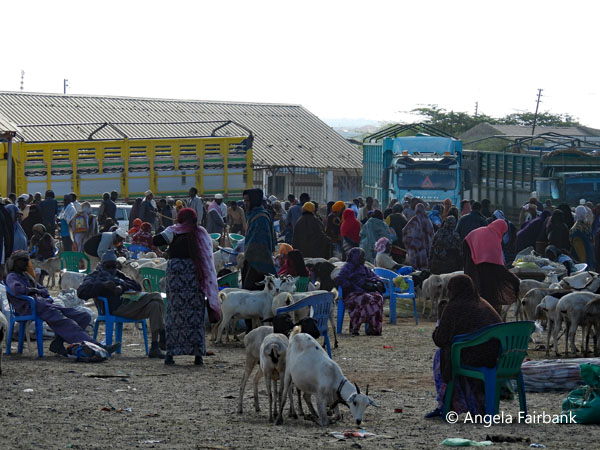 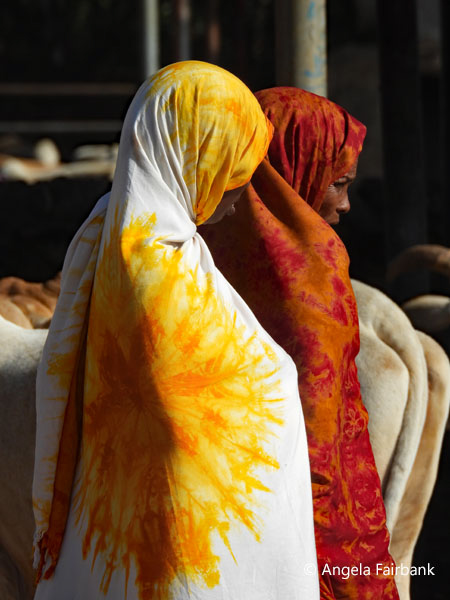 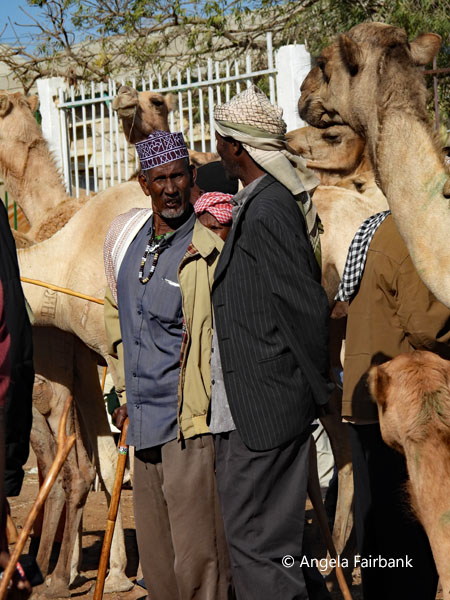 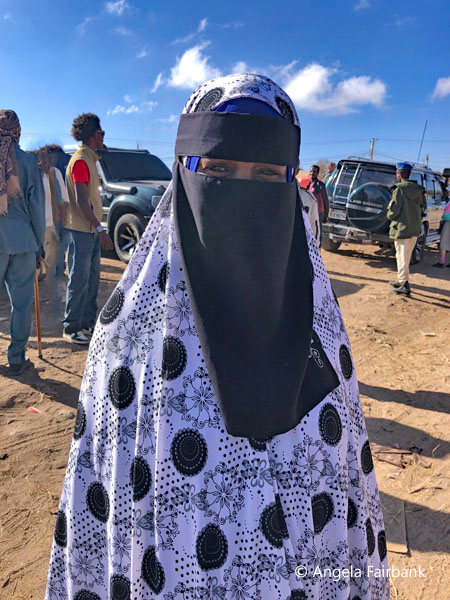   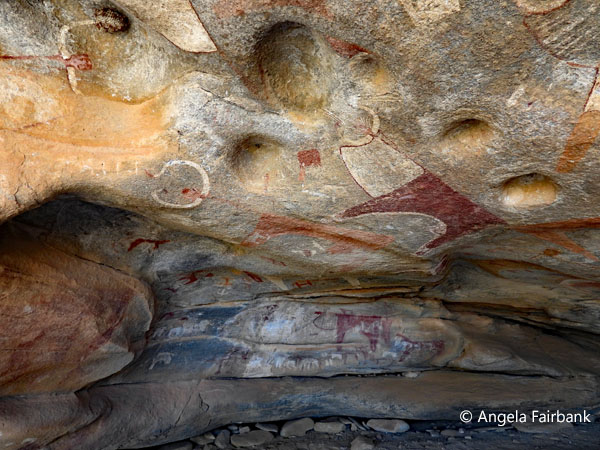 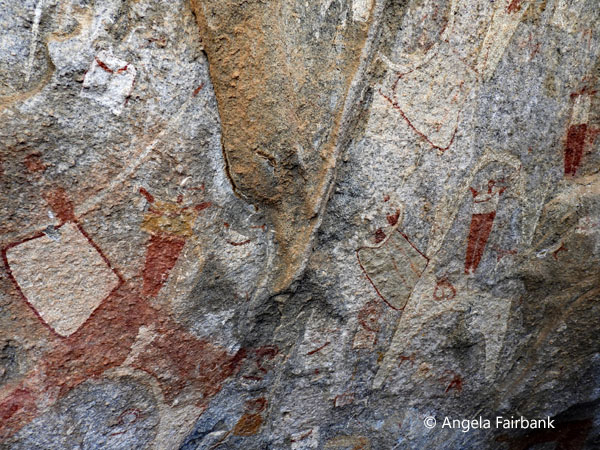  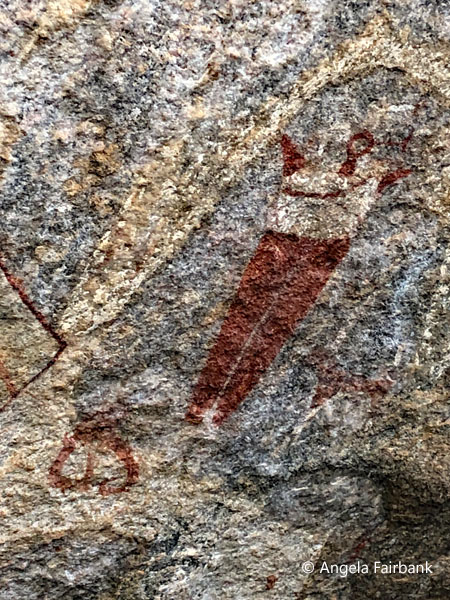 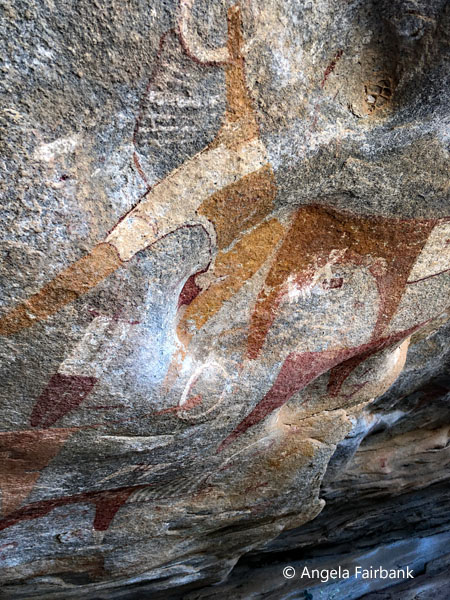 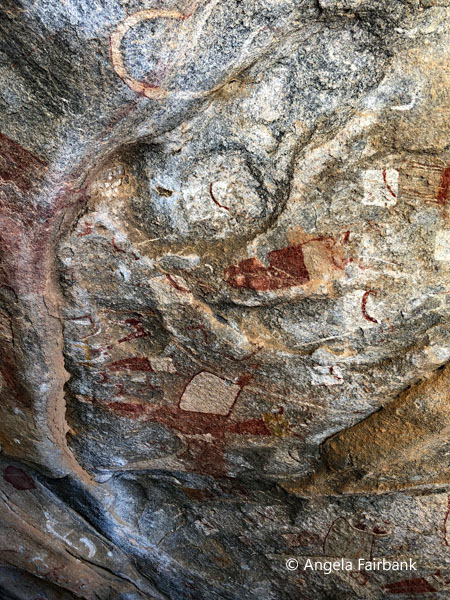 As we were sipping tea and coffee in the grounds of the museum upon our descent, we were suddenly alerted by one of the passengers that there were two Eastern Yellow-billed Hornbills (Tockus flavirostris), also confusingly known as the Northern Yellow-billed Hornbill, on the grounds of the museum, so, of course, I abandoned my cup of coffee to creep over and photograph them. Oh, and yes, the rock art was quite lovely too! On our way out of the archeological complex, I noticed the local guide was in one of our cars. He had joined our group so as to show us a giant tortoise sleeping under a clump of cactus plants.
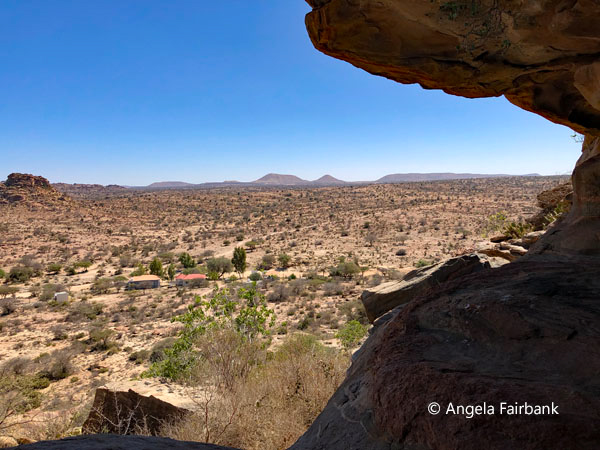  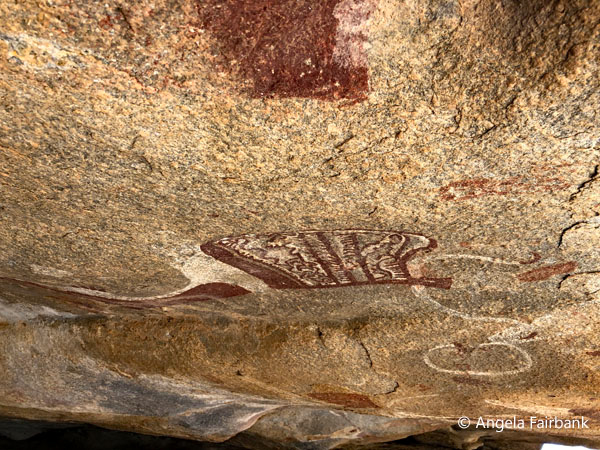 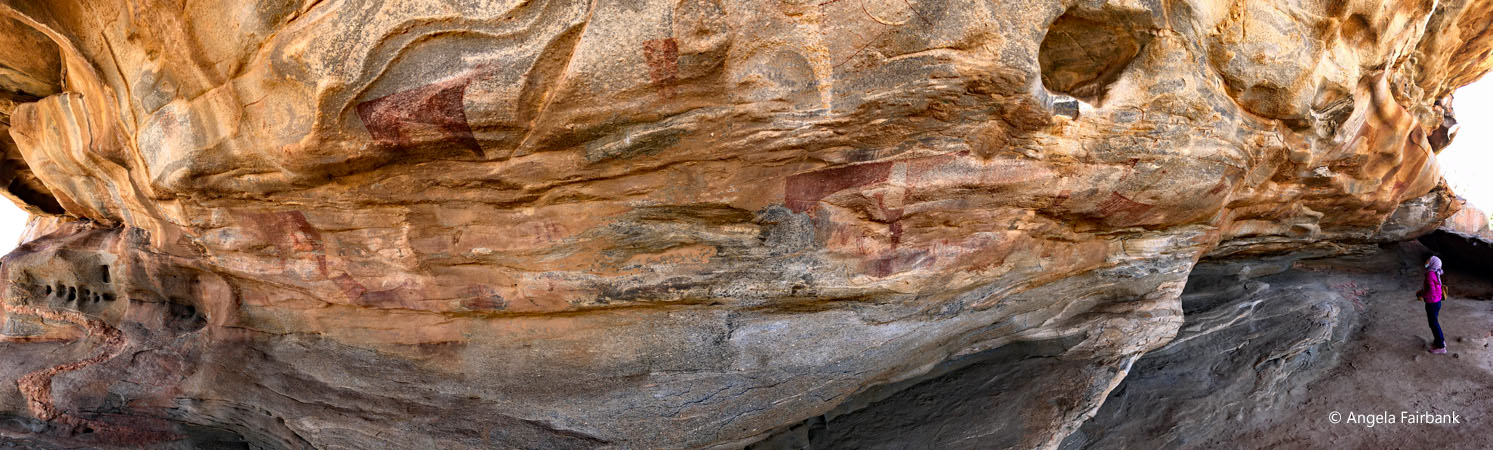 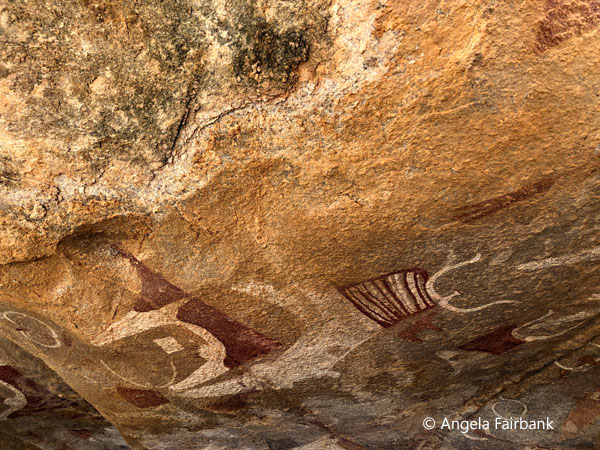 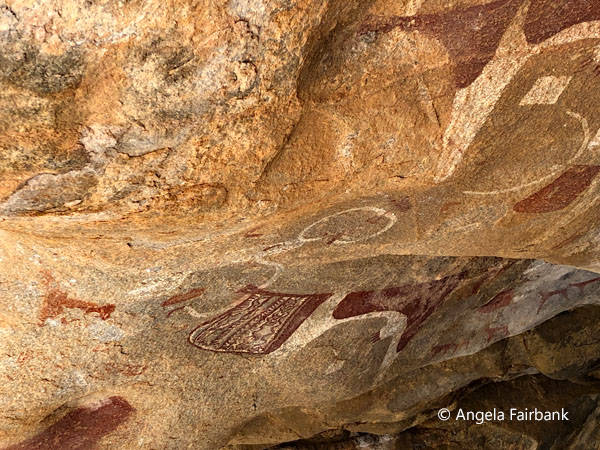 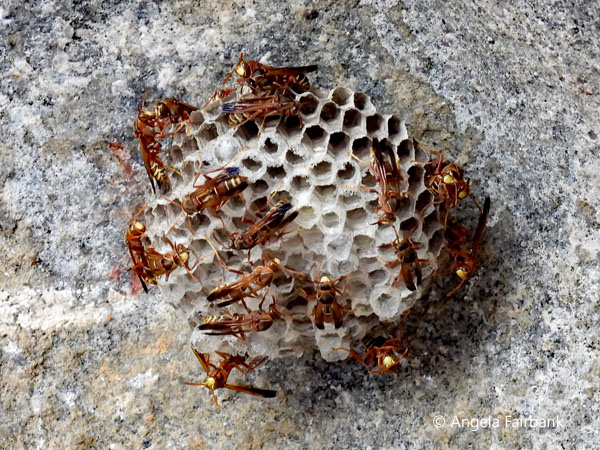   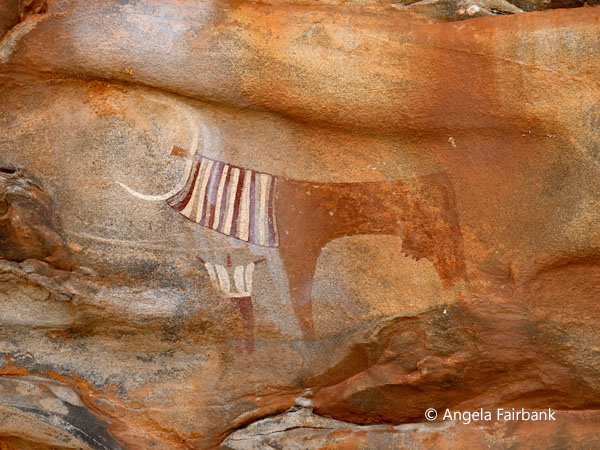    From here, we continued to the Red Sea coast city of Berbera, an important port for the entire region. After checking into our hotel, which was a member of the same chain as our hotel in Hargeisa and again quite comfortable, we had lunch at a rather nice restaurant across from our hotel, which was very dark, but the food was good. We then took our jeeps to the windy beach, where once again we met locals, particularly young men, who were interested in having their photos taken and practicing their English on us. As it was so windy, our visit here was shortened. We then motored over to the old quarter of the city known as Darole, an area of dusty streets and ramshackle buildings, some of which date back to the time of the Ottomans. Picturesque pastel paint was peeling off walls around colourful doorways, as rubble from other buildings decayed and crumbled away. It was an ideal spot for photography, but one local complained about my shooting from the hip and demanded I delete certain photos from my iPhone, which I did with Abdy's help. None of these shots were any good as it happens, so I would have deleted them anyway. Promptly after that was done, another youth came up to me wanting me to take his photo and then other members of his family including children. Dinner that night was in a seaside restaurant, outside, complete with a musician and birthday cake for my compatriot. These toilet signs are from there.
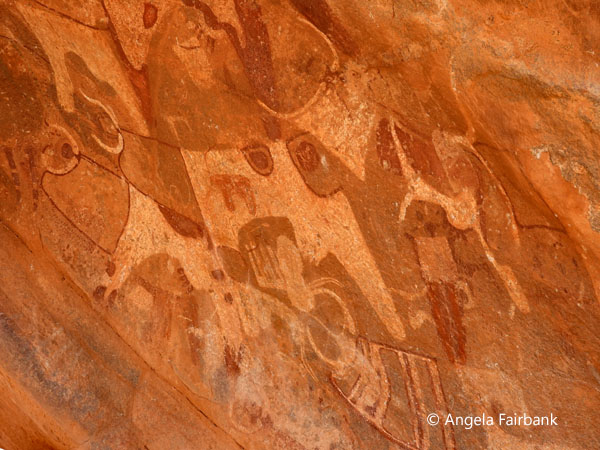  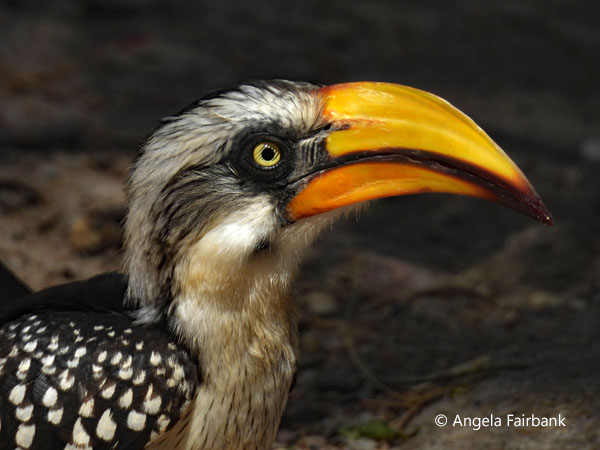     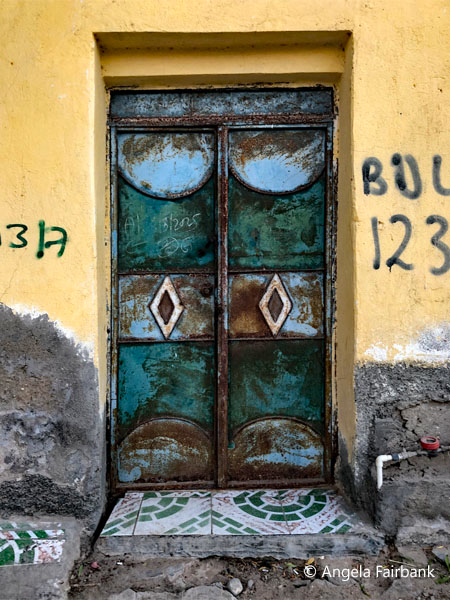   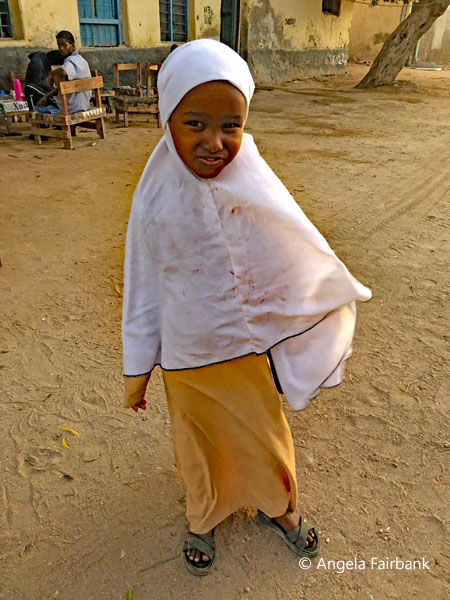  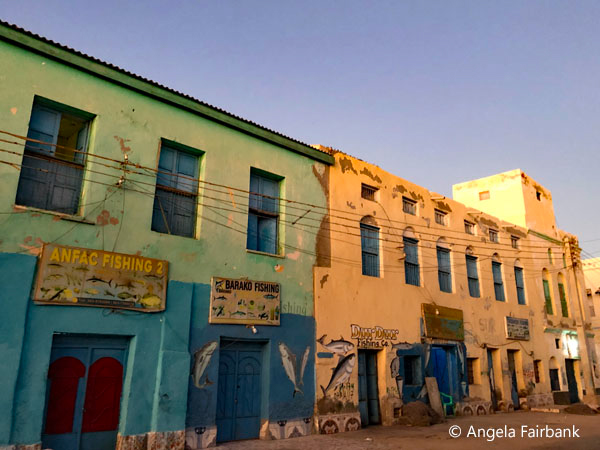 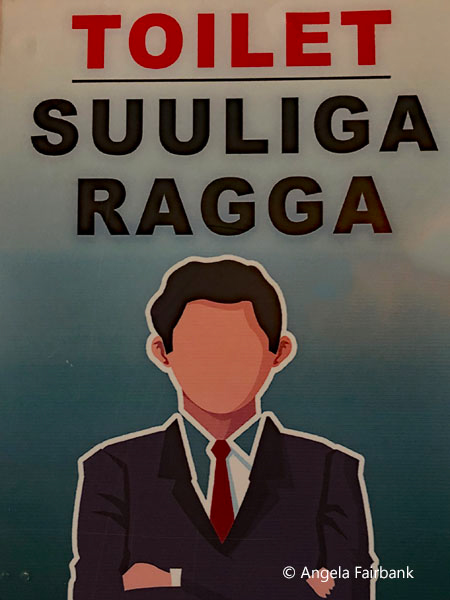 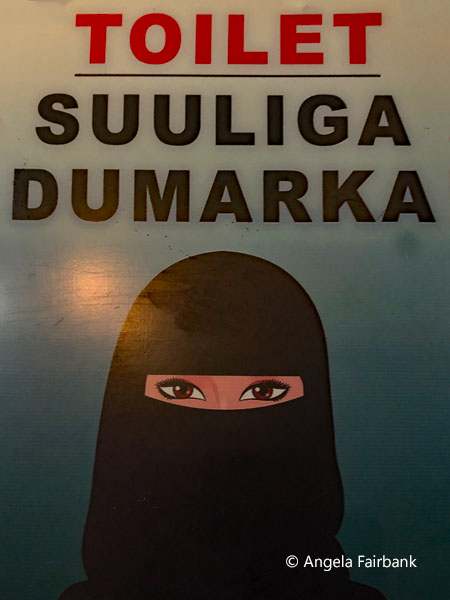 Wednesday, January 14: Berbera, Darole - Sheikh - Hargeisa, Somaliland
After checking out of this hotel, I sat in our jeep for a bit watching street life go by and as a result got some photos of a few women and men. Although it was forbidden to photograph any military personnel, these men were permitted because they are bank bodyguards. With our Land Cruisers, we returned to the old sector of Berbera, first to visit the women's fish market, launched in June 2024 to host 65 women traders, who sell their products to Berbera consumers first and then distribute them to other regions and cities in Somaliland. It is the product of joint efforts of the local administration, Denmark, and the Foreign Commonwealth Development Office (FCDO) of the United Kingdom. From there we visited the fishing port itself, photographing distant flamingos and black-headed Ibis (Threskiornis melanocephalus), as well as fishing boats, fishermen, and hangers-on before visiting the Berbera Museum, a technical institute dedicated to handicrafts, housed in an old building dating from the Ottoman era and located near the mosque, which was being renovated. We entered rooms under reconstruction without any hard hats or steel-toed boots, hoping we would be safe. 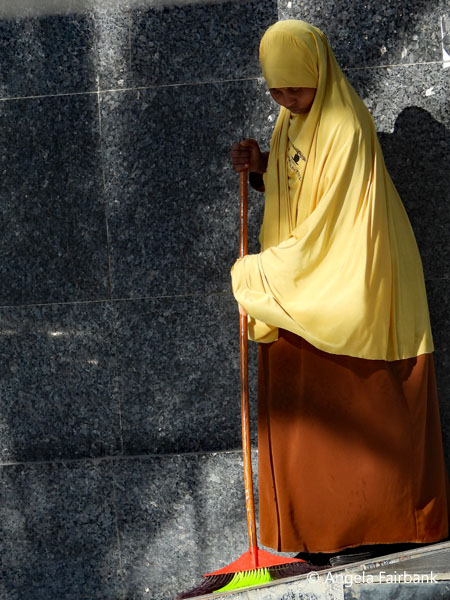 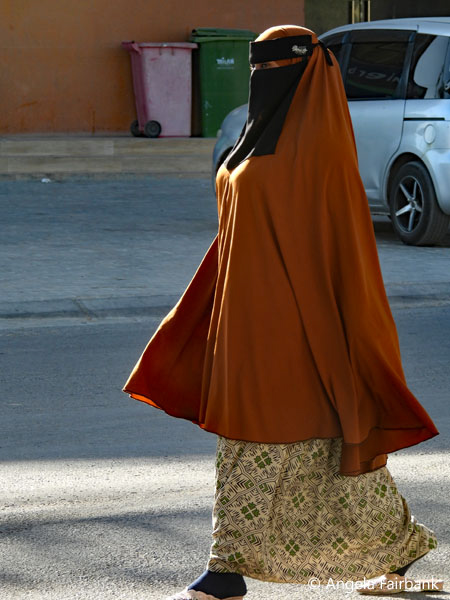  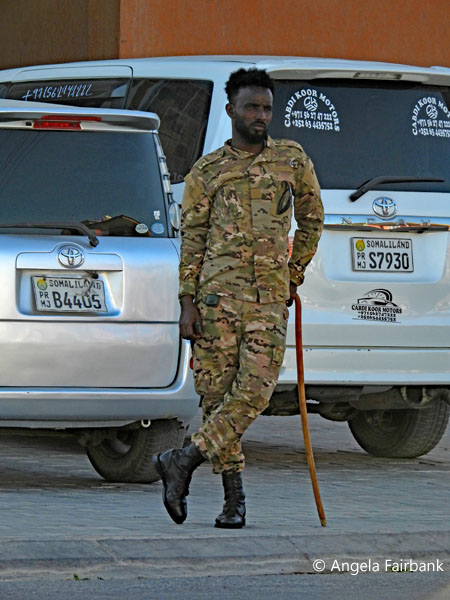      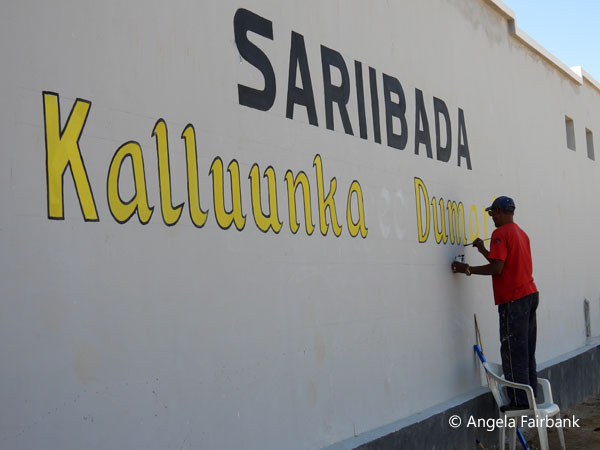  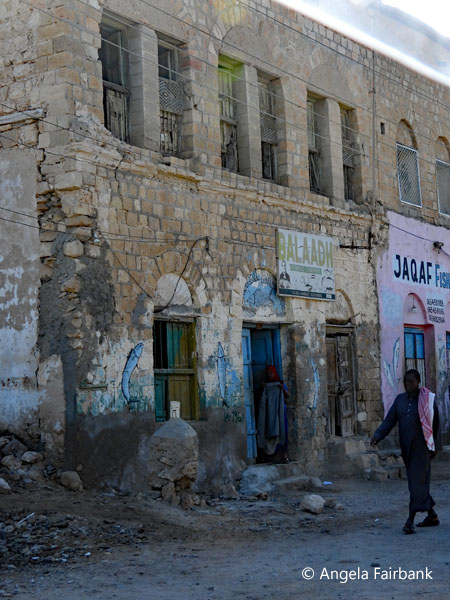  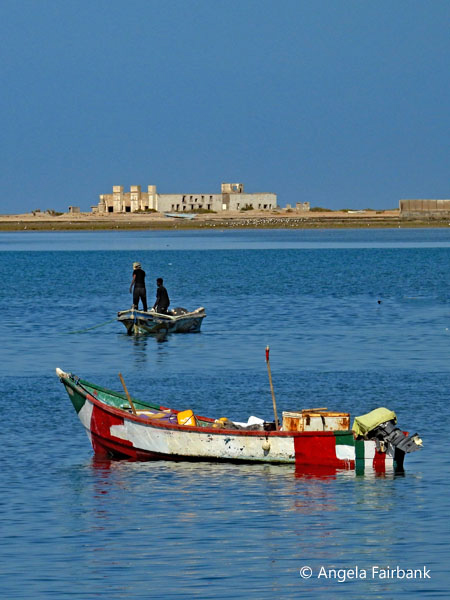 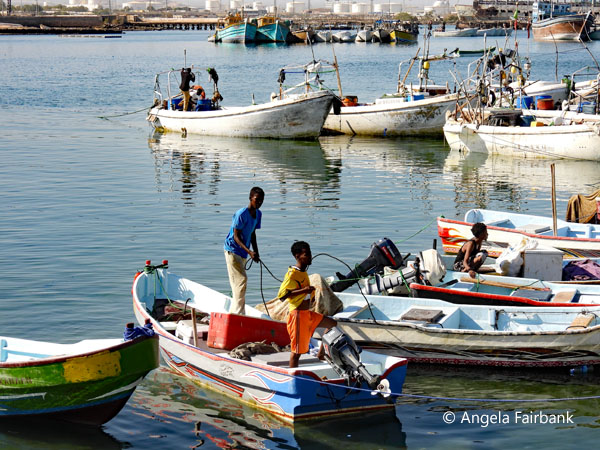 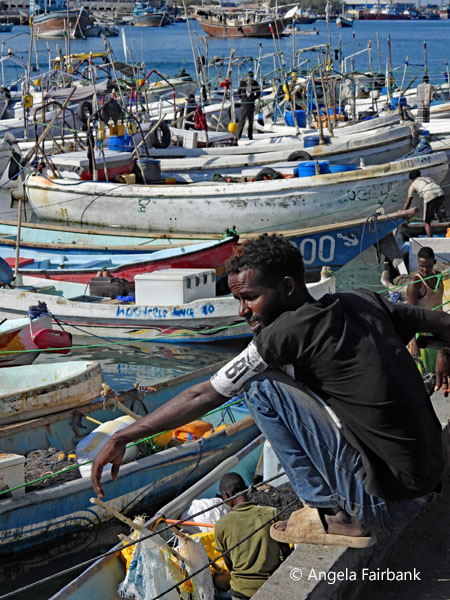   After climbing up mountains in our jeeps, with a couple of stops to admire the scenery, on a route that has been described as one of the most scenic drives in Somaliland (this sign was on the side of the highway, and I guessed correctly that it says Allahu akbar (God is great)), we finally arrived in the village of Sheikh, lying at 1430m above sea level in the Golis Mountains. Getting out of our vehicles and continuing on foot, we visited a couple more old, falling-down buildings here: the British Stone Fort Ruins, which are remnants of a structure used in the 1850s, sometimes cited as a fort or a British prison, and which to enter necessitated our bodyguards clearing away several fences made of thorny branches; and the ruins of a house, which I understood once belonged to the British government representative of some sort in this town. While strolling between these two sites, I photographed a Purple Roller (Coracias naevius) and groups of Somali Starlings (Onychognathus blythii) in the bushes, identifiable by their striking chestnut-red underwings, as well as a few shy locals. It felt great to stretch our legs, and I suppose it was as good a stop as any on our way back to Hargeisa. We were caught in some heavy, slow traffic as we neared our hotel, passing the area of the market filled with stores selling khat. We made one stop at a souvenir shop, but it was closed. At the second store we stopped at, I did not see anything I particularly wanted to buy. It was our final night in Somaliland and there was still no sign of my laundered jeans. We met informally in the hotel restaurant for dinner sans Abdy and said good-bye to our fellow travellers.
 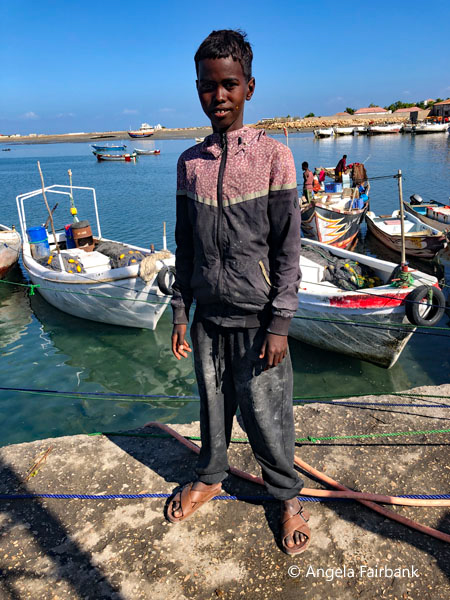  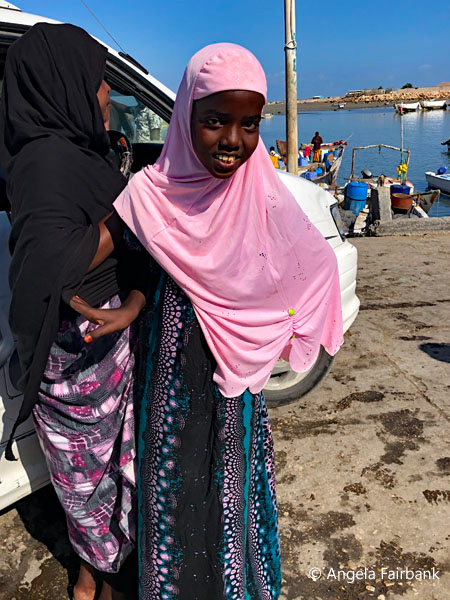 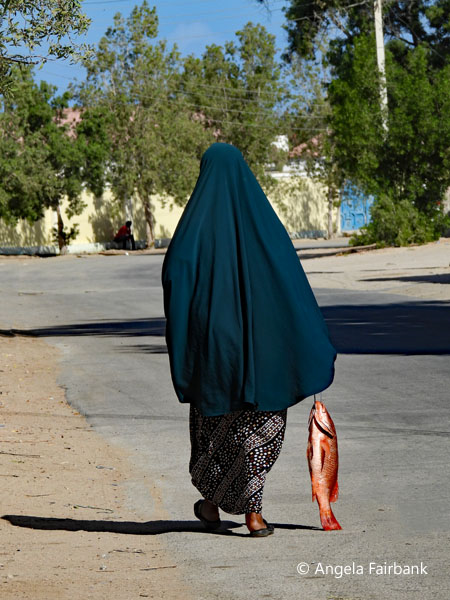   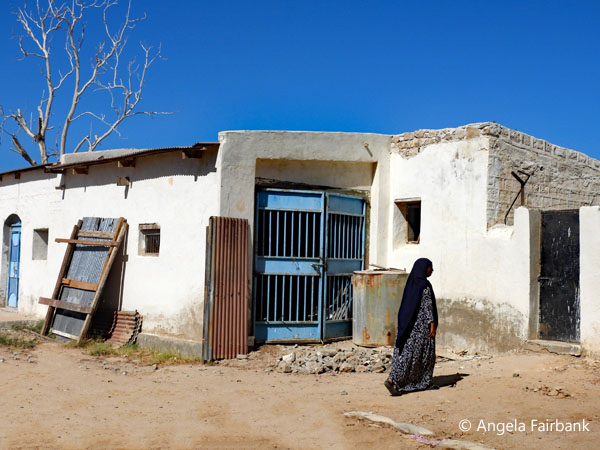 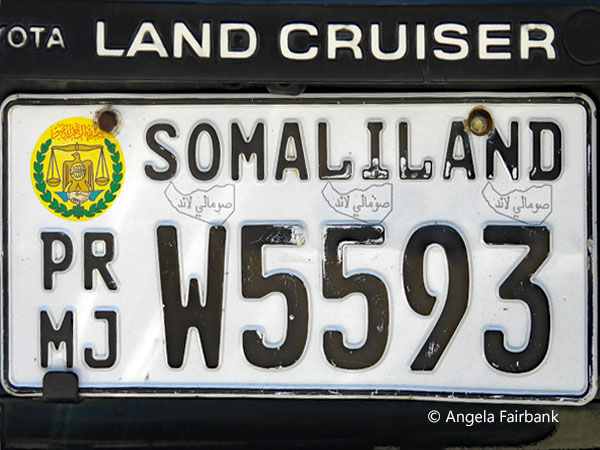 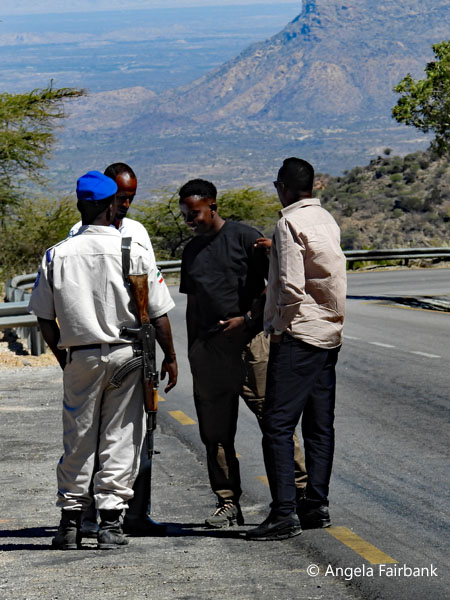  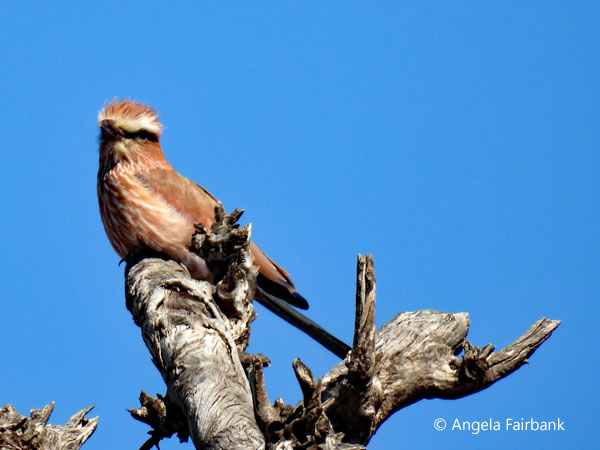 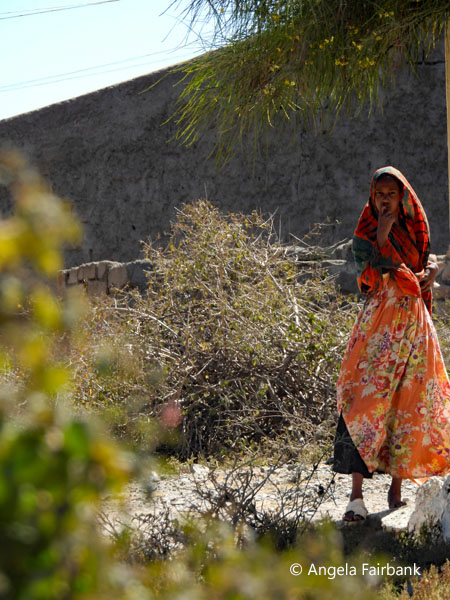 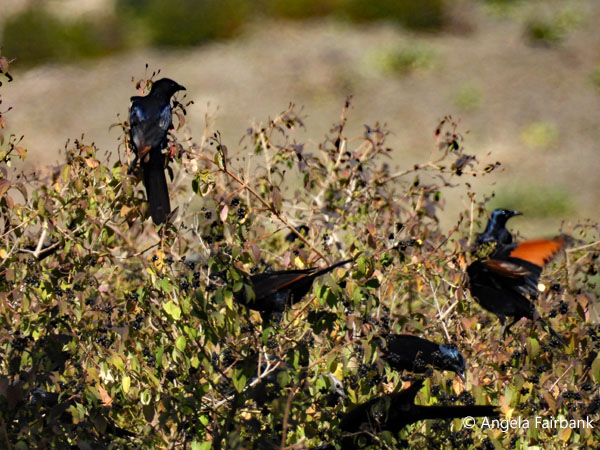   Thursday, January 15 to Friday, January 16: Hargeisa, Somaliland - Addis Ababa, Ethiopia - Juba, South Sudan
As I arrived at breakfast this morning in my t-shirt, I noticed the restaurant hostess was wrapped in a thick winter coat with a fake fur collar. However, I noted that I could see my breath in the cool morning air so it must have been colder outside than I was! Due to our bad luck with the timing last evening, I had arranged with Abdy to visit some souvenir shops today after breakfast prior to his dropping me off at the airport for my noonish flight. Three of my fellow travellers, hearing these arrangements, decided to join us. Unfortunately, the specific shop Abdy had in mind was not yet open at the time we visited either, so he went to find a t-shirt and a mousepad for me from his company's office, and I was very grateful to have them. He mentioned there were two souvenir stores in the airport as well. He knew this because once upon a time he used to work at one of them. After checking into business class and being whisked away to the business lounge after a few scans of my carry-on luggage, I asked about souvenirs and was accompanied back to the check-in hall, while the security people guarded my carry-on luggage. I found the store in question, but it was clearly closed and the sales lady had disappeared. When I reported this fact back at the carry-on luggage scanning area, two security guards went looking for her. They never found her, so eventually, I was accompanied by a female security guard out of the business lounge and onto the tarmac over to the souvenir shop at the economy gate, where I found some rather expensive bracelets, no fridge magnets, some USD15 mugs, and three designs of t-shirts, but they were all too small for me. I decided I would have to be content with the bracelets and bought them, not bothering to haggle as I was aware of the short time before boarding my plane to Addis Ababa, where there was only one other passenger in the business section. I had a short connection at Bole airport before my departure for Juma in South Sudan (UN country number 149), so only stayed a short time in the Ethiopian Airlines business lounge this time. My next flight involved a change of time. Sudan is one hour behind Ethiopia. I was in the front of the plane so was the first off and, consequently, was the first in line for immigration. Having applied for my South Sudan visa at the end of my visit to Djibouti, everything went smoothly and I was one of the first in the baggage arrival area around the corner. Someone in a hi-vis vest latched onto me fairly quickly, offering to take my luggage labels and find my bag for me (not a difficult task actually, but the area was so small and crowded and he probably needed the tip I would give him for his service so I let him at it.) My first piece of luggage, the large one, arrived fairly quickly, probably due to its priority labels, while the small luggage was one of the last off despite its priority labels, and I noticed when it arrived that the padlock had been cut off. Luckily, there was only dirty laundry in that bag, and nothing was missing, but I was nonetheless disappointed to find that someone had sought to damage my padlock and open my bag. The man in the hi-vis vest found me a taxi when I asked, although on leading me away to the parking lot, he initially assumed I had a car parked there. I should also add that as our plane touched down on the landing strip, the first thing I noticed was a plane belonging to WFP (World Food Program). Inside the terminal, I spied representatives wearing United Nations shirts there to pick up new staff, no doubt. Later, I passed a car belonging to Care and saw a sign leading to the local UNICEF office. The first thing I noticed about the people in the street is that they carry their goods on their heads. This had not been the case in Djibouti or Somaliland. My taxi took me safely to my hotel, the Radisson, which, when I'd initially looked for it online, had a hard time finding and believed that perhaps it did not actually exist. I took the chance and booked it online, nevertheless, but was happy to see that they would not take any payment until my physical arrival. Despite the ominous number of my room, 911, the hotel was very comfortable but as I had a lot of catching up to do regarding my photos and travelogue, I spent my two days here working in my room, eating the included breakfast but only relying on snacks in my luggage for lunch and dinner. I also looked up my weather app to see what temperatures would be like during my stay in South Sudan and was alarmed to note it was forecasted as being between 37 and 40 degrees Celsius. And now for some background from Wikipedia: The Republic of South Sudan is a landlocked country in East Africa, bordered by Sudan to the north, Ethiopia to the east, the Democratic Republic of the Congo to the southwest, Uganda to the south, Kenya to the southeast, and Central African Republic to the west ... The Nile River system is the defining physical feature of the country, running south to north across its centre, which is dominated by a large swamp known as the Sudd. South Sudan has an estimated population of 12.4 million by mid 2026. Juba is its capital and largest city. Sudan was occupied by Egypt under the Muhammad Ali dynasty and governed as an Anglo-Egyptian condominium until Sudanese independence in 1956. Following the First Sudanese Civil War, the Southern Sudan Autonomous Region was formed in 1972 and lasted until 1983. A second Sudanese civil war soon broke out in 1983 and ended in 2005 with the Comprehensive Peace Agreement. Later that year, southern autonomy was restored when an Autonomous Government of Southern Sudan was formed. South Sudan became an independent state on July 9, 2011, following 98.8% support for independence in a January 2011 referendum. It is the most recent sovereign state with widespread recognition as of 2025. South Sudan [experienced] a civil war from 2013 to 2020, enduring rampant human rights abuses, including forced displacement, ethnic massacres, and killings of journalists by various parties. It has since been governed by a coalition formed by leaders of the former warring factions. The country continues to recover from the war while experiencing ongoing and systemic ethnic violence. The South Sudanese population is composed mostly of Nilotic peoples spanning a variety of ethnic, tribal, and linguistic groups. It is demographically among the youngest nations in the world, with roughly half its people under 18 years old! The majority of inhabitants adhere to Christianity or various traditional indigenous faiths, while there is a sizeable Muslim minority. A member of the United Nations and the African Union ... it is one of the least developed countries in the world, ranking the lowest in the Human Development Index, and having the lowest nominal GDP per capita. And now for the description of this tour by the British travel company, Native Eye Travel: “There are few places left in Africa that compare to South Sudan, a wild and untamed world that is home to some of the continent's most traditional ethnic groups, living in the same way as their ancient forefathers ... This short trip takes you deep into the tribal heart of a truly fascinating part of the continent. From the boom town capital of Juba, we head east to the land of the Toposa people, an intensely traditional group related to both the Turkana of Kenya and the Surma of Ethiopia, who decorate their faces and bodies with elaborate scarifications that almost defy belief. We spend time exploring their villages and meeting tribal elders before returning westwards, visiting other ethnic groups such as the Boya and Lotuko along the way, learning about the challenges of life here and seeing a side of Africa that few people will ever be privileged enough to witness. Finally, we travel to the homelands of the Mundari people, known for their distinctive tribal scarring and the regular wrestling contests that take place between their villages ... This is not always an easy journey--infrastructure is often lacking, and visitors are virtually unknown--but without a doubt is one of the most exciting you are likely to make.” Saturday, January 17: Juba, South Sudan The tour company's blurb continues: “South Sudan's capital [Juba] seems a bit like the Wild West. Having been neglected for so long under rule from Khartoum, independence in 2011 has seen an explosion of infrastructure and building projects, and the city is changing rapidly to become a modern African capital. It wasn't always so. Juba has its origins in the trading post of Gondokoro, the southernmost outpost of the Egyptian authorities in the 19th century and then fell under joint Anglo-Egyptian [rule]. Used by explorers such as Samuel Baker as a jumping off point for expeditions to find the source of the Nile, it was seen as the last semblance of civilization before one headed off into the unknown beyond. There are few sights in Juba to speak of, but one thing you won't miss is the steel bridge spanning the Nile, which is the only connection Juba has to Uganda, from where most of its imports arrive. There is also the mausoleum for Dr John Garang, the former leader of the Sudanese People's Liberation Army, who was tragically killed in a plane crash before he could see his dreams of an independent South Sudan realized.” [Note: we were not taken to see this mausoleum, nor did our tour guides ever mention it.] Below is a map of our proposed tour:  On Saturday, I worked in my hotel room until just before 2:00 p.m., when I checked out and got a taxi 1 km down the road to the tour hotel, the Royal Palace Hotel. I then continued working on my photos. I was told in my tour notes that the plan was to meet my tour guide at 5:00 p.m. today but after waiting in the lobby for half an hour and seeing no one, nor receiving any replies to my WhatsApp messages, I asked the receptionist to help contact the local tour company's leader. In a phone conversation with him, I was told he was out with my fellow tour participant at a Mundari tribal visit, and that not knowing I had arrived at the hotel, had moved our meeting to 7:00 p.m. I came down to the lobby once again at that time and met the other tour participant, an antiques dealer from the UK, and the tour company owner and operator, Donald, who reminds me strongly of Jamie Foxx, the American actor. He told us that due to a festival taking place these last two days and tomorrow among the Mundari tribe, our tour itinerary would go in the opposite direction to what we had been sent, which meant that we would start with the Mundari, located North of Juba and end up in the East of the country before returning to Juba. He then offered to change our Euros and USD into local South Sudan Shillings, the three piles of 500 and 1000 shillings seen in the first photo below being the equivalent of 50 Euros. The two paintings below were on the walls by the reception desk of our hotel. I then had a few more snacks in my room as tonight's dinner was not provided as part of the tour and continued working on my photos from Somaliland.
   Sunday, January 18: Mundari Villages (camping), South Sudan
After a good breakfast at the hotel, at 10:00 we, that is to say our young guide, Sebit, slim and wearing the yellow shirt below, our driver Nabiir, my fellow UK passenger, and I, left for the aforementioned Mundari Cultural Festival, which was an excellent opportunity to meet the locals, and where I learned that 'thank you' is anouka so of course I used it a lot! For some strange reason, seeing my camera, a number of girls wanted to have their photos taken holding it. It was slightly traumatizing for me to release my baby, but our trusty guide was there at the time and recorded their photos on my iPhone as a back-up. There were various large posters in front of the sitting area in the stadium, explaining the various cultural points of the Mundari and I shall write them up below: 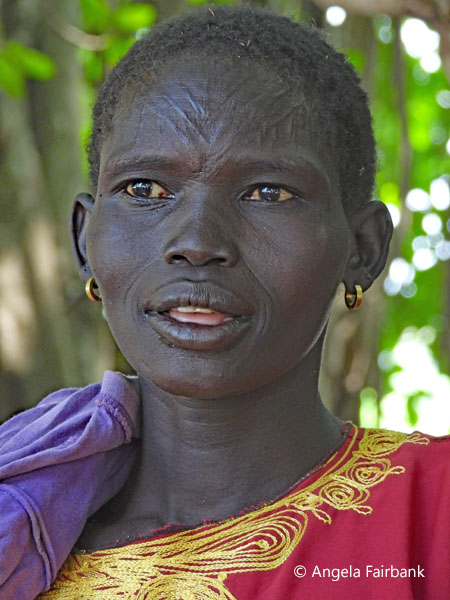  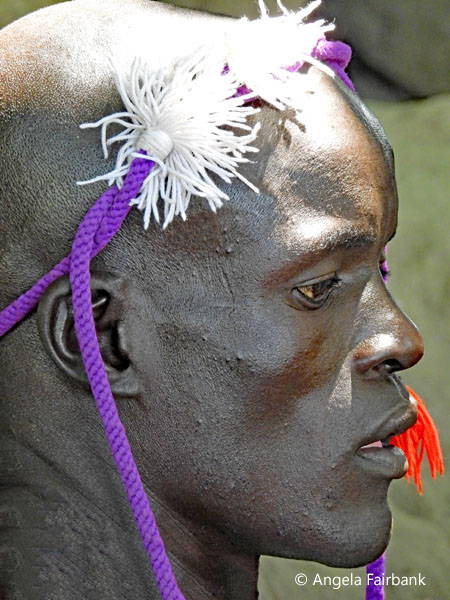 “Scarification among the Mundari is a culturally significant practice marking identity and the transition to adulthood. Distinctive forehead scars set them apart from other Nilotic groups and signal readiness for marriage, cattle herding, and community roles. During initiation, men receive five V-shaped cuts symbolizing cattle horns, followed by a cow and a new name. Regarded as beautiful and spiritual, scarification signifies belonging, pride, and ancestral continuity, although the practice is declining.”
  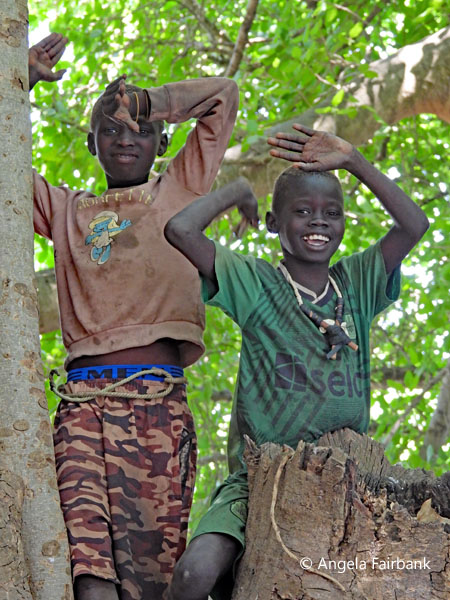 “The Mundari are a Nilotic people of South Sudan, whose identity and social life centre on cattle herding and community traditions. Living mainly around Terekeka north of Juba, cattle symbolize wealth, status, and culture, shaping marriage, rituals, and conflict resolution. They combine pastoralism with farming and fishing, organize society by clans and age sets, and preserve customs, language, and resilience, despite conflict, modernization, and displacement.”
 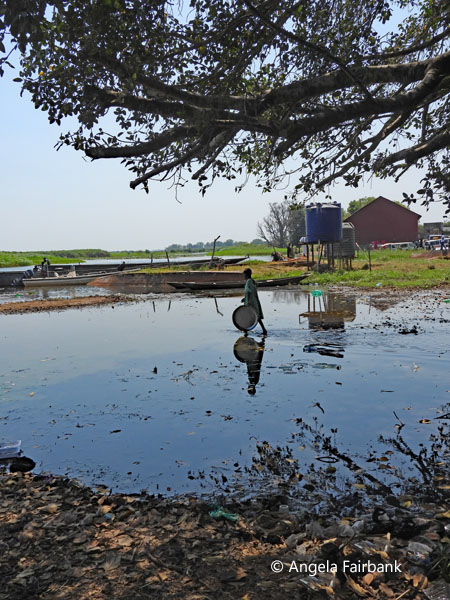  “The Mundari of South Sudan go to great lengths to sustain their sacred Ankole-Watusi cattle, which are central to their culture and survival. When nearby pastures are depleted, herders must drive their animals across rivers, forcing both people and cattle to swim in search of fresh grazing lands. This arduous journey reflects the struggles they endure to protect their herds, highlighting resilience, devotion, and the deep bond between the Mundari and their cattle-driven way of life.”
   “For the Mundari of South Sudan, milk is the essence of survival, culture, and spirituality. Drunk fresh, often directly from the udders, it sustains families and symbolizes purity, abundance, and sacred bonds with cattle. Youth learn responsibility by tending herds, while rituals affirm milk's spiritual role. It embodies life, continuity, and identity, anchoring pastoral tradition and pride.”
   “Among the Mundari of South Sudan, cow urine is central to hygiene and aesthetics. Men bathe with it for its cleansing and antiseptic properties and use it as a natural hair dye, producing a distinctive orange colour. This practice reflects their deep connection to cattle, which underpins their economy, spirituality, and identity. The orange hair serves as a cultural marker, symbolizing tradition, pride, and the pastoral lifestyle that defines Mundari society.”
   After photographing their V-shaped forehead scarring and dancing with them (they mainly jump like the Masai) in the main stadium, we ate a lunch of re-fried chicken and fries and then took a short drive to Terekeka, where cattle are used in marriage dowries (ranging from 10 to 100+ head of cattle) and are a primary form of traditional currency. The Mundari live as nomads in close symbiosis with their cattle along the Nile River, using cow dung for fires.
 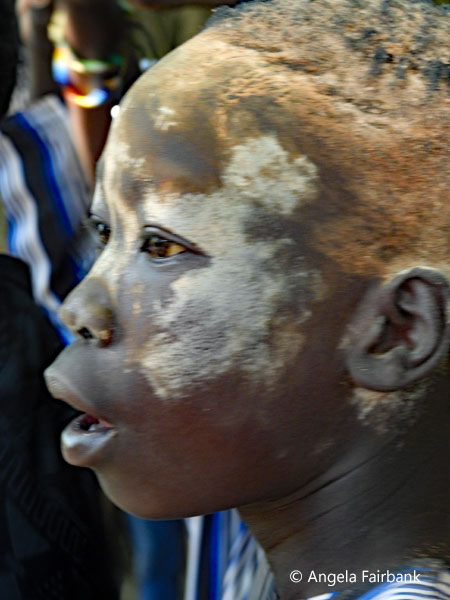 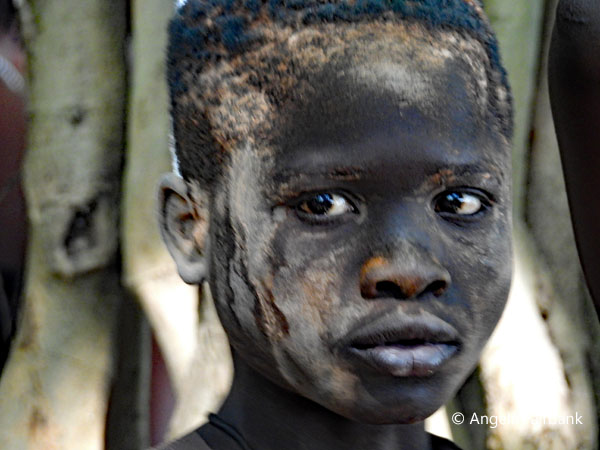 After a drive of about an hour, we arrived at this particular community's current location, although as I stated earlier, since they are nomads, they travel to and settle briefly wherever their cattle can feed. While a tent was set up for each of us complete with bed, mattress, pillow, and clean sheets, despite the UK travel company I had booked this tour through telling me I would need to buy a summer sleeping bag (I had also added a mattress to my order from Amazon, but clearly neither piece of sleeping equipment was needed), we observed the daily rituals of the community, and eventually watched the large-horned Ankole-Watusi, (Bos taurus watusi, Bos primigenius f. taurus or Bos taurus indicus) cattle arrive back from their grazing. This particular breed, known for their massive horns and characterized by a hump, are highly adapted to extreme heat, and resistant to diseases and tick-borne infections. They are also known for their ability to thrive on low-quality forage. The curious thing we noticed about them is that their horns were different from each other for the most part. During our visit to the festival, we had been photographed in groups along with Mundari at their request and were asked to copy their gestures of bent arms, being told that this pose symbolized the horns of their cattle. We later learned on examining the beasts that the shape of their horns was created by clipping them, thus forcing them to grow back bent and twisted. You will see some of the unusual shapes among my photos of the cattle below. You might also notice bells attached to some of the larger bulls. This was so that when they approached and moved their heads, for instance to swat aways the flies, you would hear them ringing and perhaps move away from potential danger.
    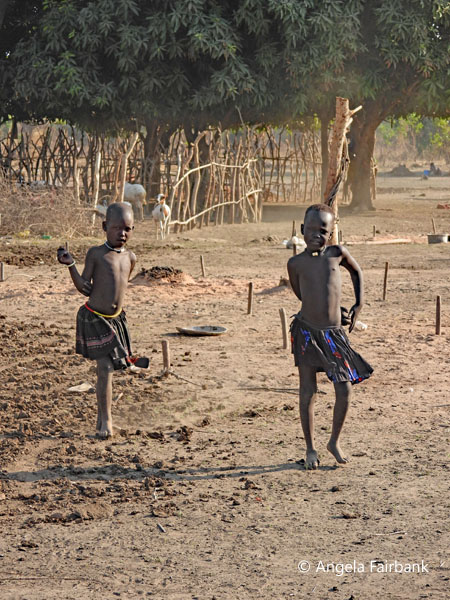 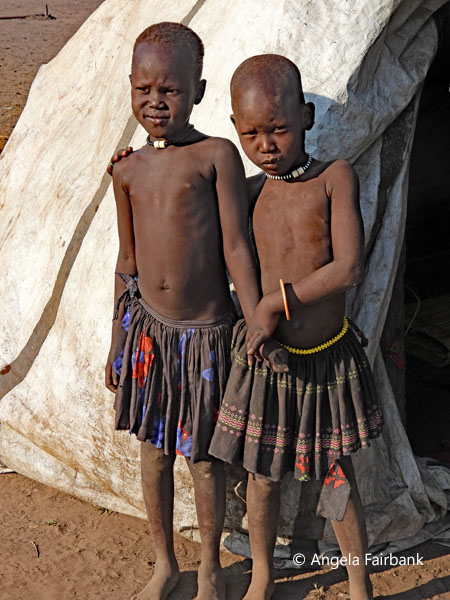  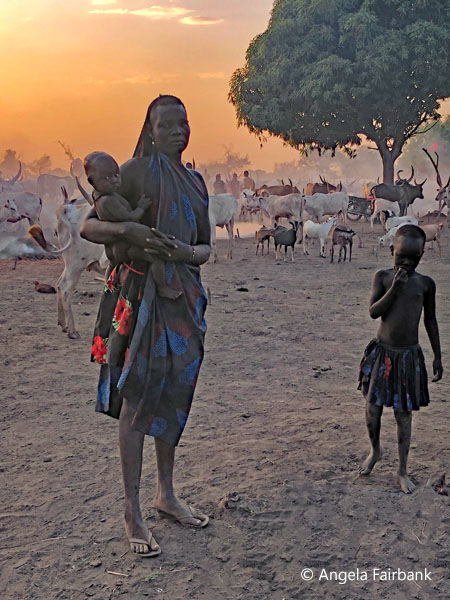 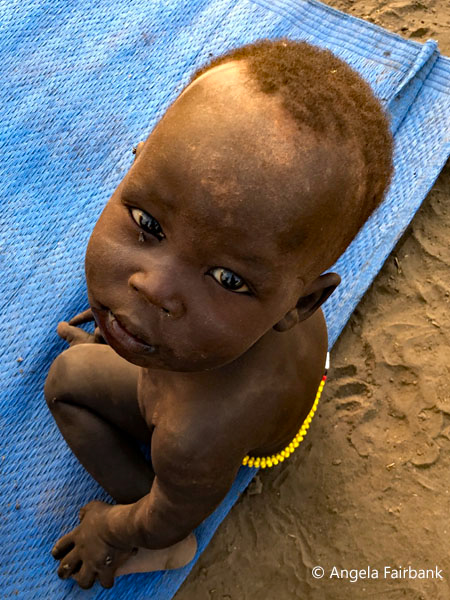 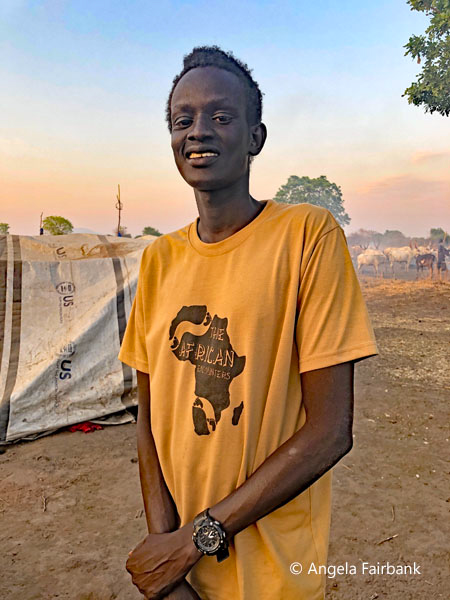   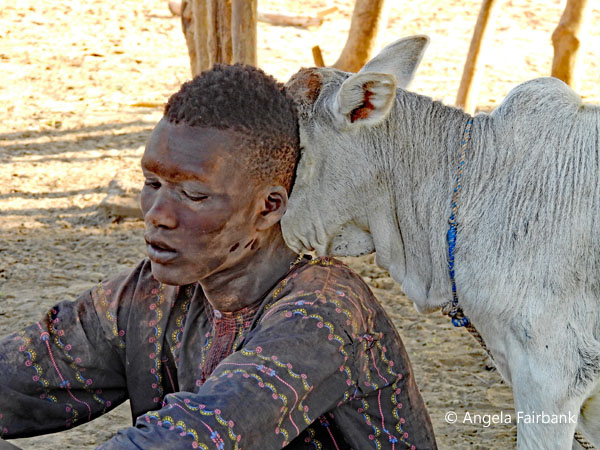 At the make-shift camp in this place, we shared a drop toilet in a separate roofless tent-like structure with a small group from Spain, who were travelling with the same tour outfit as us but in the reverse direction from us and were thus at the end of their trip. The dung fires were emitting smoke, which our clothes and bodies eventually reeked of, but at least it helped keep away most of the flies. In any case, we were able to witness firsthand the daily rituals of this group, gathering the dung, sorting it into piles, and then setting it alite, herding the cows back to the camp by beating drums, and tying them up to their posts. Curiously, the cattle knew their habitual posts and would stand by them, waiting to be attached. There was one low tent-like structure in which we were told the women and children slept, while the men--most of them young--slept on raised wooden beds behind a curtain.
 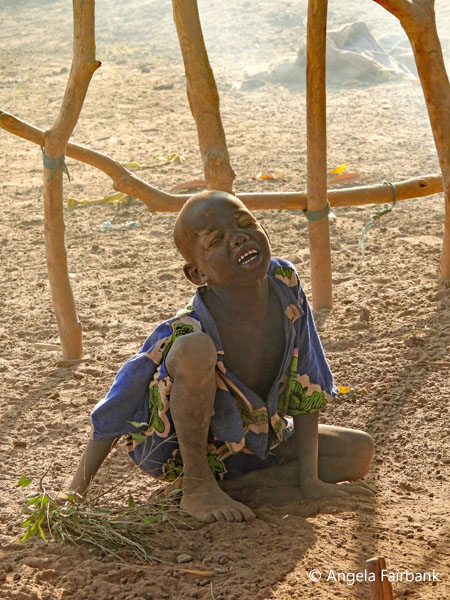 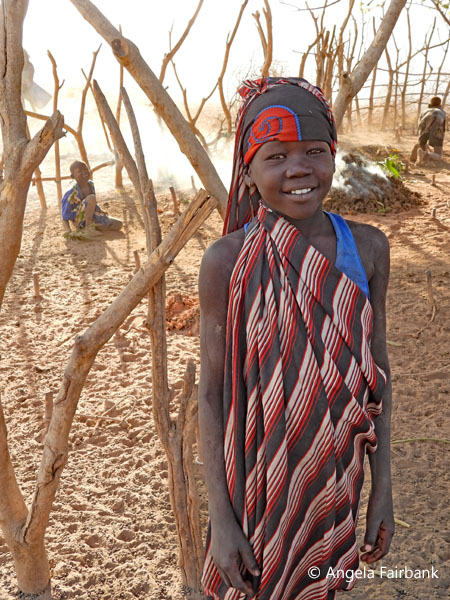   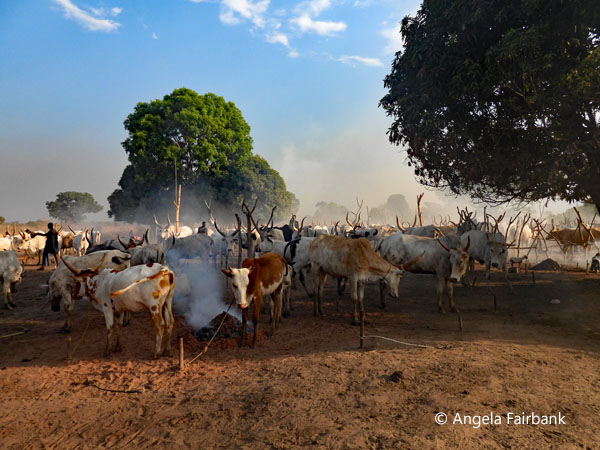 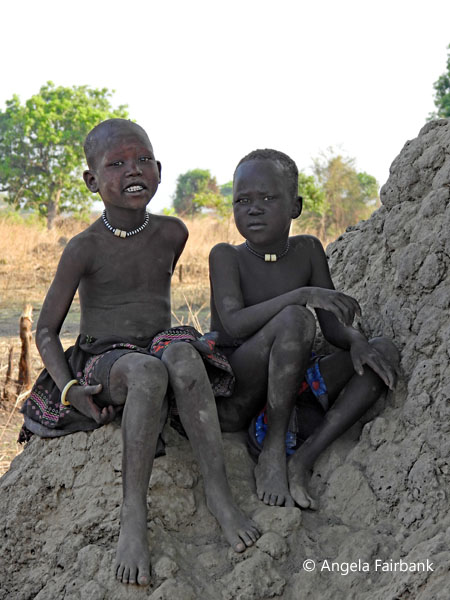  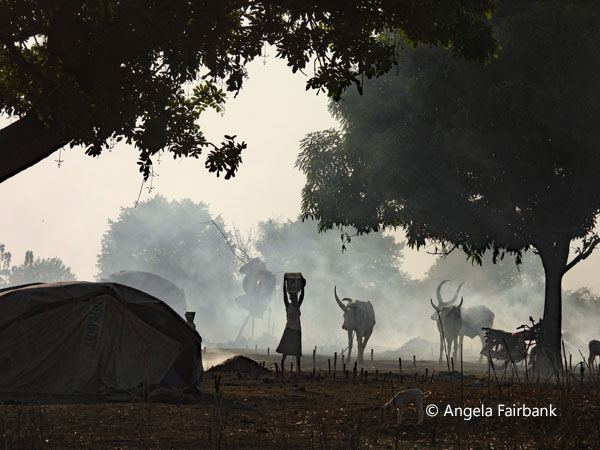 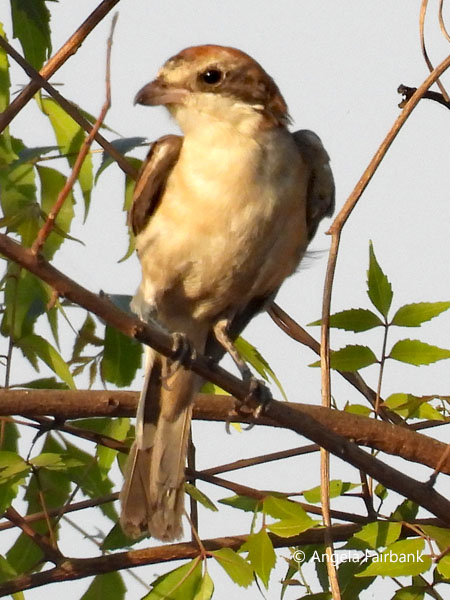 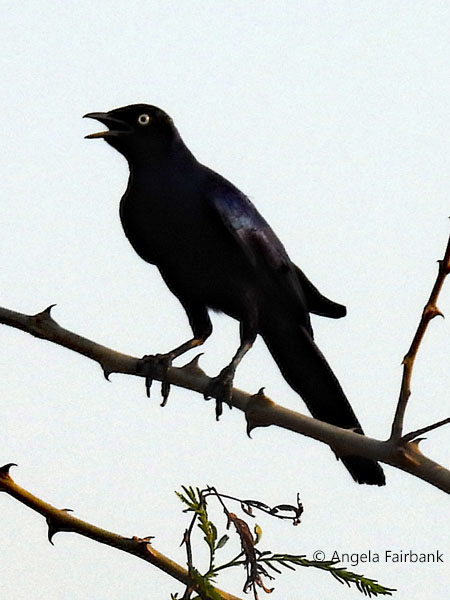     The scene of smoke-filled haze, the moos of the cattle, the bleats of the sheep and goats, the hammering of the stakes into the ground, the drumming calling the cattle in, and the cries of black kites flying overhead, was so mesmerizing, I seem to have made a number of videos and, of course, taken hundreds of photos, noticing that many of the younger children were wandering around naked, probably not because they did not own any clothing but because they felt more comfortable that way. Prepubescent girls were topless but wore pleated skirts, or just a belt of bright beads around their waist. I also photographed this Woodchat Shrike (Lanius senator) near our tents. In this area too was some kind of yellow-eyed starling, most closely resembling Rüppell's Starling (Lamprotornis purpuroptera) or perhaps a Long-tailed Glossy Starling (Lamprotornis caudatus), but it was difficult to see any bright colouring due to its position in the tree.
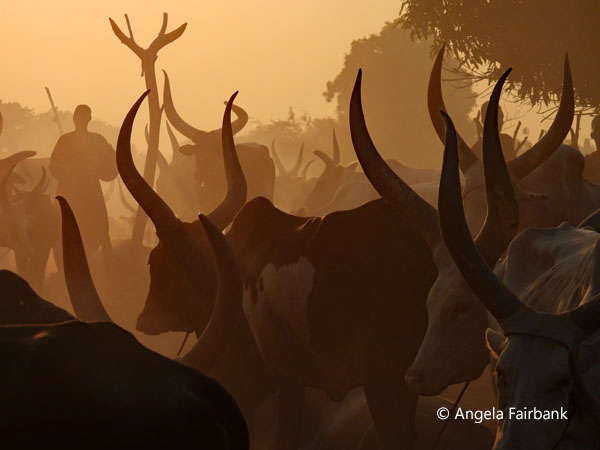 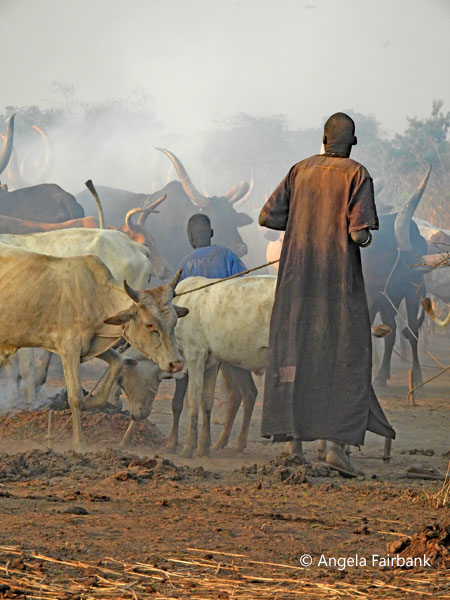   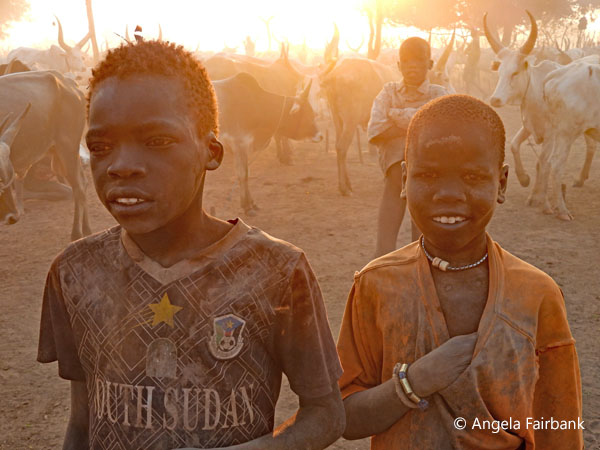  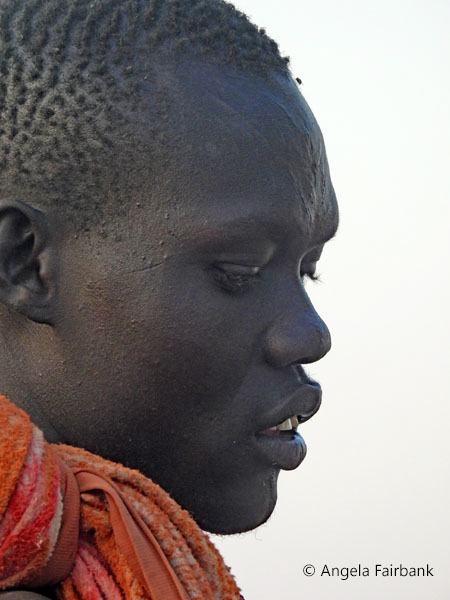        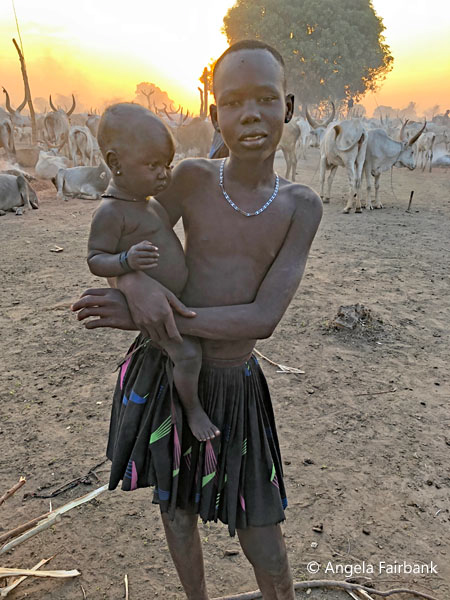 After a beautiful sunset, which also added to this special atmosphere, our dinner was prepared by our camp cook. As we ate it, we noticed hundreds of termites crawling on the tree behind us, on which was suspended a light, fed by the battery of our Toyota Cruiser. Needless to say, due to the darkness and our exhaustion from quite a stimulating day, we retired early to our tents and managed to sleep, despite a refreshing but short rain shower. Although perhaps not the most comfortable, I was warm enough.
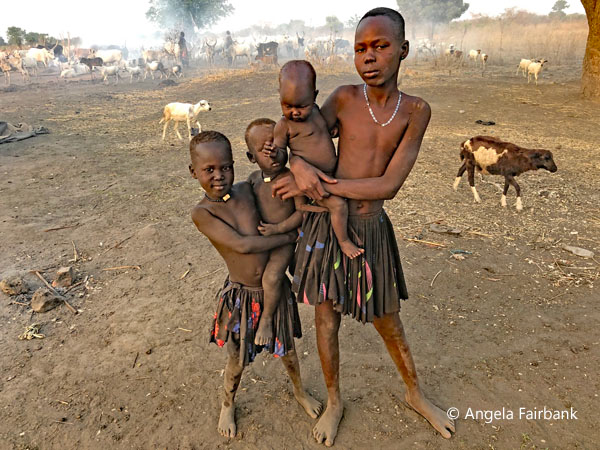    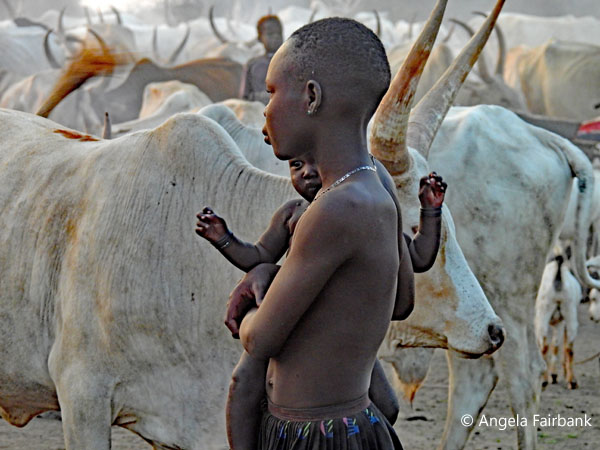  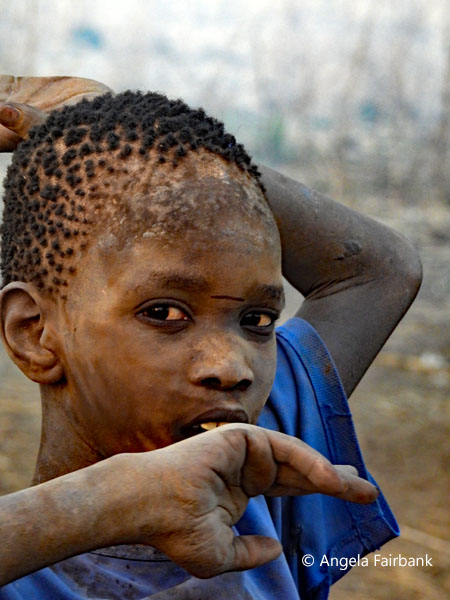  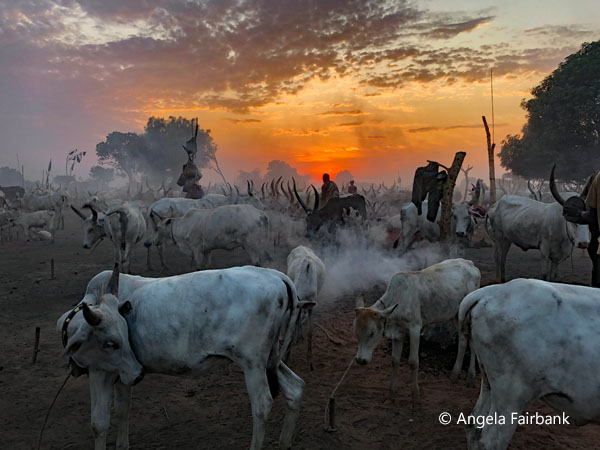 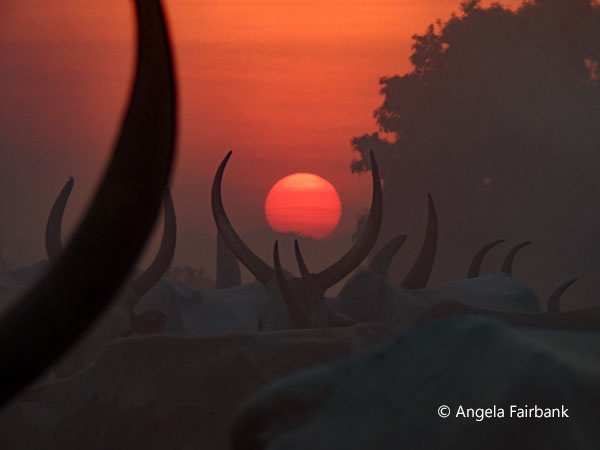 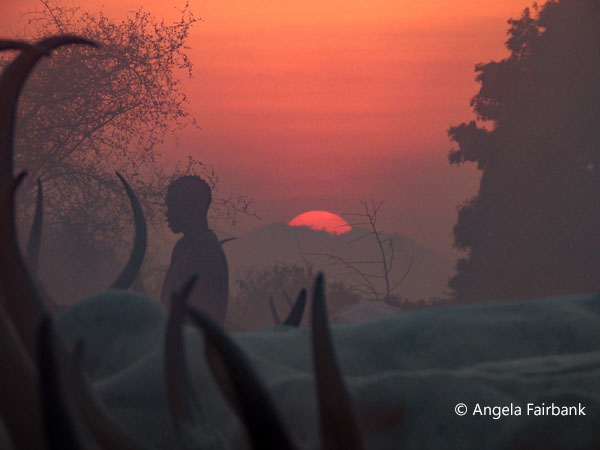    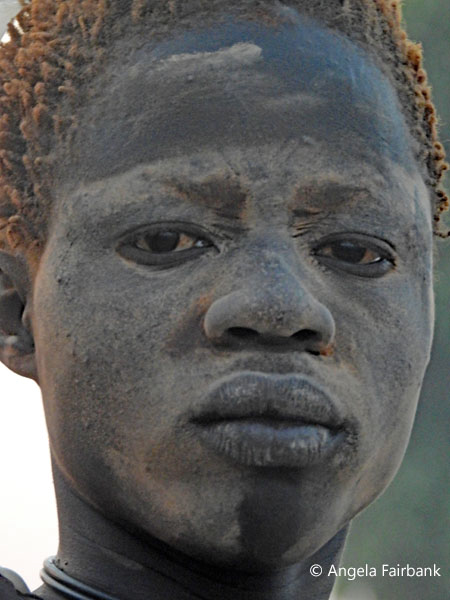   Monday, January 19: Mundari Villages - Juba, South Sudan
After waking up early to watch the sun rise, we had breakfast and then spent the morning with the Mundari, as they gathered up manure produced during the night, washed themselves by standing beneath streams of urine, collected urine in pails, or drank milk directly from cow or goat udders and collected more milk in buckets. At one instance, I phootographed one boy drinking from the teat of a cow udder while a kid goat drank from another. Then, as Black Herons (Egretta ardesiaca) and Great White Egrets (Ardea alba) flew singly and White Storks (Ciconia ciconia) flew in a V-formation overhead, male youths, preparing to take their cows our to pasture, brushed their teeth using chewing sticks made from the Salvadora persica tree, often referred to as the 'toothbrush tree.' I had also noticed our guide in Djibouti, Souheb, using one when he came to our hotel to collect us one morning, and these twigs being sold in the market in Hargeisa as well as by small boys at the Mundari Cultural Festival. I remember first seeing this natural dental cleaning stick being used in Ethiopia in 2005. 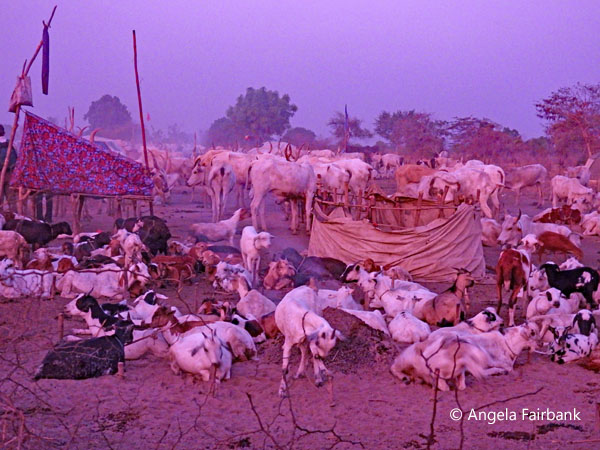 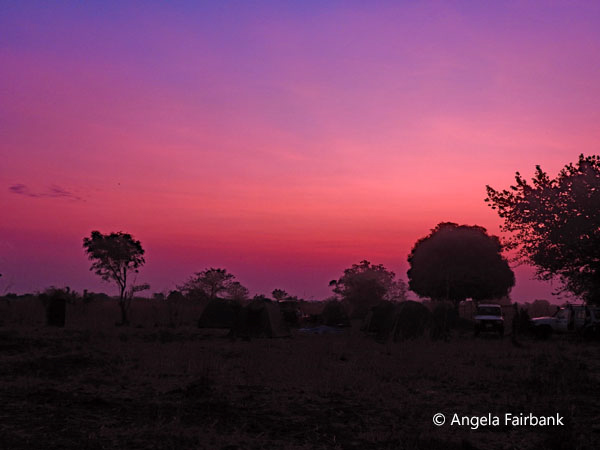  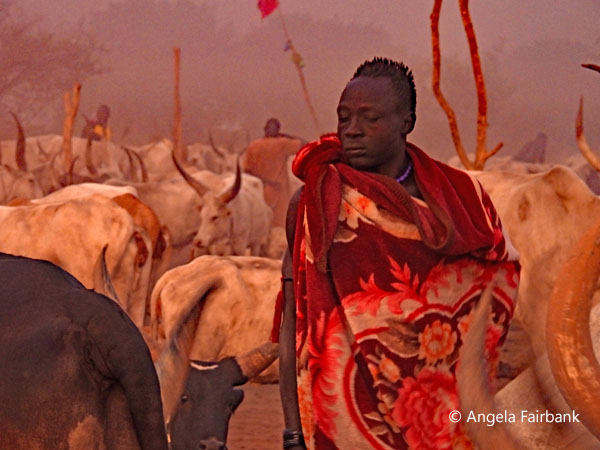  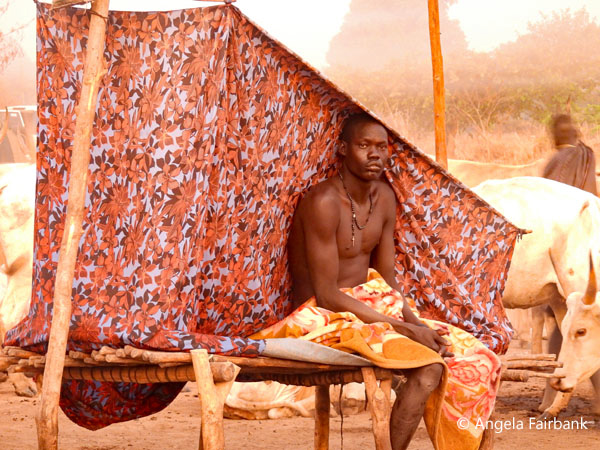   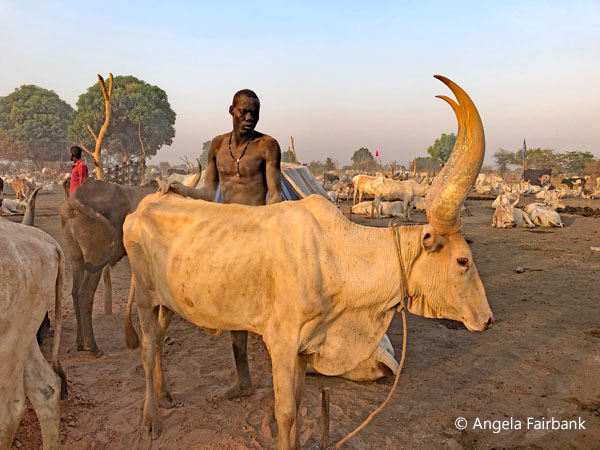 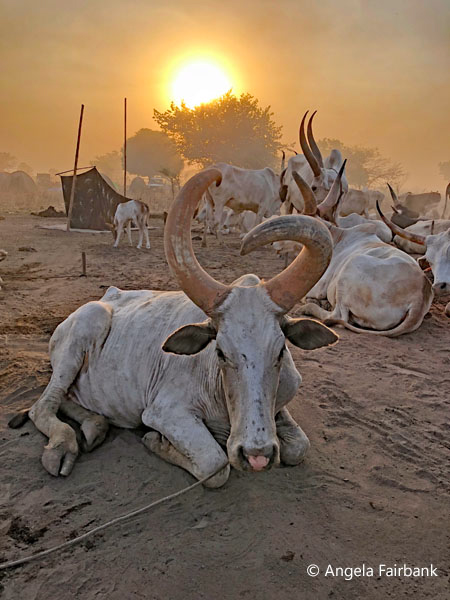  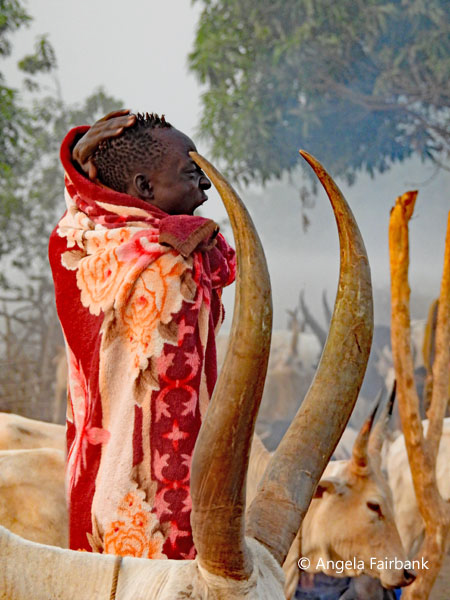 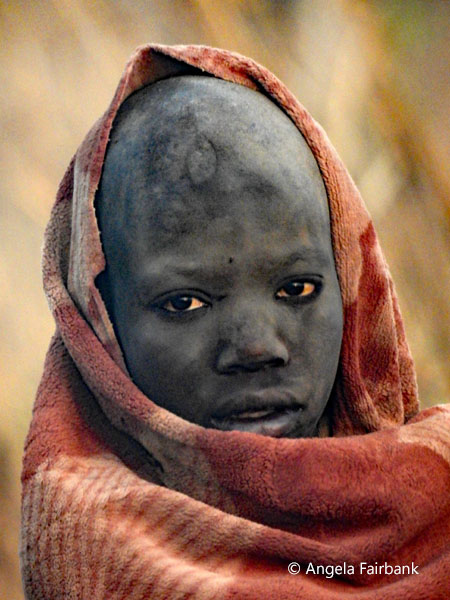   The process is this: Users cut a small, fresh branch or root, then chew on one end to fray the bark into natural, stiff bristles, creating a make-shift toothbrush. The wood is naturally antiseptic, antibacterial, and contains fluoride, which helps clean teeth, remove plaque, and freshen breath without toothpaste. The practice is a daily routine, particularly in pastoralist cattle camps along the Nile, where it is used to keep teeth white and healthy. While Salvadora persica is the most common species, other bitter, non-toxic, or astringent woods are sometimes used as well. We then watched as one young man, having finished cleaning his prize bull by rubbing its coat and shining its horns using cold manure fire ash from the ground, led it around the site, in an effort, we were told by Sebit, to impress the young ladies of marriageable age in the camp's purview. Then, having completed their morning routine, and after letting us take some final photographs of them, the young men untied the cows and bulls from their posts and led them out to the fields again. This then gave us the chance to photograph the young women who had been left behind in the camp, one of which asked us for soap, so I fished a fresh cake of soap out of my suitcase and give it to her. Did I mention these ladies were very tall?
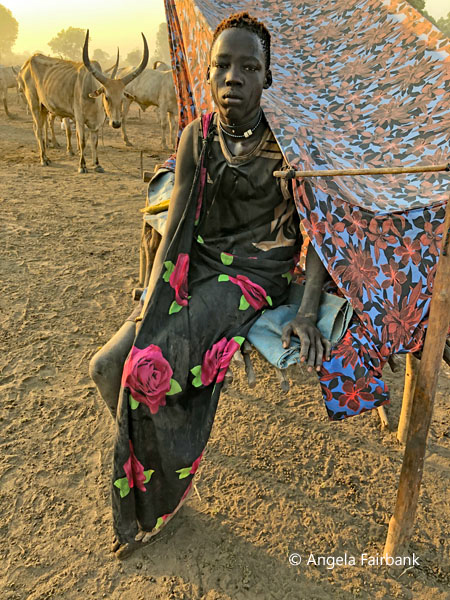   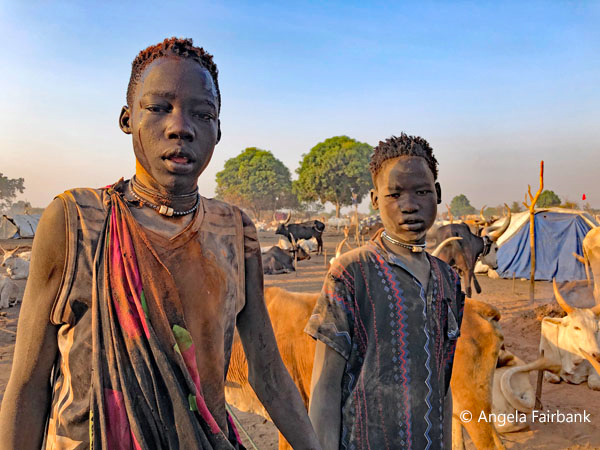 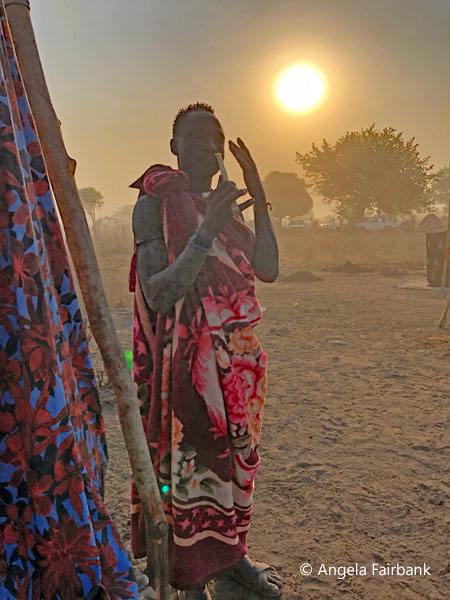   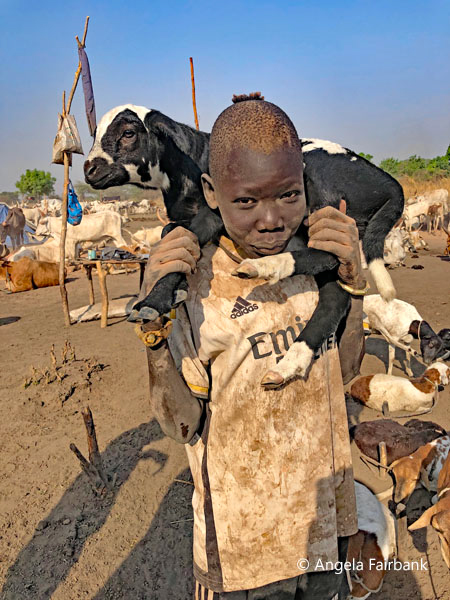  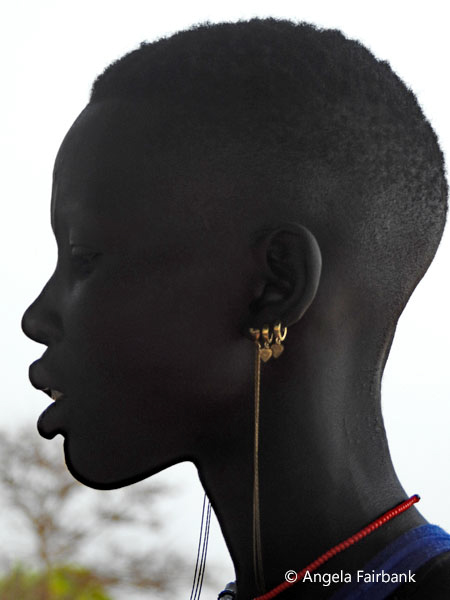    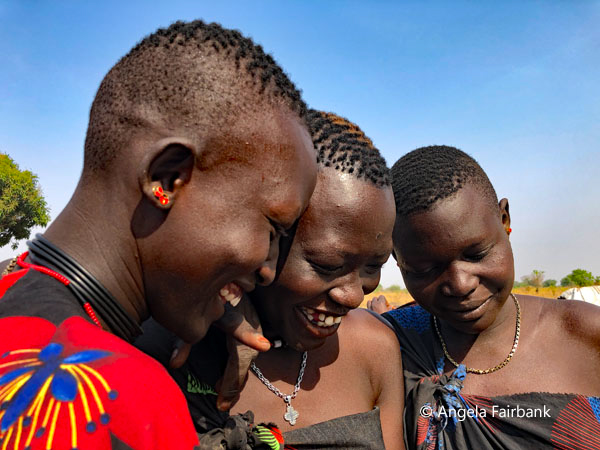  Not wishing to stay another night in tents as programmed, we grabbed the offer of returning to our hotel in Juba, checking back in, and having showers. Once we had gotten the stink of cow dung smoke out of our skin and changed clothes, we next made a visit to the handicrafts market, where I bought a fridge magnet, a bracelet, and a t-shirt. I also took a couple of photos of some of the friendly female vendors. Then I worked on my multiple photos from last night and this morning.
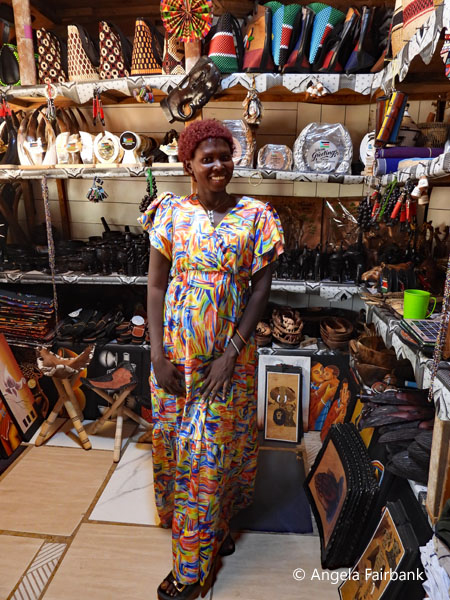  At about 3:00 p.m. after lunch at the hotel, Sebit and Nabiir took us back to the Mundari camp, where the Spanish tour group had stayed all day, to watch the cows and bulls return again, as well as a pace of donkeys, one male of which was, ahem, very excited, shall we say. After taking closer note of the variation of horns and ear markings among the cattle, and getting some more portraits of these very photogenic people, including forehead V-scarifications, heads decorated with chicken feathers, and two young boys trying to get a newly-born kid to suckle at its mother's teats, without, I might add, any help from the adults, we then returned to our hotel. I do confess that the last photo in this set was manipulated slightly by me. I photographed the flying black kite carrying a snake he had just snagged from the ground separately from the closeup of the setting sun and merged them for a better effect.
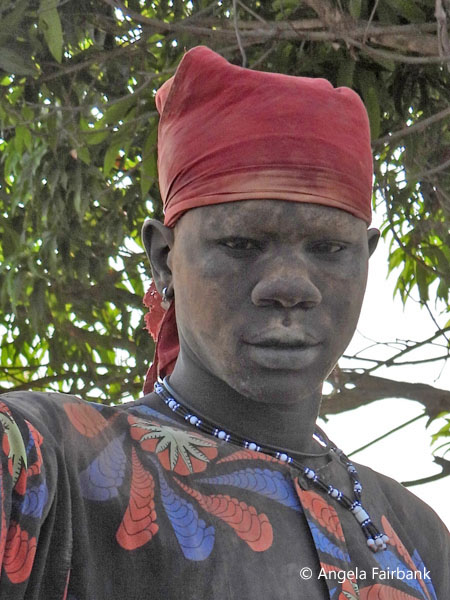   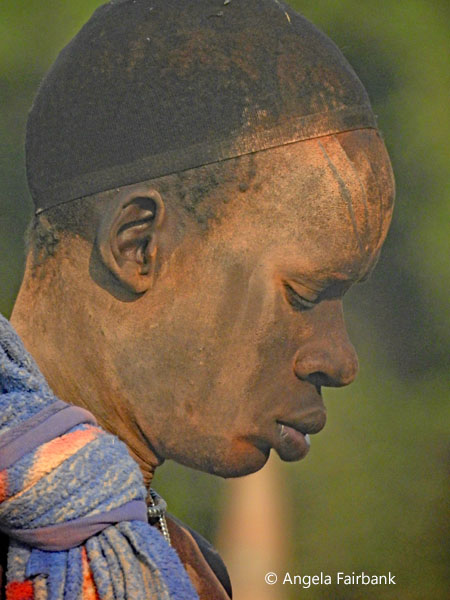 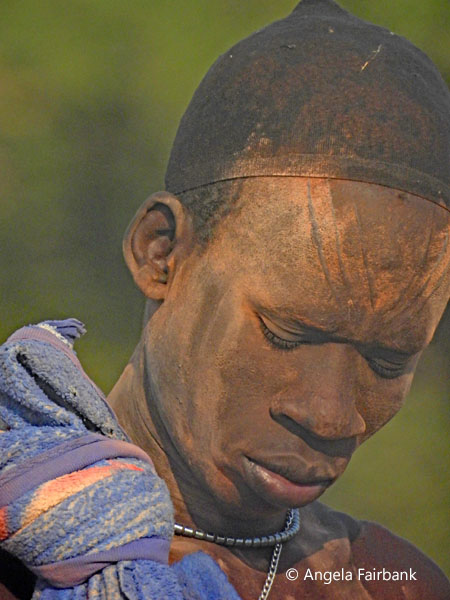 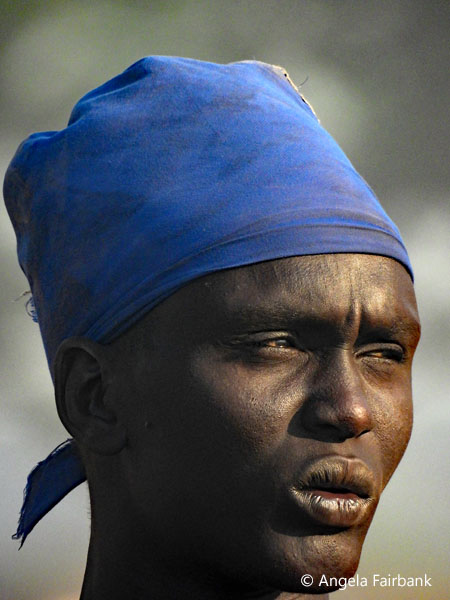 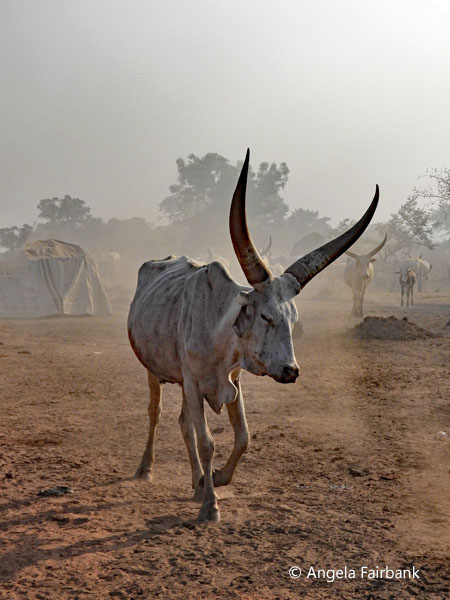   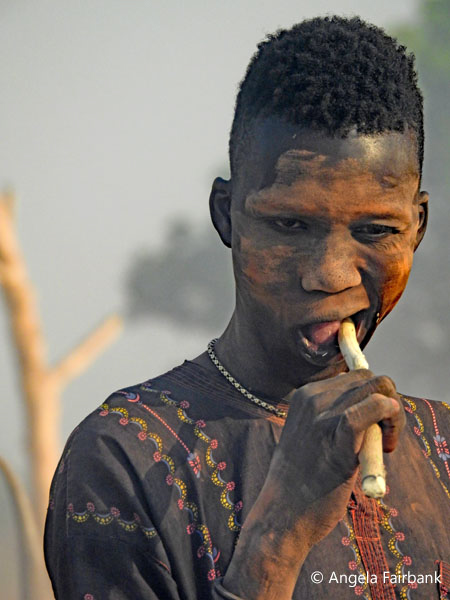      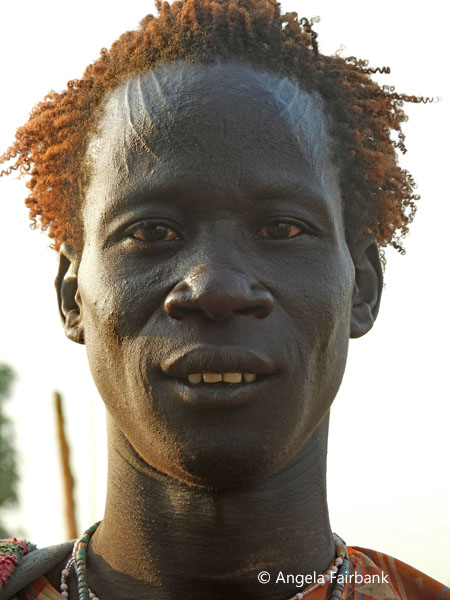 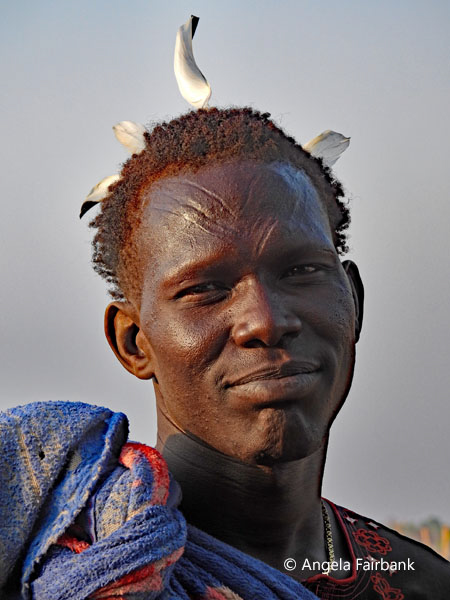 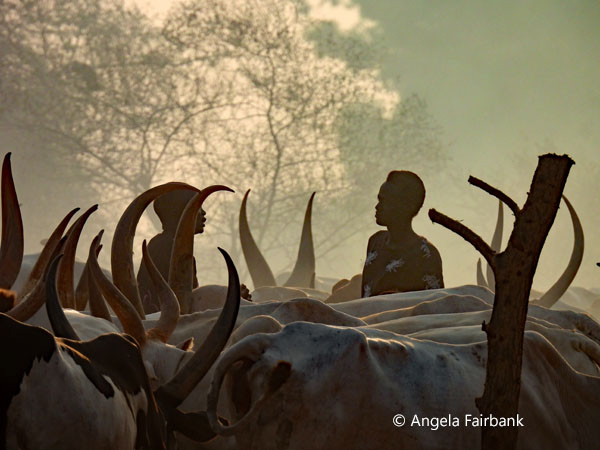  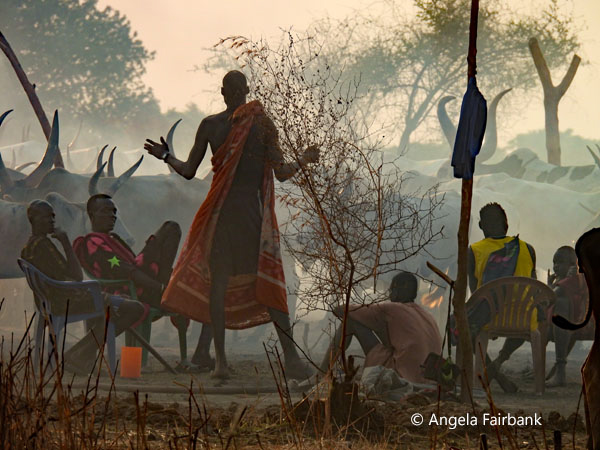 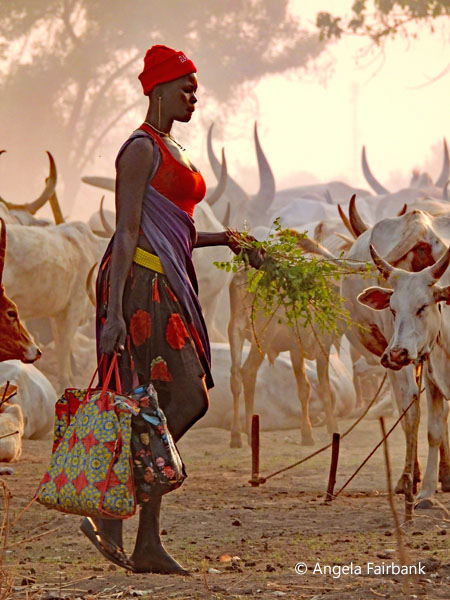       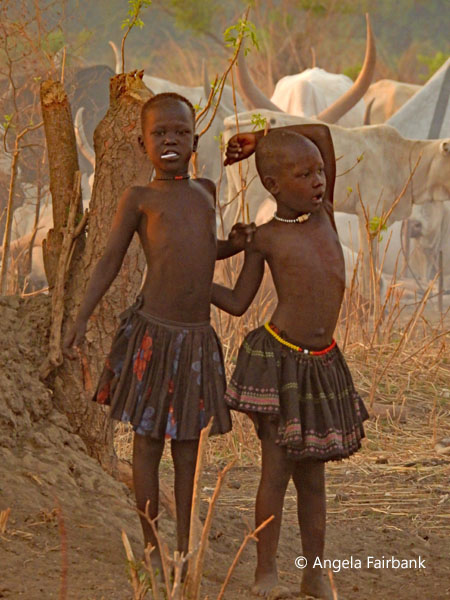 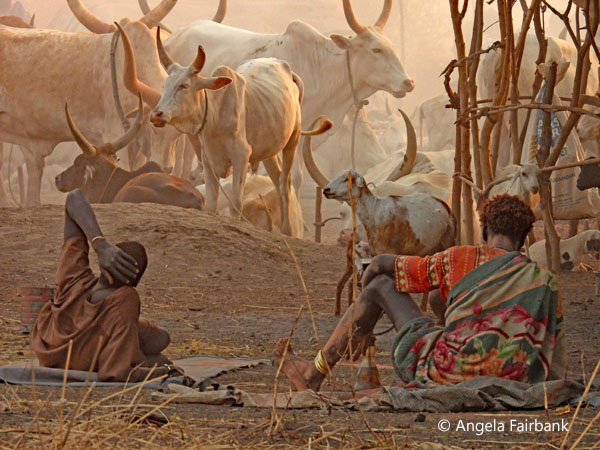 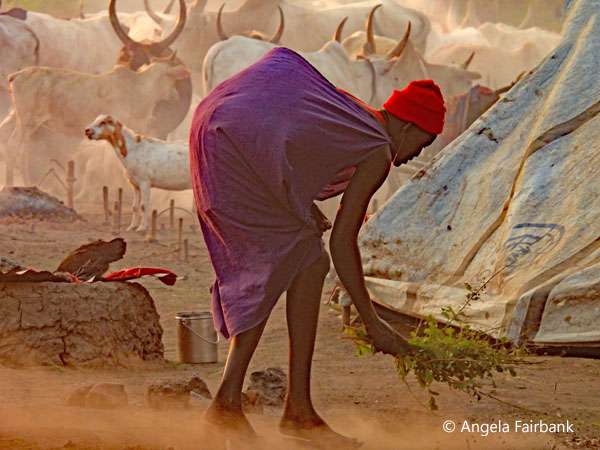 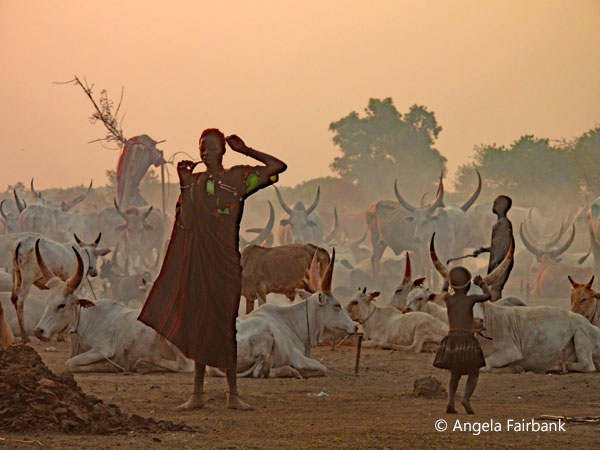        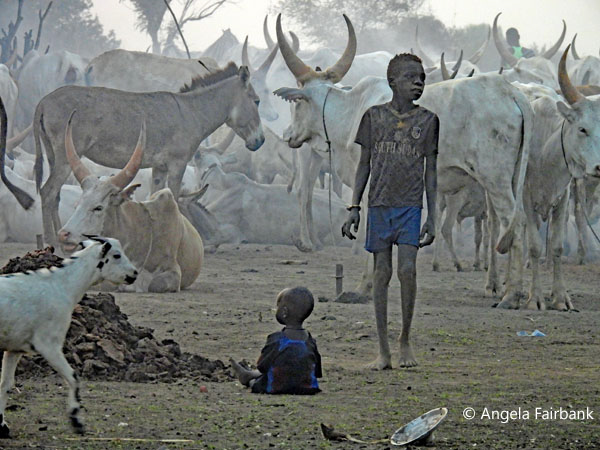 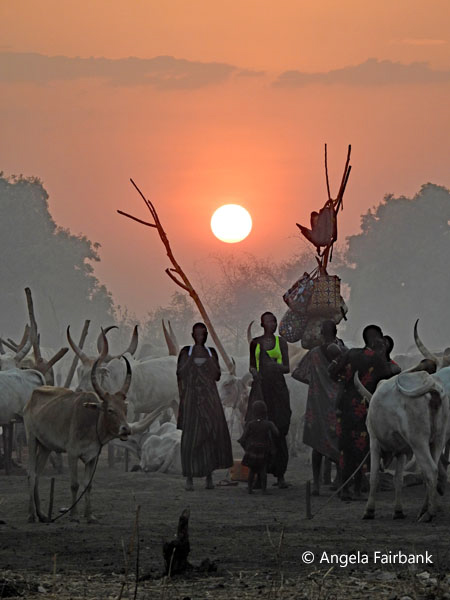 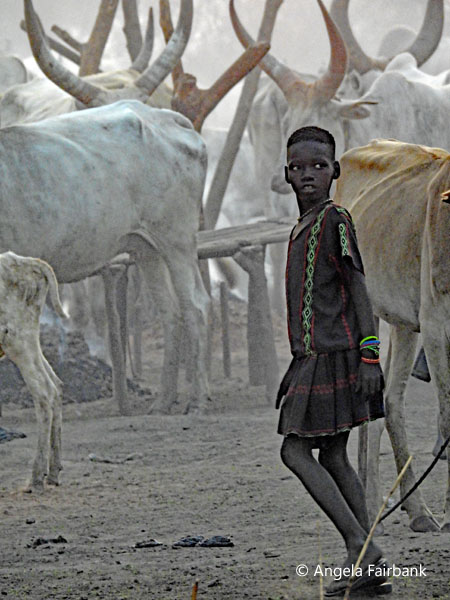 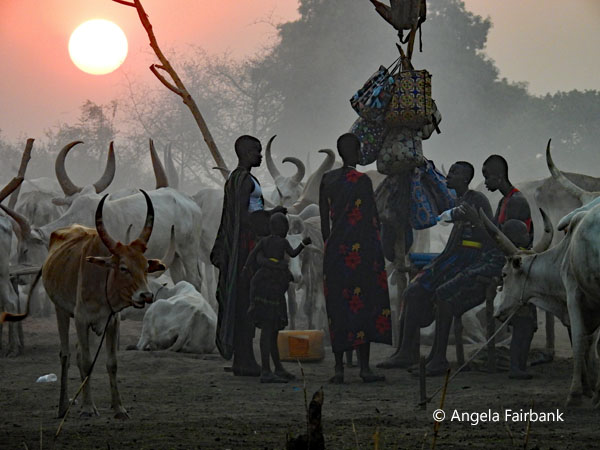 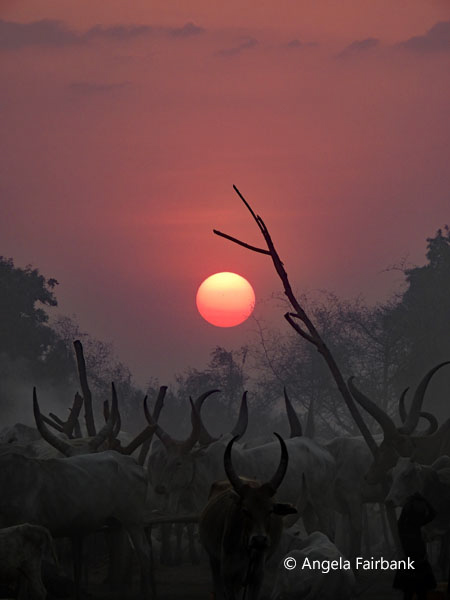 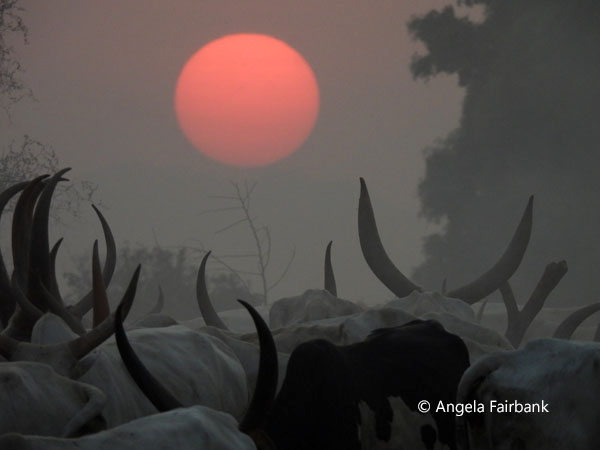  Tuesday, January 20: Juba, South Sudan
I spent today in Juba. In the morning, I went on my own with Sebit and driver Rosco to an art gallery, The Baobab Tree, where I admired a number of beautiful local paintings and met one of the artists. Sebit kindly modeled beside some of these paintings I was sorely tempted to buy, but the logistics of carrying them home, not to mention the price, made me decide not to, so I shall merely display them here so that others may admire them. The object Sebit is holding that is not a painting is actually a cow necklace made of spent bullet casings!       Our next visit was to Juba University, an English-language public university established in 1975 as the first institution of higher education in southern Sudan. The university admitted its first students in 1977, and it is now the largest and highest-ranked university in South Sudan with what Wikipedia says is circa 40,000 students. I was particularly interested in visiting its impressive, well-stocked library, around which we were guided by a young woman named Amira, who told us that the current student count was 23,000. Although many of the books were donated and many came from India, I was surprised to find a series written by the Premier of China (whom I have met, by the way), and Canadian Nursing manuals.
 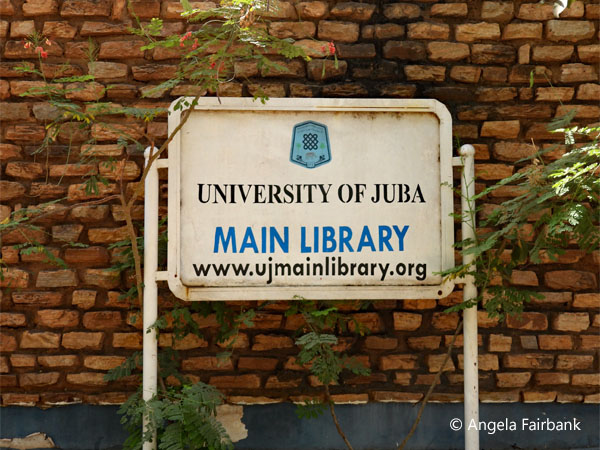  Our third stop was at Juba's fruit and vegetable market, where I had some great conversations with some of the vendors and got some superb photos. Sebit bought me a couple of mangos from the woman holding mangos in one photo. Outside the market on our way back to our van, I was greeted by a little person (whom Sebit said was a pygmy, but I am not certain about that). Seeing my big camera, she asked to have her photo taken, so of course I was delighted. I then returned to the hotel to transfer these new photos to my laptop.
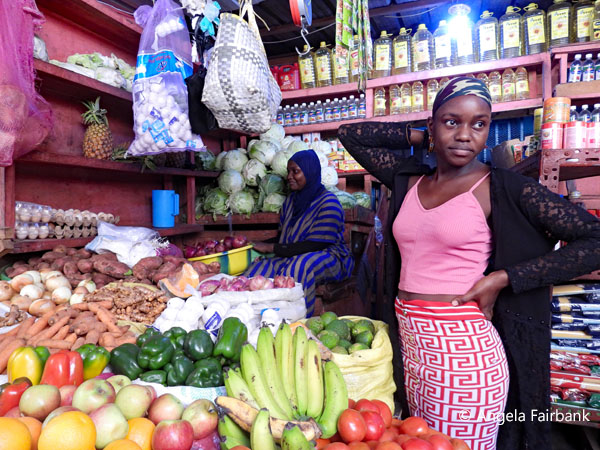      At 1:30 p.m., my fellow traveller and I were driven to another hotel on the Nile riverside for lunch. Here I photographed a Savanna Riverjack damselfly (Mesocnemis singularis). After we had finished lunch, we took a boat ride on the Nile for an hour and photographed people in mud huts (with either grass or corrugated metal roofs) on the opposite bank, who waved to us, and others who washed their clothes, themselves, or their dishes in the river, fished with rods or nets, and swam, as well as a couple of sunken ships, the usual black kites, some flying Cattle Egrets (Bubulcus ibis) in their orange-buff breeding plumage, and a nonbreeding adult Common Sandpiper (Actitis hypoleucos). The water was surprisingly clean and blue, compared to its colour downstream in Egypt, which is more of a brown. We then returned to our hotel to find out what our itinerary would be for the next few days. We learned from speaking to the Spanish group at the Mundari camp that they had flown to the Eastern most town in their tour and then driven back to Juba gradually visiting the same villages as we would on their way back to Juba. It was suggested by the tour operator that since we were doing our route in the opposite direction, it would save us time and exhaustion if we did the same, that it to say, took a plane back from our furthest destination, Kapoeta, on our last day. However, it would cost us an additional USD150 not included in our original tour price. My fellow tourist and I agreed to this, and bookings were made in our names on the one small plane offering this service that had capacity for 11 passengers. We were given the caveat that the plane, although booked, might not fly at all, or might fly later in the day, so the only option left to us (now Plan B) would be to travel back to Juba by car as originally scheduled, which could take nine hours or more. After this meeting, I worked on my photos in my hotel room. Because we had had such a late lunch, I skipped dinner and just ate some snacks from my suitcase.
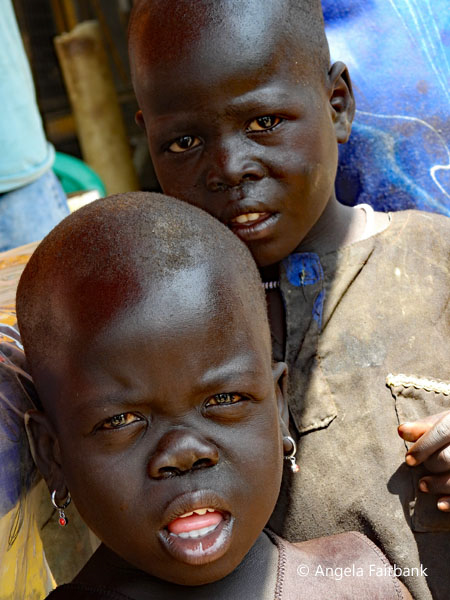 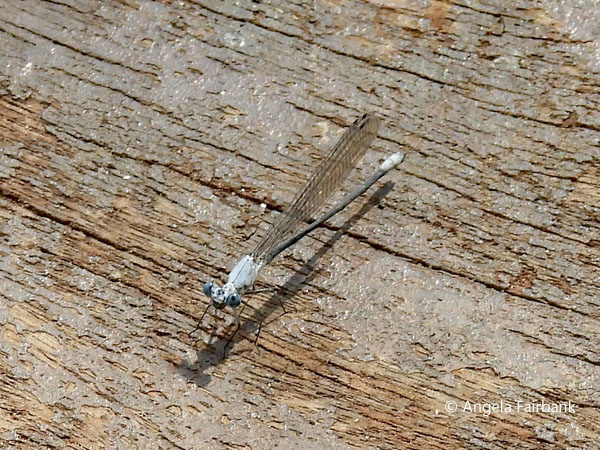 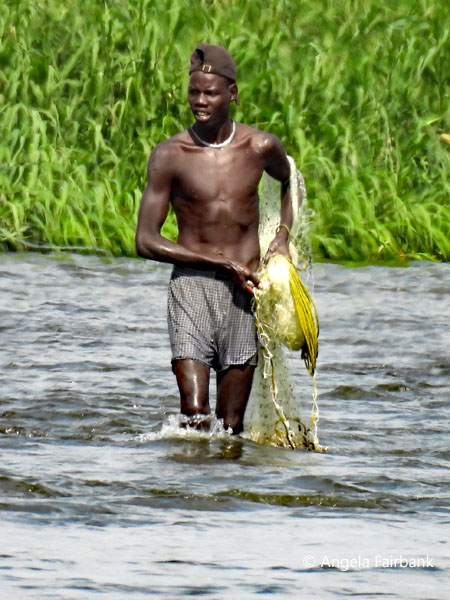 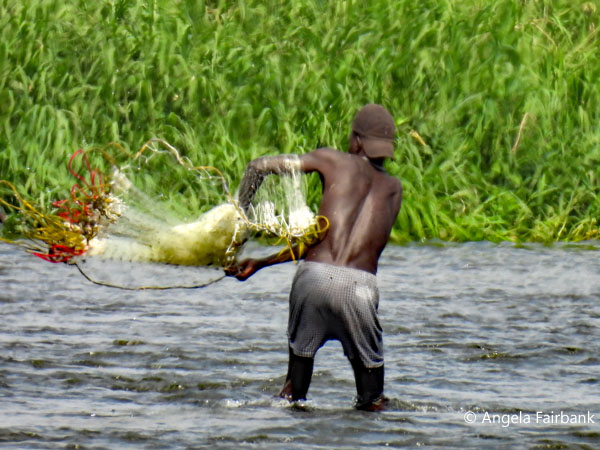   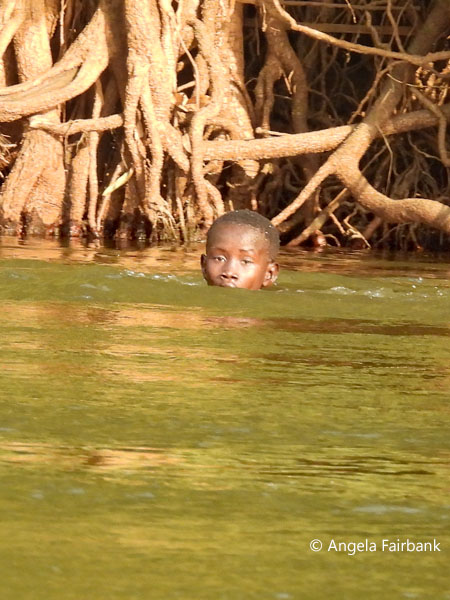  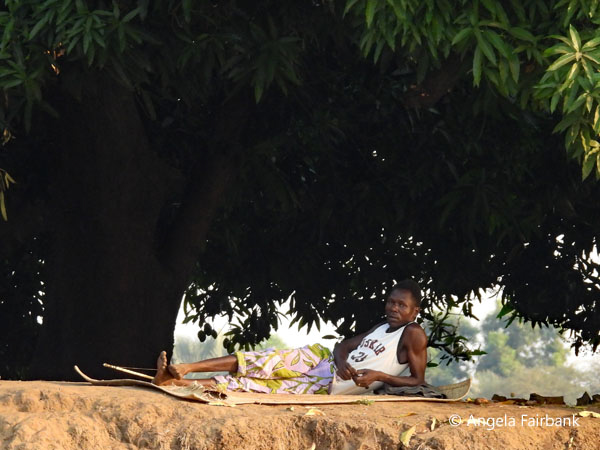  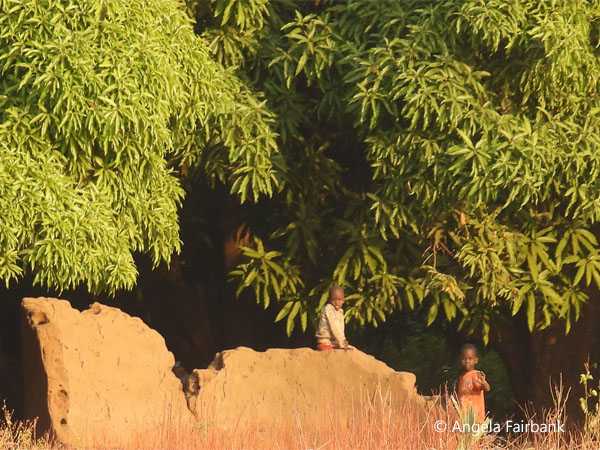 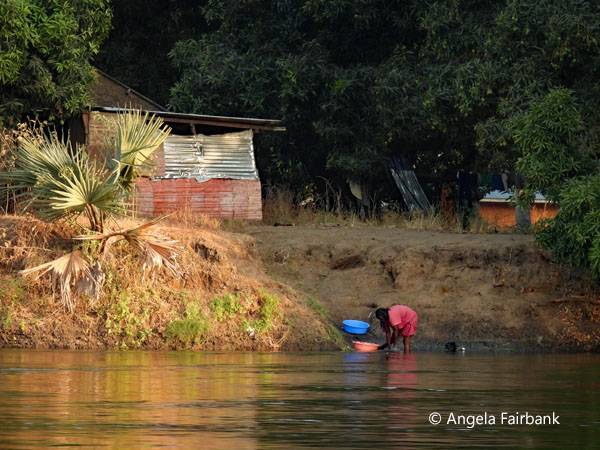   Wednesday, January 21: Juba - Torit, South Sudan
Today, after checking out of our hotel in Juba, we headed east with two Toyota Land Cruisers (one for us, driven by Ivan, and the other for our luggage, driven by Emma) through East Equatoria State to the town of Torit, approximately 150 kilometres (93 mi) east of Juba in the southeastern part of South Sudan close to the international border with the Republic of Uganda. Its claim to fame is that on August 18, 1955, the Equatoria Corps mutinied at Torit rather than be removed to Khartoum and Arab control, thus starting the First Sudanese Civil War. In 1964, the military government in Khartoum closed all the Christian mission schools in the area. We were stopped twice by police checks, and I think the first one required a bribe, while at the second one we had to surrender our passports but then a senior officer came along, enquired what the problem was, and told his subordinates to return our passports to us and send us on our way. Despite their youth, our guide and drivers were well able to handle this task, being respectful of authority yet providing all the necessary documents as required. On our way, we met a few locals, some begging for food so luckily we had a supply of bananas with us, others carrying loads on their heads, but who seemed happy to stop and have their photographs taken. Language-wise, English is the lingua franca in South Sudan and had been the language of communication when Sebit spoke with our previous drivers, Nabiir and Rosco, who, I found out later, were both originally from Uganda, but he spoke a different language with Ivan and Emma. It was pleasant sounding and I was curious to know what it was. I was surprised when they said it was Arabic. Apparently, the Sudanese and South Sudanese speak a different kind of Arabic from most Arabic-speaking countries. I looked it up and found that Sudanese Arabic is a distinct dialect, heavily influenced by local languages like Nubian, characterized by a softer pronunciation, unique vocabulary, and the absence of certain interdental consonants (like "th" and "dh"). It is part of the Egypto-Sudanic dialect group, making it similar to Egyptian Arabic, yet it retains archaic features, specialized local vocabulary, and varies significantly internally, particularly between riverine, Western, and Northern regions. In any case, as I listened to their conversations, I noticed they didn't contain the gutturals I was expecting and were not interspersed with various words that include the name of Allah (Alhamdulillah, Allahu Akbar, Inshallah, Mashallah, Bismillah, Assalamu Alaikom and others), probably because the South Sudanese are mostly Christian. I was told I could use the regular Arabic shukran for 'thank you' in general in this country, but that each tribe had its own language and therefore its own way of saying 'hello' and 'thank you.'     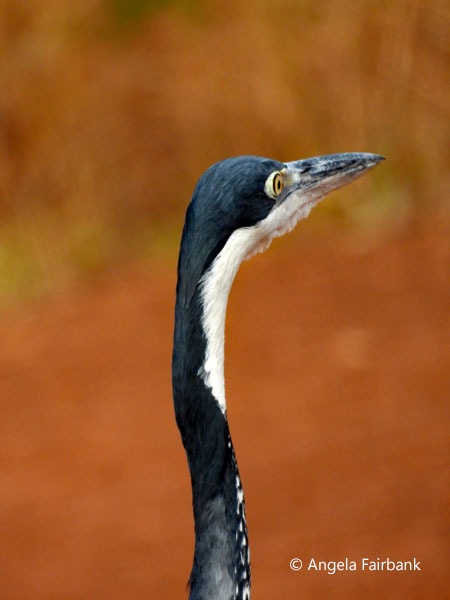  Along this route, a number of people were selling bags of charcoal, which you will see a photo of here. Apparently, in South Sudan, charcoal is a critical, booming, and largely unregulated industry driven by urban energy demand, with a sack costing roughly 10,000-45,000 SSP in 2024-2025 [at the exchange rate of January 2026, this would be equivalent to USD2 to USD9]. It serves as a vital income source for many, including soldiers and displaced persons, while also becoming a significant, often militarized, revenue stream for armed guards controlling checkpoints. The trade, which heavily contributes to deforestation, is largely dominated by local production, although it faces government efforts to curb environmental damage. At one point, we stopped for this Black-headed Heron (Ardea melanocephala) standing in the middle of the iron-rich laterite soil roadway before arriving at Hotel Torit in time for lunch. After checking into the hotel for the night and eating lunch, it was here that I saw my first Pied Crows (Corvus albus) in South Sudan, although definitely not the last. There was also a ubiquity of sparrows and Black Kites (Milvus migrans). After spending some time here to rest, we continued later in the afternoon to the territory of the Lotuko people, visiting one of their villages before returning to Torit for the night.
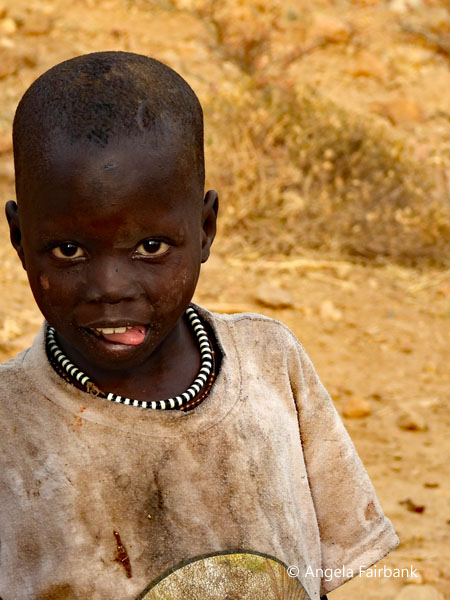 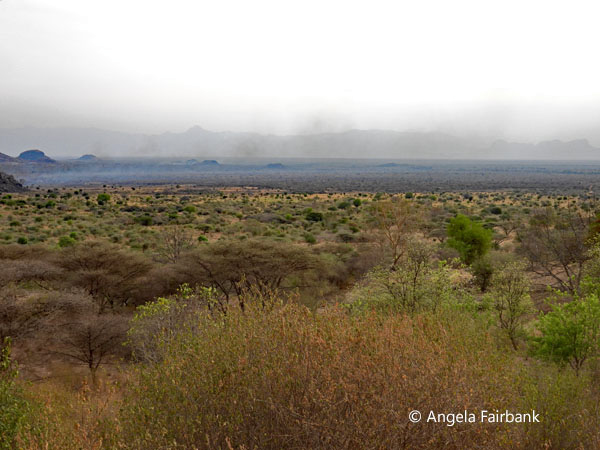  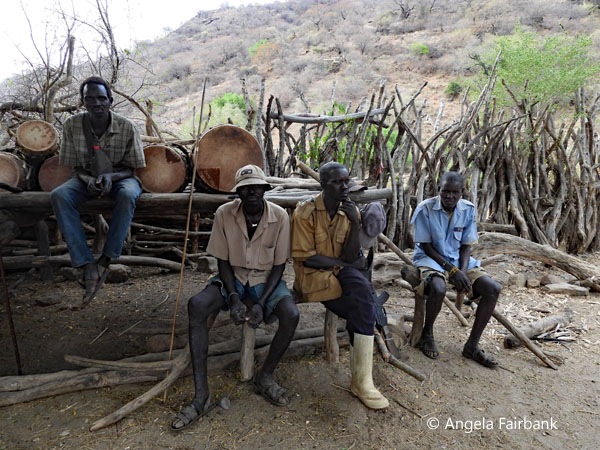 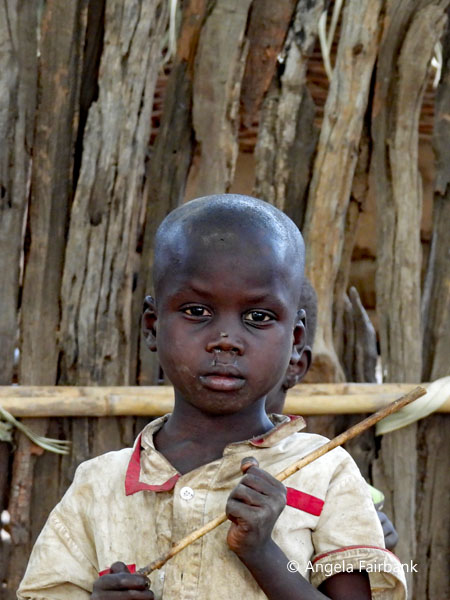  The Lotuko are the main ethnic group living around Torit. Although less traditional than some other groups, many of the Lotuko live in villages nestled in the hills and hidden among the rocks, which they moved to in order to escape the predations of the civil war--or as they explained it to us, 'the Arabs,' which I was told meant the Islam-practising Sudanese. Many of the houses are perched upon raised terraces made of stones, and the general construction and location of the villages makes them difficult to see from far away. In the past, the Lotuko were led by a rainmaker who was the spiritual head of a number of different villages, and it was his job to intercede with the spirits in order to guarantee rain and ensure a profitable harvest. The village we visited still contained the traditional stone enclosures that serve as a meeting point for the men, where problems and issues relating to communal life are discussed. Around 100,000 in number, the Lotuko have in many ways embraced modernity to a greater extent than other groups, but the attraction of visiting is to wander around their picturesque settlements, which are apparently different from the villages of the Boya or Toposa we will visit later and show a different perspective of life here in South Sudan.
  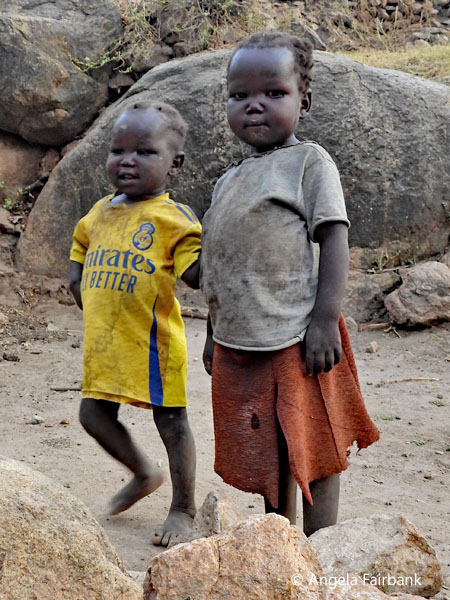    AI says the following: The Lotuko (or Otuho) people are a Nilotic ethnic group numbering over 500,000. They are traditional agro-pastoralists who cultivate sorghum and maize and raise cattle. Known for resisting outside religious influence, they maintain a traditional belief system centred on a nature-based deity named Ajok, a creator spirit believed to be benevolent, but who stopped bringing people back to life after a dispute over resurrection. A unique tradition involves marriage by kidnapping, where a man kidnaps the woman he wishes to marry, followed by negotiation with her father. They have a strong oral tradition and social structure with a focus on community ownership of land. Historically, they have navigated relations with neighbouring groups, occasionally engaging in conflicts over resources but also seeking peaceful co-existence. The Lotuko continue to retain their cultural identity, with their society deeply rooted in their traditional beliefs and practices.
      The village we visited was reached by a longish route after turning left off the laterite highway. Vacating our Land Rover, we then climbed in our running shoes over large rocks and along a path regularly used by women and children carrying containers of water on their heads, and such a group, we later realized, happened to be following us. We were greeted in glee by flocks of children, who were shy at first, but like most children, warmed up to us and approached closer and closer. I couldn't count their number there were so many. They were for the most part clothed in clean but well-worn t-shirts and shorts, and I noticed a small group of women washing clothes in a small patch of rocks with indentations for water--the local laundry if you will. With our local guides, one walking with a single crutch, we were brought first to a group of men, with whom we shook hands and introduced ourselves. One of them was fashioning rat traps from the strings of bows. Yes, they eat rats here. After learning that mong meant 'hello' and ngai meant 'thank you,' we walked uphill to another layer of huts to meet the so-called queen of the village, a blind, 66-year-old woman, who, we were told, had special powers. I managed to find out her age by introducing myself through an interpreter and telling her mine. We climbed up a couple of further levels, meeting more children, and finally arrived at a large area where eventually a drum was brought out and women arrived in traditional dress and beaded jewelry over their normal clothing. The men took off their shirts, and covering their bare arms, chests, and backs in a white powder, began dancing together with the women and several children. One woman sought me out and danced with me, twirling me around with her hand on my head. After they had finished dancing, I took a photo with the entire troop. In this same entertainment area, I saw this Red-headed Rock Agama (Agama agama), the only lizard-type creature I have seen on my trip so far.
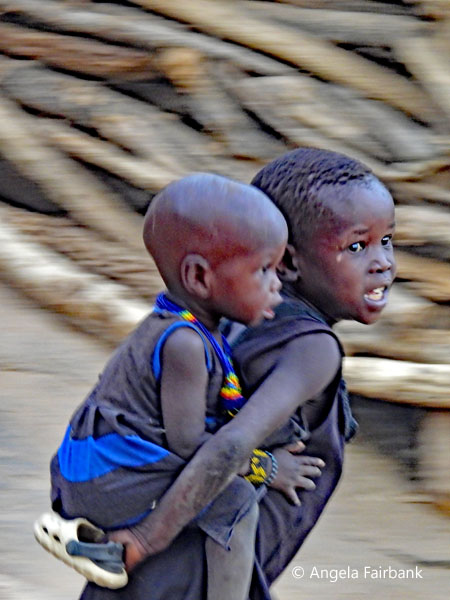    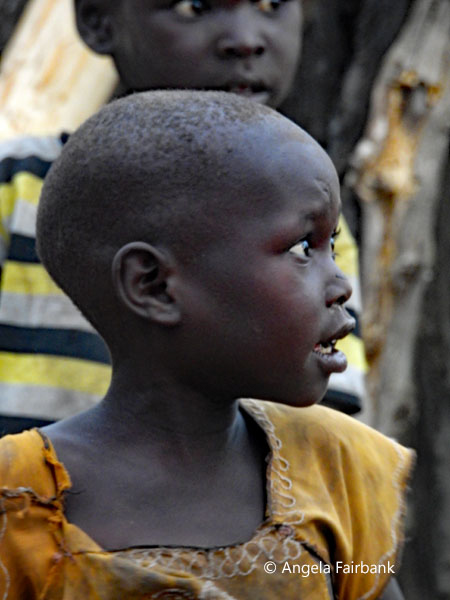 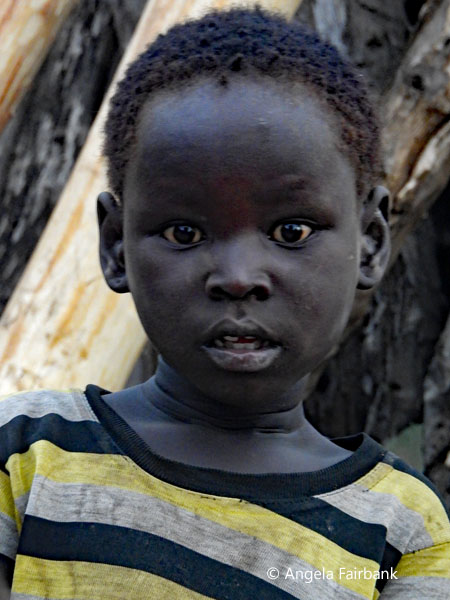 Because the sun started setting and we had a ways to go to descend the mountainside, we sent off down on foot again with our local guides and Sebit, arriving at our vehicle in the pre-dusk. On our drive back to our hotel, we briefly spied an owl on the roadway but of course it was too dark to photograph, let alone identify.
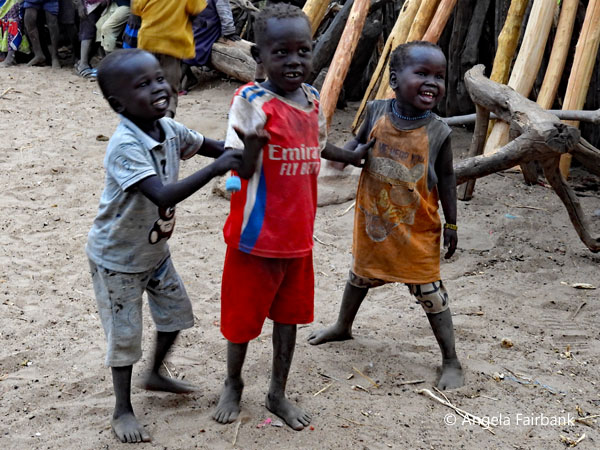   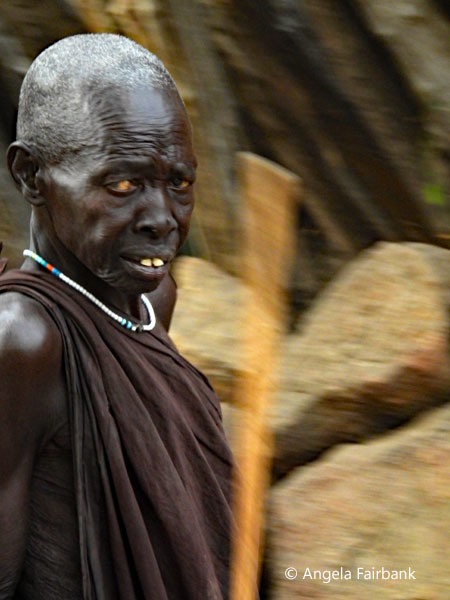 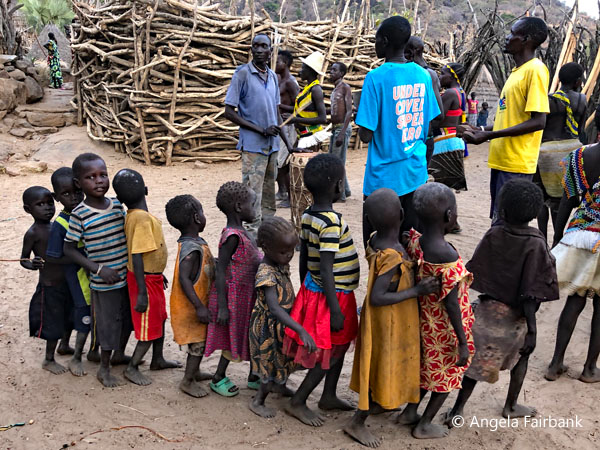 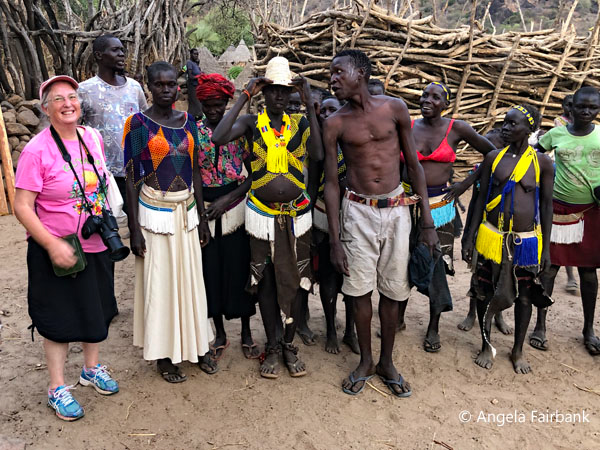 Thursday, January 22: Torit - Boya villages - Kapoeta, South Sudan
Leaving Torit, passing one area of moving water containing Hamerkop (Scopus umbretta), and Marabou Stork (Leptoptilos crumenifer), as well as multiple groups of people in tribal clothing carrying various items, such as bags, hut roof material, and long tree trunks, often accompanied by goats, against a backdrop of tall termite hills, we veered off into the bush at the roadside settlement of Camp 15 to explore a village belonging to the Boya people, located amongst rocky hills.    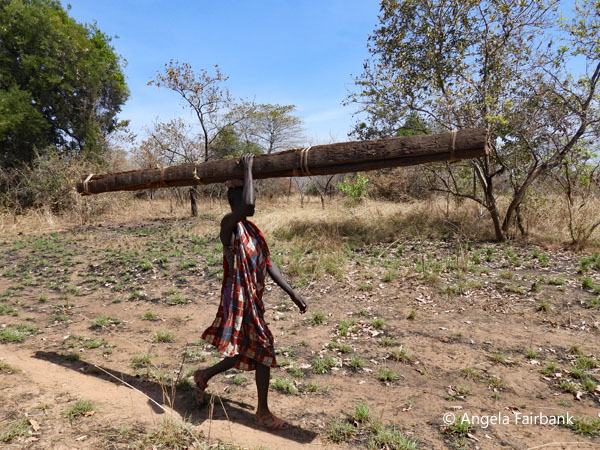 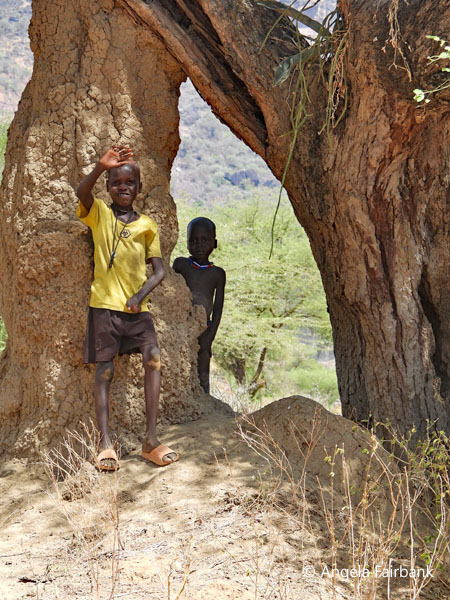  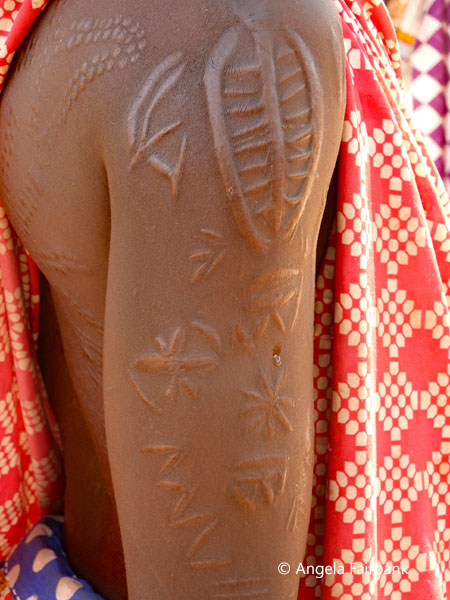  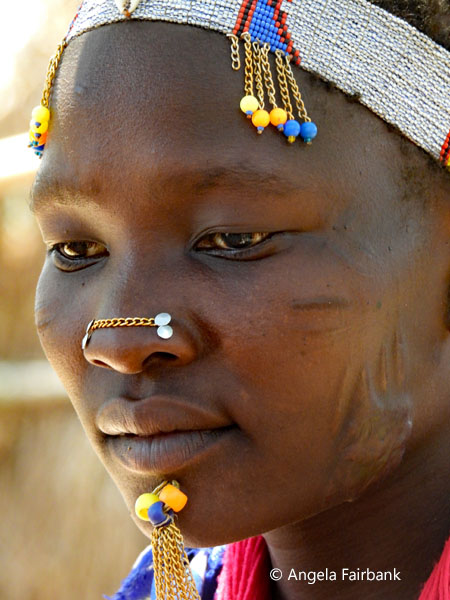 The Boya are a Surmic agro-pastoralist ethnic group of 20,000-25,000 people in South Sudan's Eastern Equatoria state living east of the town of Torit, centred around a small and rather ramshackle settlement with the unpoetic name of Camp 15. Living in pretty villages in the shadow of mountains and gigantic boulders, the Boya are known for their small, fortified houses with small doors for protection and their adornment of intricate beadwork. Although scarification is practised here to signify beauty and identity, interestingly, it is more prevalent among the younger women than the older ones, and the local explanation is that they are copying a trend from the Toposa, one of their near neighbours. Traditional mourning dress for Boya women involves wearing animal skins around their waists and binding their legs and arms with thin leaves to make a striped pattern. Like in many other African countries I have visited, when a husband dies, a Boya woman becomes the property and responsibility of his closest male relative. The Boya are also hunters, and it is not uncommon to see groups of children practising with bows and arrows.
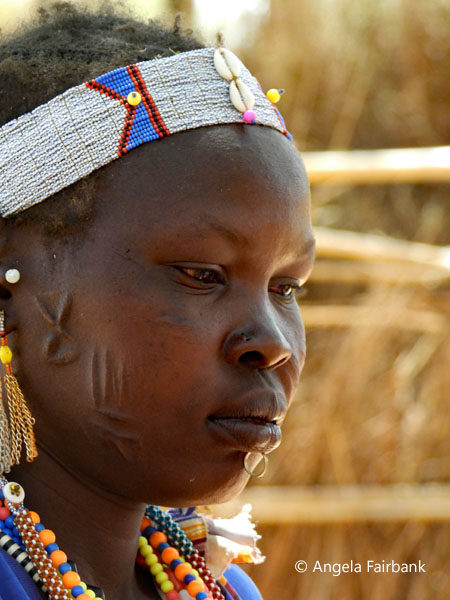    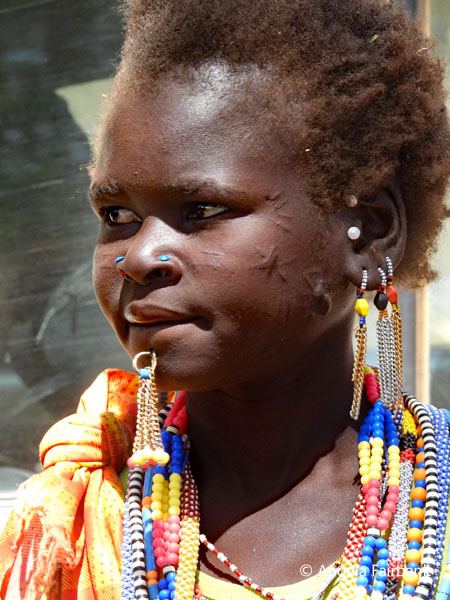  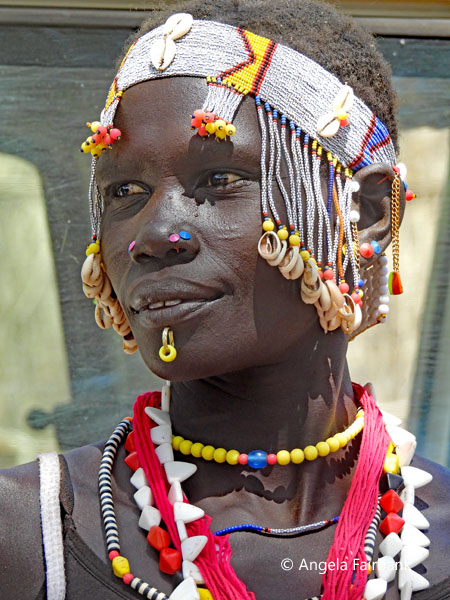   Just like yesterday, we were greeted by crowds of friendly children, some of the youngest ones completely naked, others carrying younger siblings on their backs ... and then a dozen or more young women and teenagers in beaded jewelry, including arm bands and head bands, necklaces, earrings, and belts, colourful pleated skirts, multiple lower-leg bracelets and, in some cases, tall socks. A few of them were carrying decorated sticks that reminded me somewhat of those used to play lacrosse. But more particularly they were posing for photographs because they too were known for the scarification on their faces (cheeks and foreheads) and bodies.
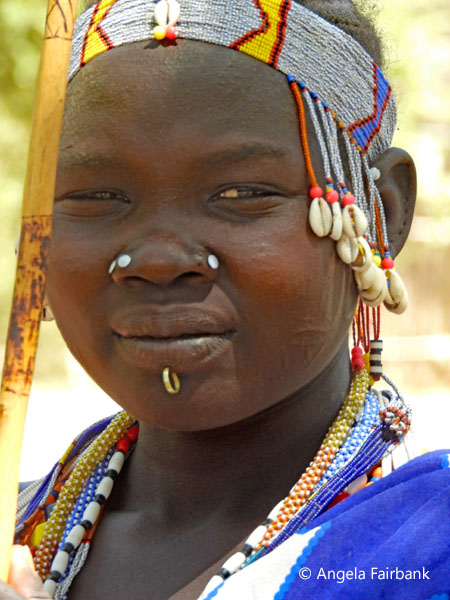 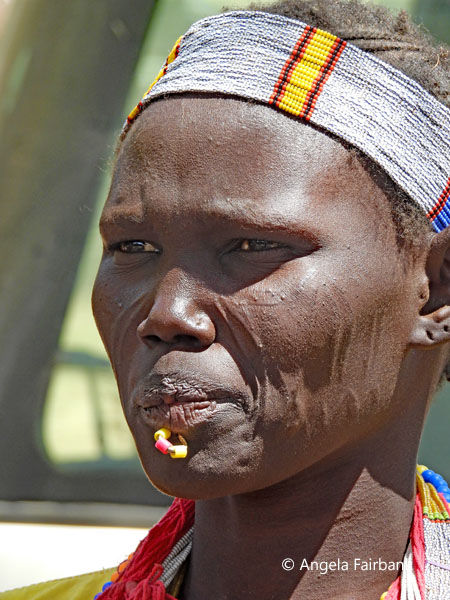 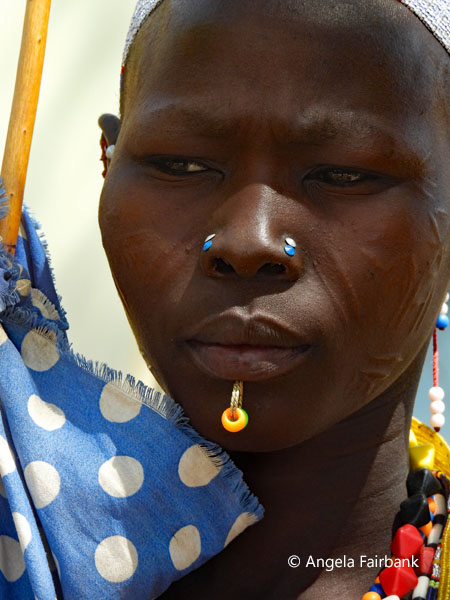  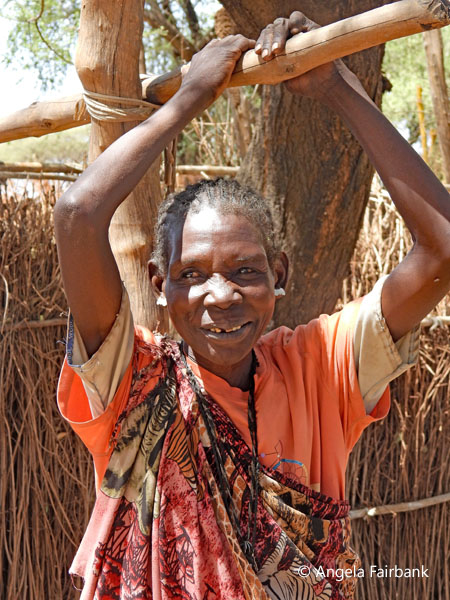 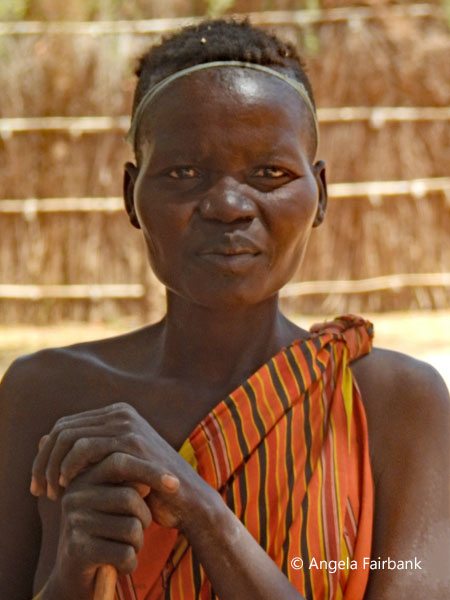    We were next provided with some dancing entertainment by these girls and women, and I danced with one older woman (perhaps she was the same age as me), which consisted to twisting our bodies and moving our elbows towards each others', which Ivan kindly thought to record on his phone and send to me later. After the dancing, we wandered through the village and admired their unique houses made of interwoven sticks and unusually shaped roofs of straw, which forced people to duck in order to enter, and decorated with large snail shells. We were amused to see upside-down ceramic bowls or empty plastic water bottles stuck on the tops of the roofs along with rings, no doubt to keep the rain out. Two pre-pubescent girls accompanied us around the village and posed in front of various structures for photographs as if they were used to doing so. One of them showed me her lack of front middle bottom teeth. Apparently, teeth removal (known as ablation) is a traditional practice found among several tribes in South Sudan and is a significant cultural, aesthetic, and initiation rite, typically involving the extraction of lower incisors and sometimes canines, usually performed during childhood or around the age of puberty.
 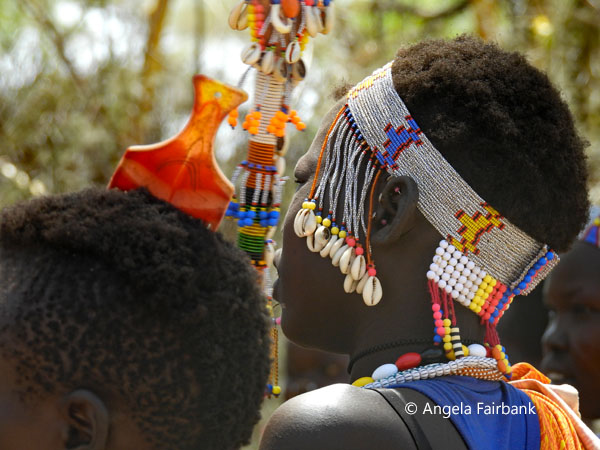 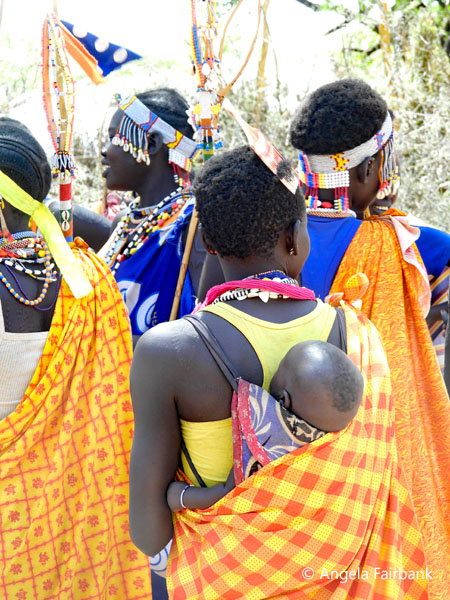 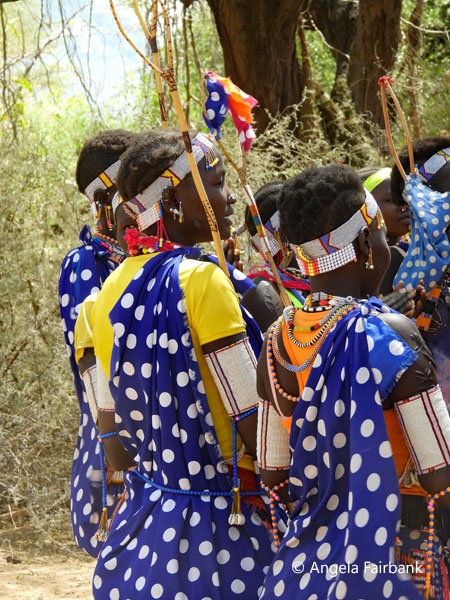   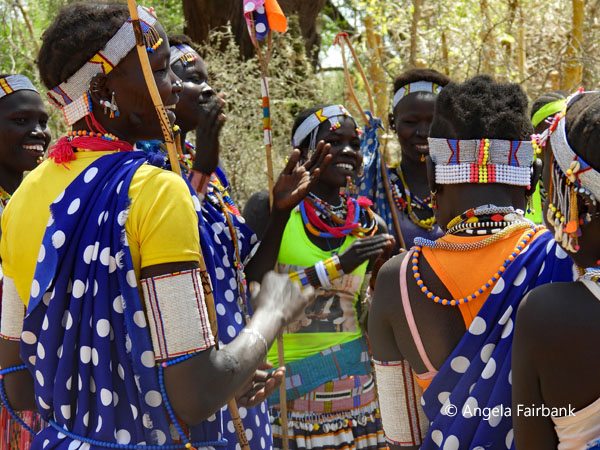   Looking up this practice later, I found the following additional information. Among the Dinka and Nuer, the lower six anterior teeth are often extracted. The Bari tribe also engages in this practice for both men and women as part of initiation. The extraction is usually done using tools such as fishhooks, metal wire, iron spikes, or knives. It serves as a sign of maturity and adulthood and is a required step for marriage. The removal is a tribal identifier, with a belief that not removing the teeth makes the lower jaw look unattractive. In some cases, it is falsely believed that removing teeth prevents illnesses such as diarrhea. The procedure is frequently performed by traditional healers without anesthesia or sterilization, leading to risks such as severe pain, excessive bleeding, infection and, in some cases, death. While the practice is decreasing in some areas due to education, it remains present in rural areas. Some state authorities in South Sudan have taken steps to ban this practice due to the health risks. Many, particularly those who have left for the diaspora, seek to have their teeth restored.
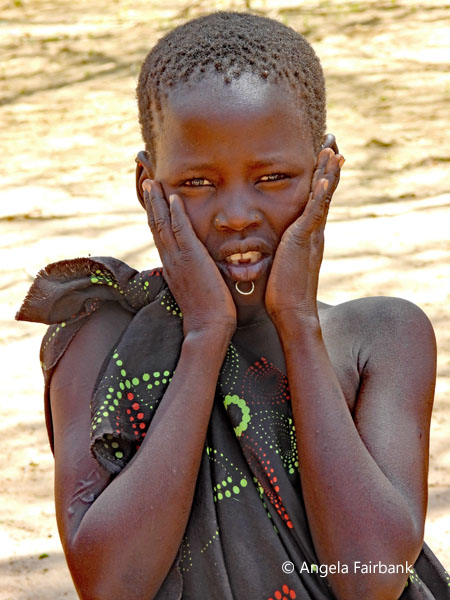 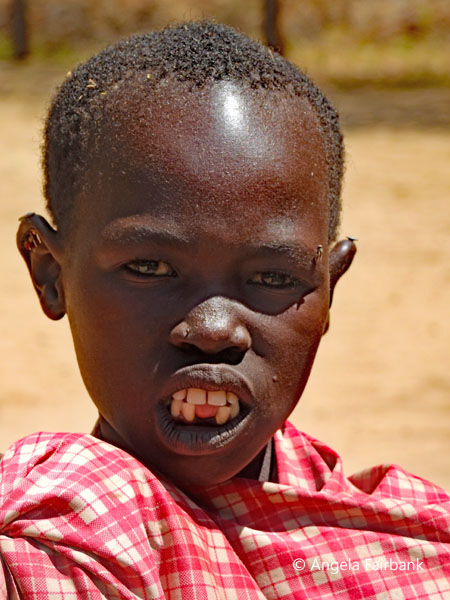 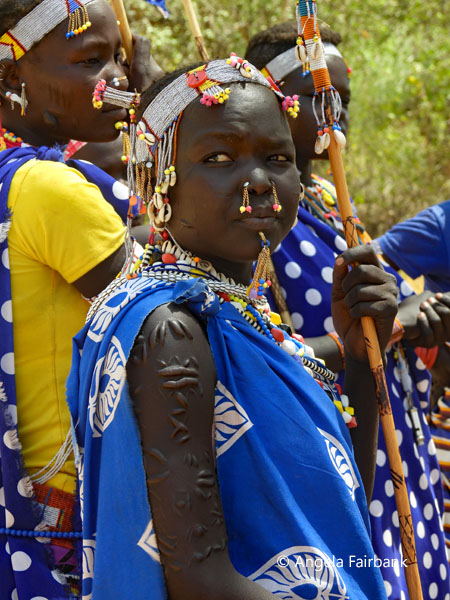   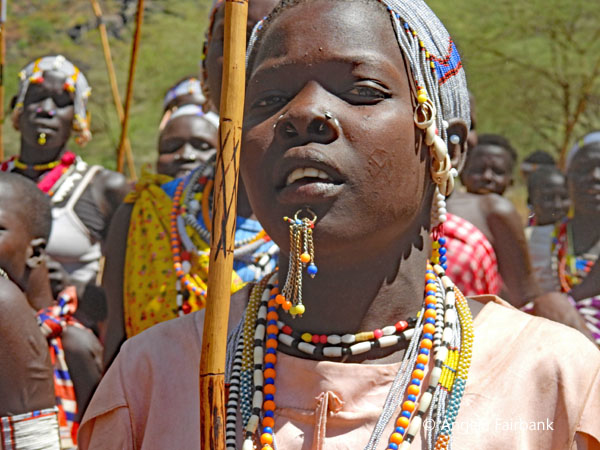 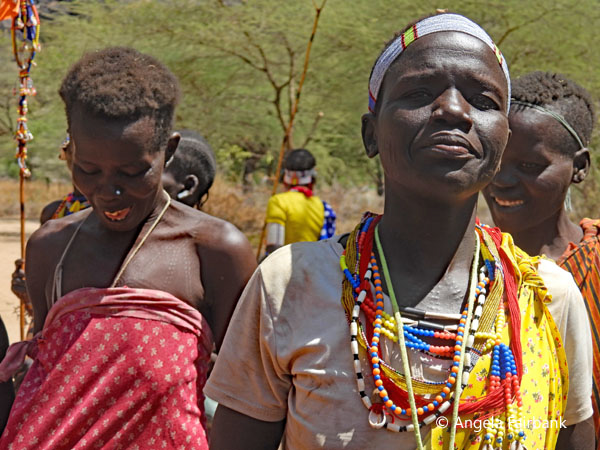 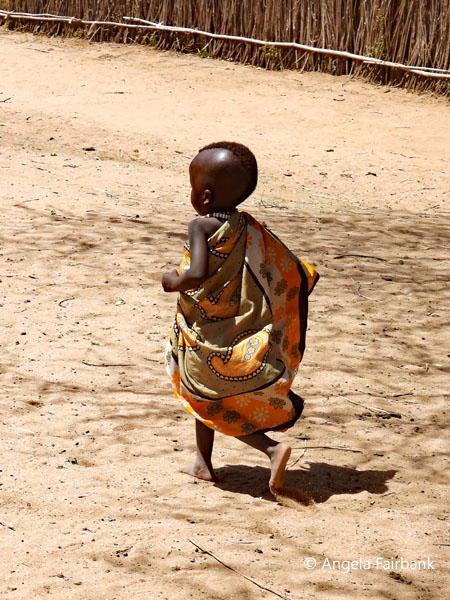 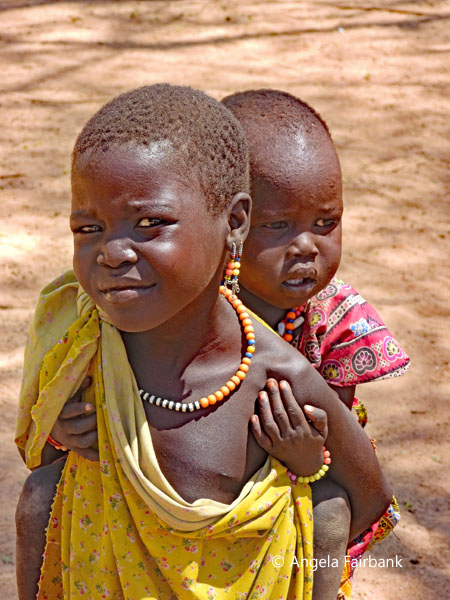 Noticing against one house stacked bundles of sticks and roof material that I had been seeing women and children carrying on the road, I asked Sebit to help me mount one on my head so I could get an idea of their weight. I was able to balance it and did not find it too heavy for the few seconds it remained atop my head. I was curious to know which was heavier to carry on one's head--this or a container full of water. It was thought by our village guide that the container of water would be heavier. The last group of little boys who followed me back to the cars were anxious to show me their English skills, asking how I was, my name, where I was from, and then counting up to 10, and with my encouragement up to thirty. They missed a few numbers on the way, but their enthusiasm was infectious. I believe Sebit told me there are few schools for them, so I suppose it's possible an English-speaking tourist taught them at one stage.
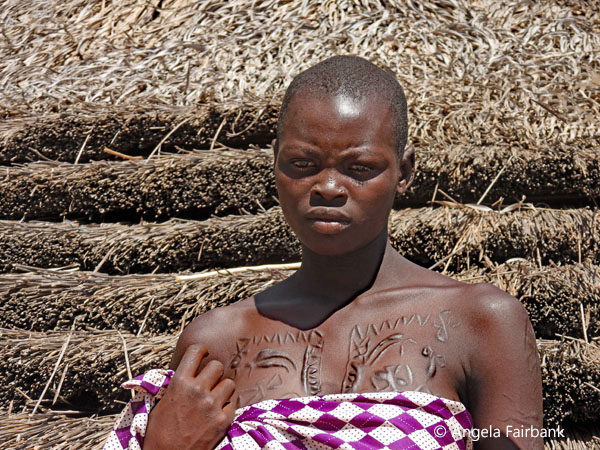 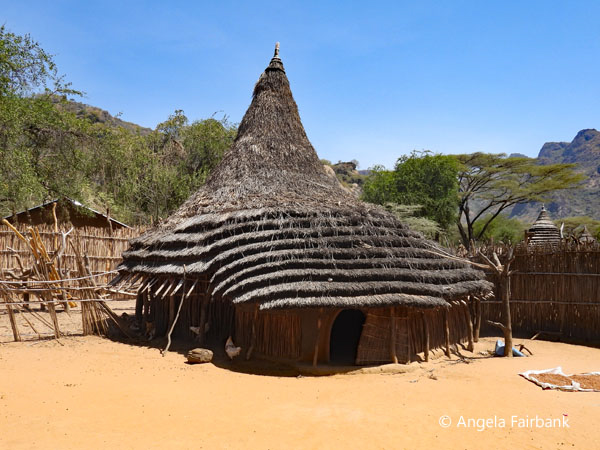     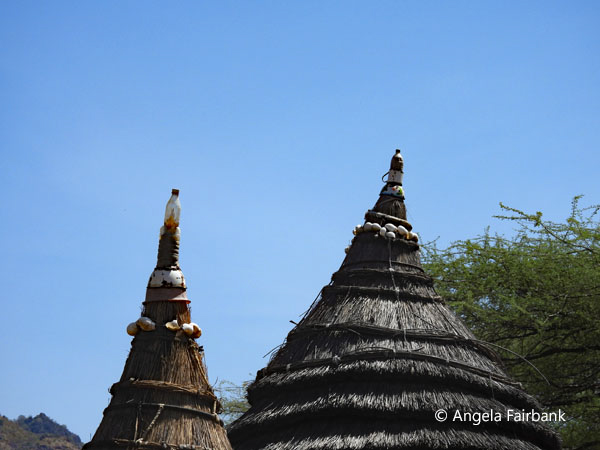  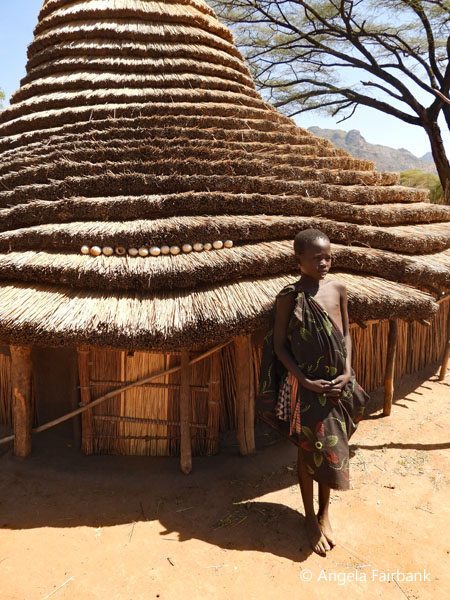 As I returned to our vehicle, I noticed that the girls and women who had danced for us were now sitting under the shade of a tree, choosing hair products and various toiletries. I was told later that the money that my fellow traveler and I had contributed to the tribe in exchange for permitting us to visit them was the cause for this distribution. I understood that these items were what they had requested our contribution be spent on. In comparison, at yesterday's visit to the Lotuko tribe, I had witnessed Ivan, or perhaps it was Sebit, paying the local guide in cash. We consumed a lunch of boiled eggs from our previous hotel in our vehicle and then continued to drive east past an oasis of date palms and Desert Roses (Adenium obesum) on the way out of the village to Kapoeta, where we stayed at a so-called resort populated by 15 to 20 Black Kites, as well as Speckled Pigeons (Columba guinea) and Pied Crows. Because the hotel's restaurant didn't really have any meals to offer us apart from breakfast, we were picked up by Emma at dinner time and driven to the hotel he was staying at with Ivan and Sebit, which had a nice restaurant although unfortunately, the Tilapia fish I ordered was quite dry and inedible. I shared one of the mangos that Sebit had bought for me at Juba's fruit and vegetable market with my fellow traveler for dessert. We were seated outside in a pleasant breeze that kept most of the mosquitoes and flies away.
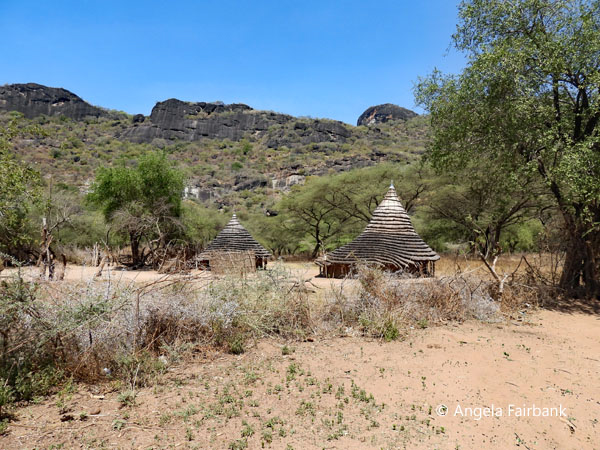     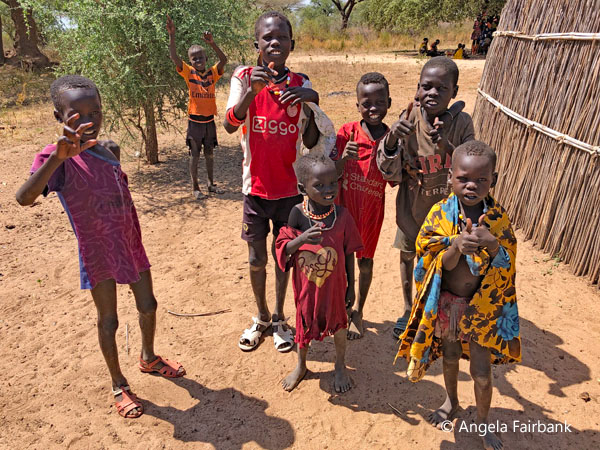 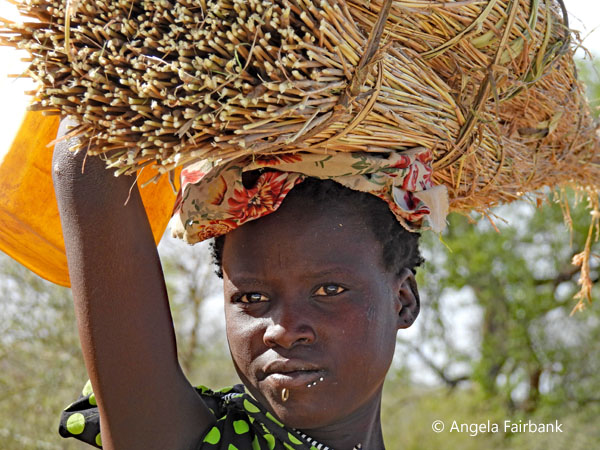 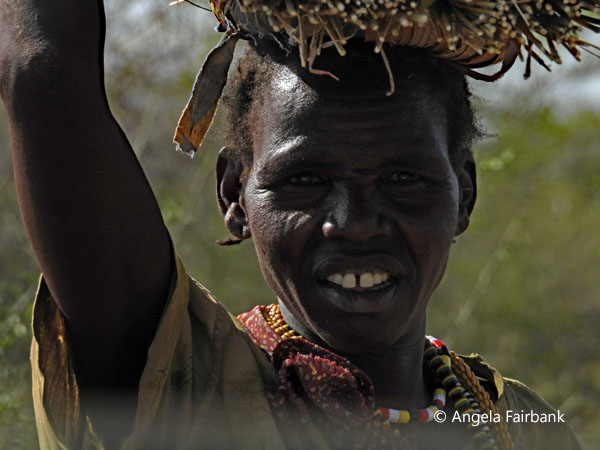     Friday, January 23: Kapoeta, South Sudan
Today's visit was to a village belonging to the Nilotic ethnic group, the Toposa, one of the country's most traditional tribes, who live well outside of mainstream society and follow lifestyles that have barely changed for centuries, if not millennia. Closely related to the Turkana of Kenya, whom I visited around Christmas 1998, and the Karamojong of northern Uganda, they are herders of cattle, sheep, and goats with an economy based largely around livestock, from which they obtain milk, blood, meat, and leather, although in the past they were also involved in the ivory trade. During the wet season, the animals graze near the villages. When the rains end, the men take the herds to dry season pasturage then slowly bring them back, grazing along the way, to arrive in the village when the next rainy season starts. Some areas of good pasturage cannot be used due to their lack of drinking water. They are also prolific cattle raiders, which has led to conflict with other groups in the past, although with the country's independence and greater stability this is now less of a problem. The Toposa live in villages made of mud and sticks, with thatched roofs often adorned with the skulls of cattle.  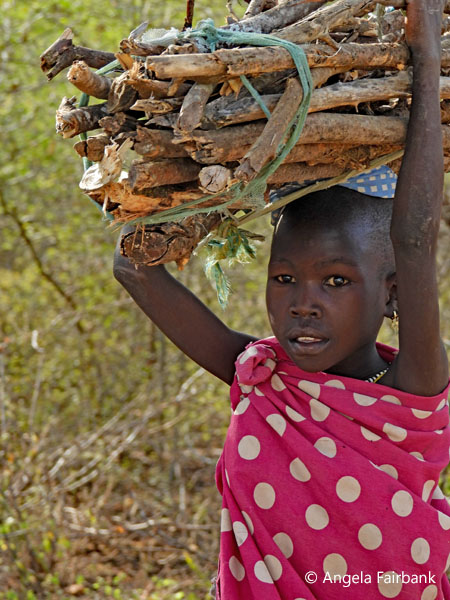  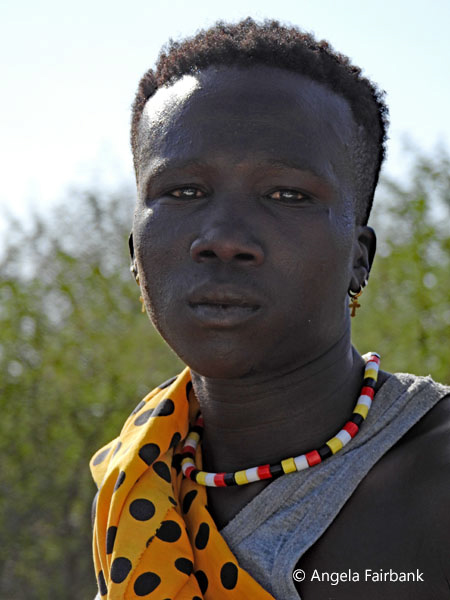 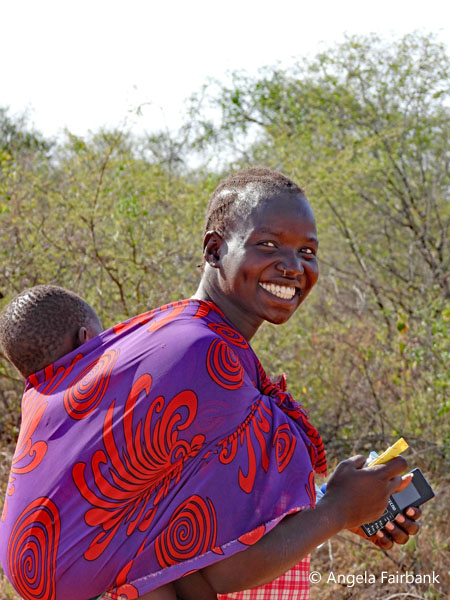  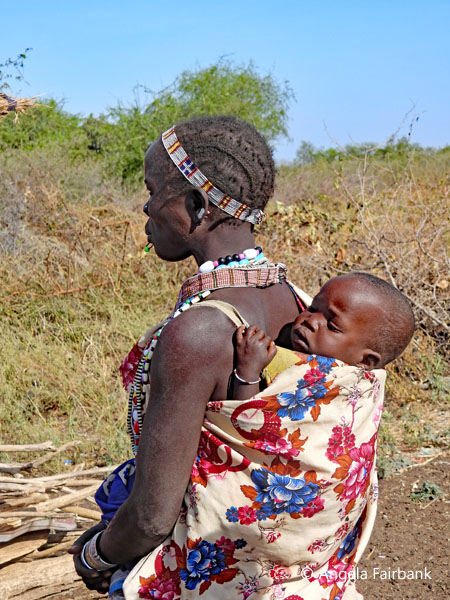 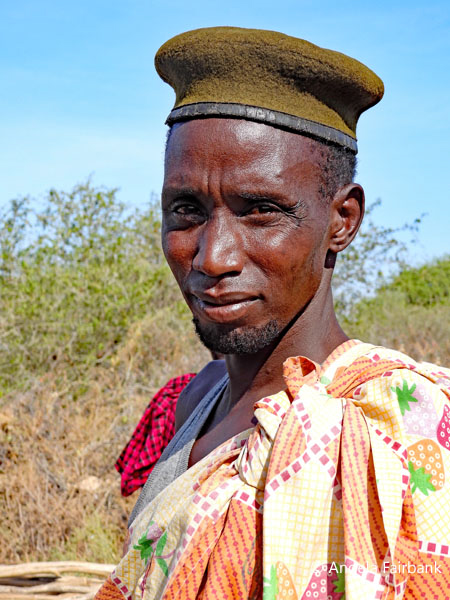 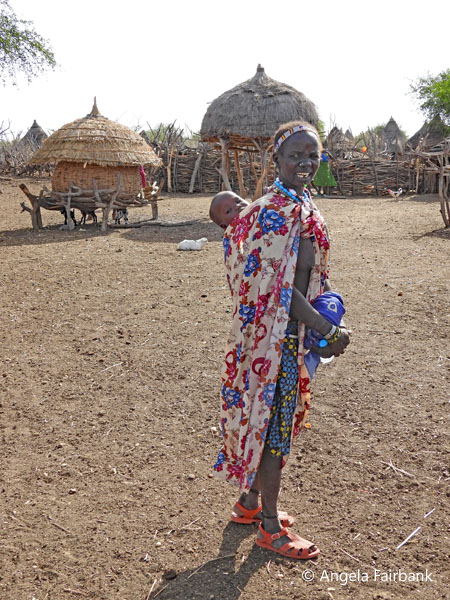 As withe the Mundari and the Boya, their most striking feature is their practice of scarification. Both men and women are decorated with elaborate raised patterns caused by careful incisions covering their upper arms, torsos, backs, and faces. Although modernity is starting to erode their customs, many of the older Toposa still adhere to traditional dress, as you will see below, while men often go naked, but we only noticed such nakedness in rivers and water holes. The men we saw, although sporting swaths of material tied around one shoulder, were wearing shorts underneath. We were also told that no self-respecting Toposa male will leave his compound without the obligatory AK-47 slung over his shoulder, although there was no sign of such weapons in the village itself.
     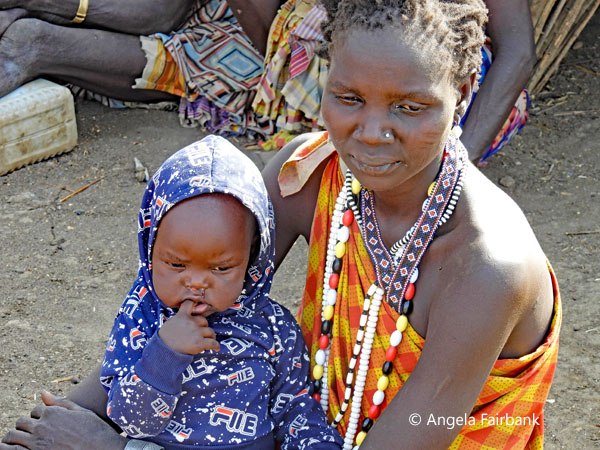    During the Second Sudanese Civil War (1983-2000), at times the Toposa helped the Sudan People's Liberation Army (SPLA) while at other times they sided with the Government of Sudan. After the war, sporadic clashes with neighboring tribes continued. The Toposa way of life is slowly being modernized and traditional social organization is eroding.
         The Toposa believe in a supreme being and in ancestral spirits, who may assist in overcoming problems such as drought or epidemics of disease among their herds. They believe that men originally lived with 'Nakwuge' in the sky, but many slid down a rope to earth. The rope then broke, separating them from heaven. As of 2000, perhaps 5% of the population could read. The Toposa culture is orally transmitted through songs, dance, music, poems, and folklore. Apparently, the Roman Catholic Diocese of Torit has been actively proselytizing among the Toposa with some success. In reference to this, during both our evenings in Kapoeta, from my hotel room I could hear the songs and speeches of a Christian Crusade via loudspeaker coming from a field near our hotel.
    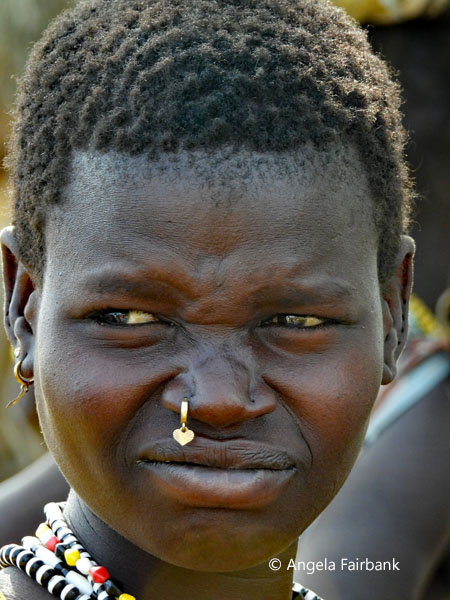     On our way to the village by car from our hotel as it was early, we began seeing young men on their way to herding their livestock. We were told that this would be the only time of day that we would see them on the road as clearly most of the day they were usually off-road in pastures with their herds. The first five photos for today were people we met on the road and photographed from the car. So, what a delight it was to meet dozens of young men in traditional dress at the village we visited today, together with the usual women and children of several age groups, including pipe-smoking elderly women who, when I asked their ages, were unable to reply because they did not keep record. Sebit demonstrated one stool, of the like I had seen in Southern Ethiopia in 2005, and before that, of course, among the Turkana in Kenya in 1998. It was here that I received a proposal of marriage--from the winking fellow with the grey beard in this set of photos. I told him I was honoured but no thanks. I kicked myself later for failing to ask the man how many head of cattle he believed I was worth. However, he probably had several younger wives (and children) already, so I was seriously not interested in competing with them.
         Their huts were somewhat different from those in the villages of the ethnic groups we had visited on previous days, the entry door being higher than that of the Boya, for instance. I photographed one with a small solar panel on its roof--probably, like I had seen in Madagascar, to charge smart phones. Interesting too were these smaller huts raised on stilts, which we were told were used for storage. (Perhaps this is where they had hidden their AK-47s!) I had a conversation with one pipe-smoking elderly woman shown here who was asking for salt. I mentioned her request to Sebit and he replied that they had actually brought salt with them. There was more teeth cleaning among the young men here and then young men and woman alike suddenly started dancing for us, involving stomping of feet, and jumping (along with babies crying), which I videoed. I was also intrigued in the number of earrings they managed to fit on each ear, while they in turn looked at and touched my single long-hanging silver ones. Some of the younger women had piercings elsewhere on their faces. Zooming in one photo I did notice that some of them also had missing bottom teeth like the Boya, but not all of them. I also photographed the elaborate series of 10 bracelets (perhaps 8 of them in gold) in addition to a digital watch worn by one young man .
    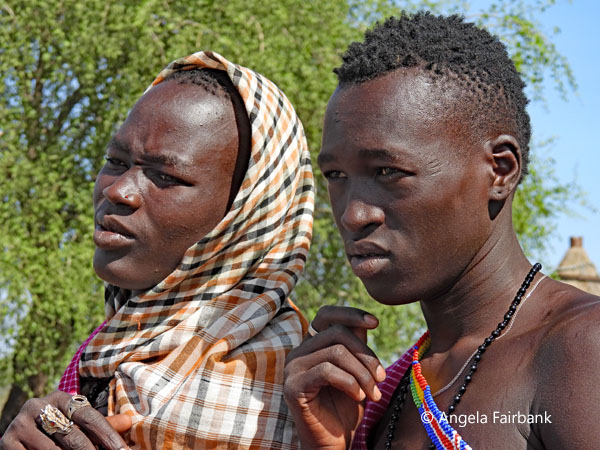 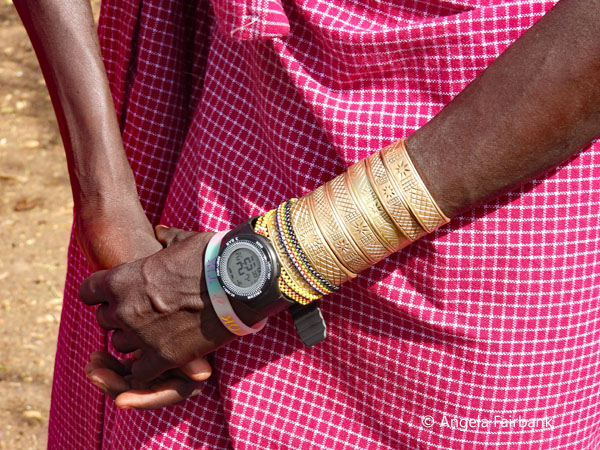    I finally asked about the young man wearing fabric that had an animal-skin pattern, who was sitting on a chair scrolling through his thick smart phone, and was told he was the chief of the village. I went up to him to introduce myself through an interpreter and he told me he had been chosen for the job by the village elders. He invited me to return to the village some day. I then took a tour of the houses and found this group of three preschool aged children playing together in a round structure made of sticks and they too were happy to be photographed. Another young boy was sitting on another kind of 3-legged stool made from small logs, which he is modeling for me here, while the photos of a young man in yellow are due to his interesting face scarification. The scar on his left cheek is in the shape of a bull's head. A couple of young children in another spot were drinking milk out of old water bottles, the girl already used to carrying it on her head. In front of one collection of houses, I photographed a crop of tobacco plants--grown to fill the pipes the elderly women were smoking.
          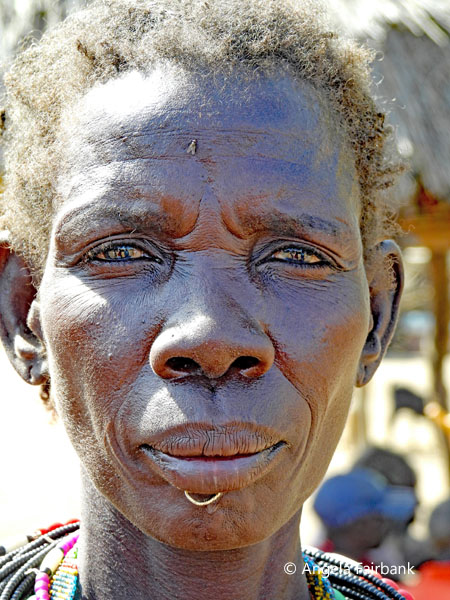  As I was photographing some of the young men, all the women sat in a circle and one of the older ladies handed out the packets of salt we had contributed. At one point, a fight broke out between two women, perhaps they thought the allocation of salt had not been just. But it was soon resolved. We left the village somewhat reluctantly, knowing it was our last village visit, and drove back to our hotel. Later, we ate our lunch at the same restaurant where we'd had dinner last night, surprised to see a couple of live turkeys ((Meleagris gallopavo) in the courtyard near our table. I wasn't sure if they were pets or future food (perhaps both). There were also a couple of workmen in the courtyard re-laying paving stones using mixed concrete. A slow job. We then took a late afternoon visit by foot to the market in Kapoeta, where we met and photographed some more Toposa as well as a number of young men and shy children who asked me to take their photos, once again probably because they saw I was carrying a good camera and not just a smart phone. After viewing the images of them in my camera, a couple of youths on motorbikes (the man in the blue shirt and the one in the white turban with amazing white teeth) actually asked for copies, so Sebit took the phone number of one of them so he could forward them after I had sent them to him.
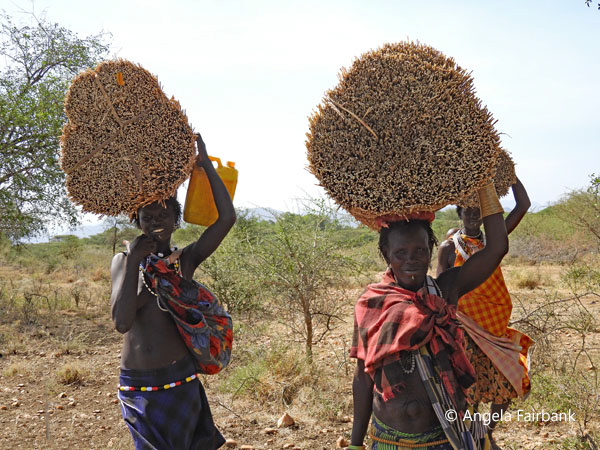   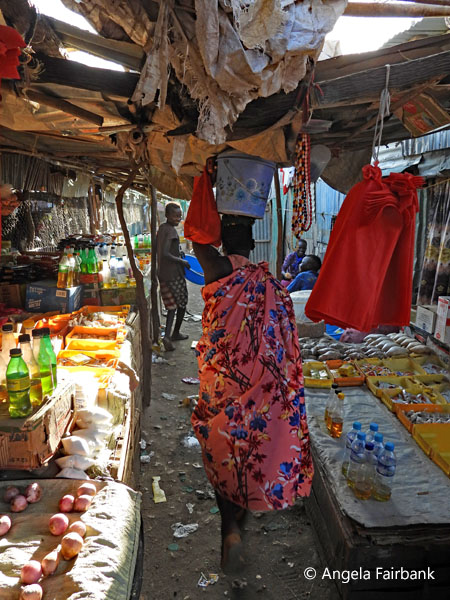 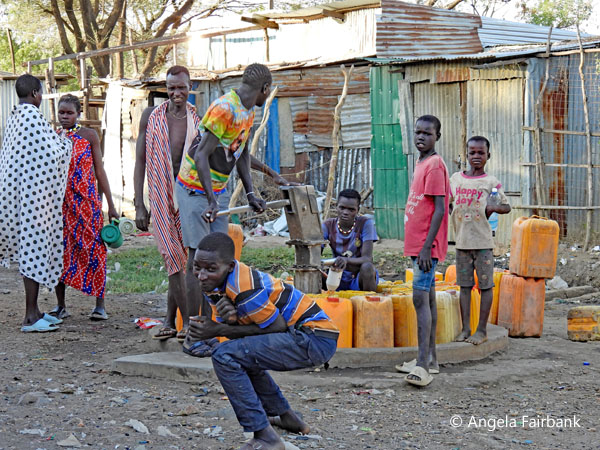 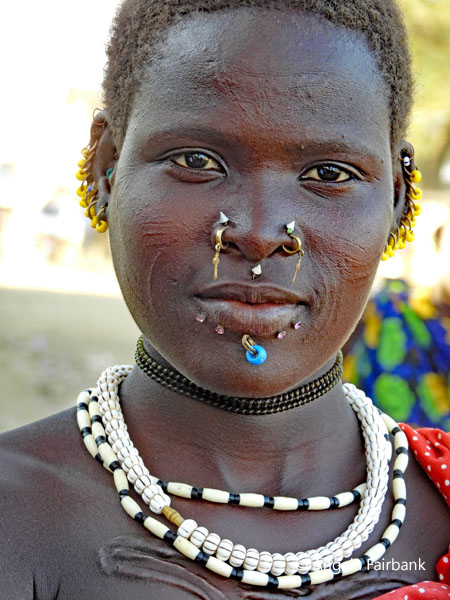 Seeing a well (or at least a pump) in the market, I dared to ask if I might give it a try to see just how much effort was needed to draw water this way. My fellow traveler made a video of it in which I can been seen grimacing at the strength required, although I couldn't of course make it look easy and show up the strong young man whom I taken over from and relinquished the task to after my brief trial. At least I got a laugh from the locals, which was probably my underlying goal.
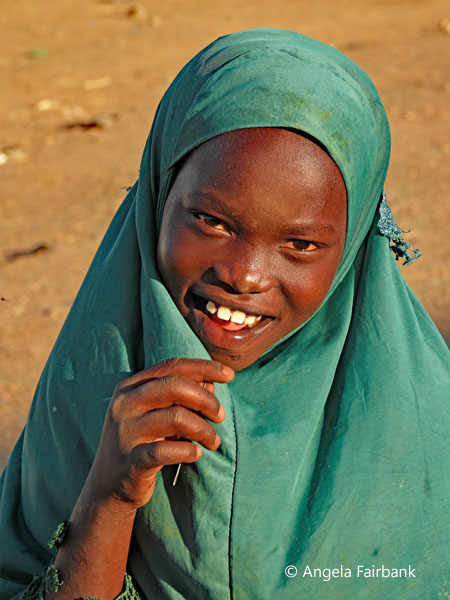 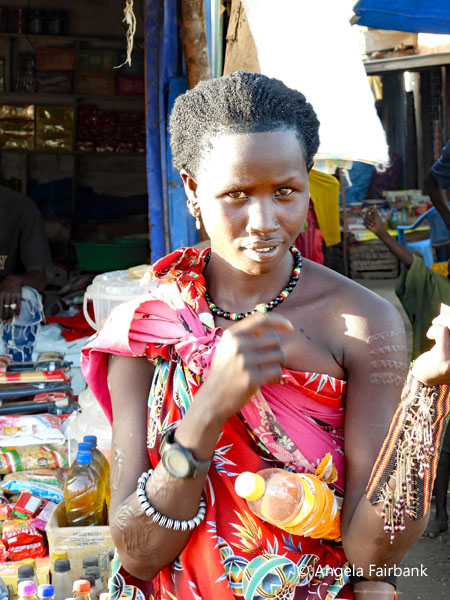 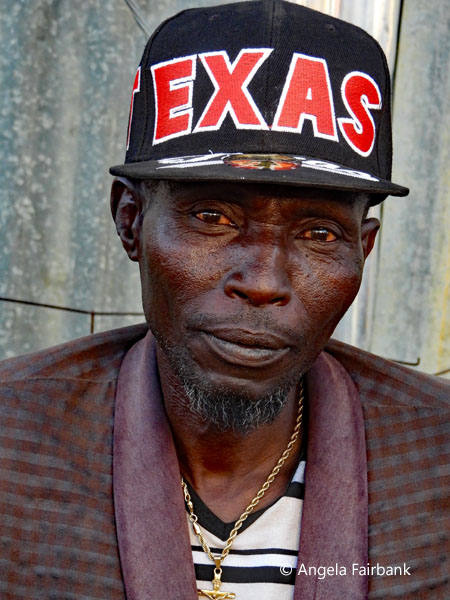  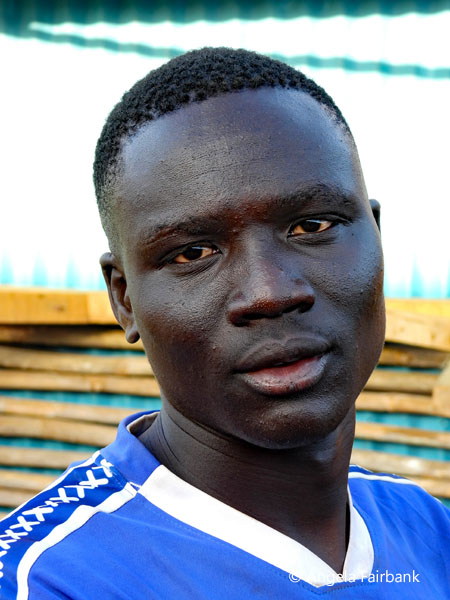 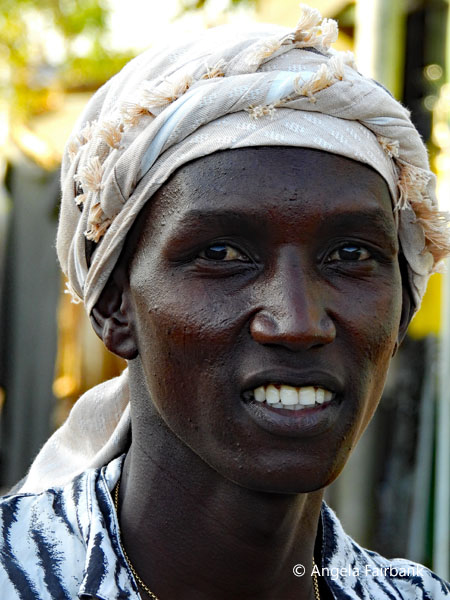 Another seated man at the market was shaving cows' leg bones with an actual Schick razor. I looked up this anomaly but couldn't find anything about it.
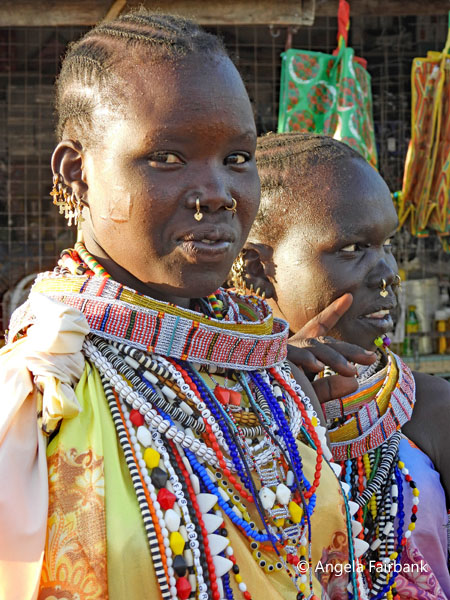     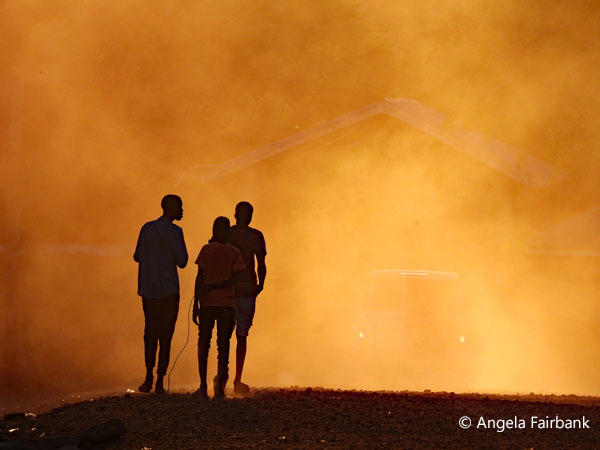 Leaving the market, turning left at the roundabout, and strolling down the road to our hotel, we were met with a splendid scene of a gorgeous sunset, providing these beautiful silhouettes against a background of yellow. We ate dinner once again at the same place we'd had lunch. So as not to repeat the same dinner as yesterday, we were invited into the kitchen to see what was on offer and chose an omelette, which was unfortunately not hot. Nor was the rice with which it was served. We then returned to our hotel for our last night here in Kapoeta, expecting to fly back to Juba around 8:00 a.m. tomorrow morning.
  Saturday, January 24: Kapoeta - Torit - Juba, South Sudan
Just as I was turning out my light last night, I read a WhatsApp group chat message that said that the flight we were booked on wasn't in fact possible because the plane was now flying elsewhere. Our guide made the rapid decision that we would drive back, which meant an early wake up. I was therefore up at 6:00 for a shower and a rapid breakfast of instant coffee and hotel-fried square doughnuts before enduring a very long drive of 263 km west to Juba with a one-hour brunch stop at our previous hotel in Torit around 10:00 a.m. We were told at the start that there would be no stops except for two toilet stops and our brunch stop, which meant no photographs for me. I saw a multitude of pigeons or doves, helmeted guinea fowl, turquoise-coloured starlings (Shelley's Starlings perhaps or Superb Starlings), hamerkops, a couple of herons, and a couple of goshawks, I think, as well as many more species, especially in the early morning. We arrived at our hotel in Juba around 3:00 p.m. (i.e. nine hours later) exhausted, hot, and sweaty, despite being mostly in the car all day. Somewhere en route prior to Torit, we asked for, and were granted, photographs of these women, who, I believe, belong to the Kuku (or Koko) tribe. This 'no guns' sign was on the entrance door of the Torit Hotel. We also saw soldiers/police travelling in a convoy complete with rifles and machine guns en route closer to Juba, but they were clearly for protection and non-threatening. To my recollection, we were not stopped at any of the police controls this time. No dinner was provided this evening, as per the tour itinerary, so I stayed in my hotel room and worked on my photos.  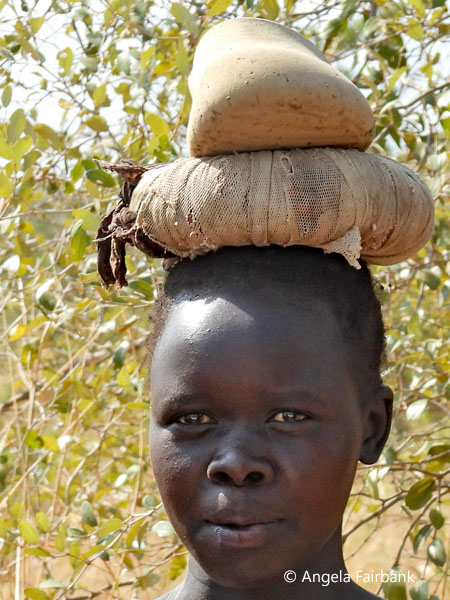 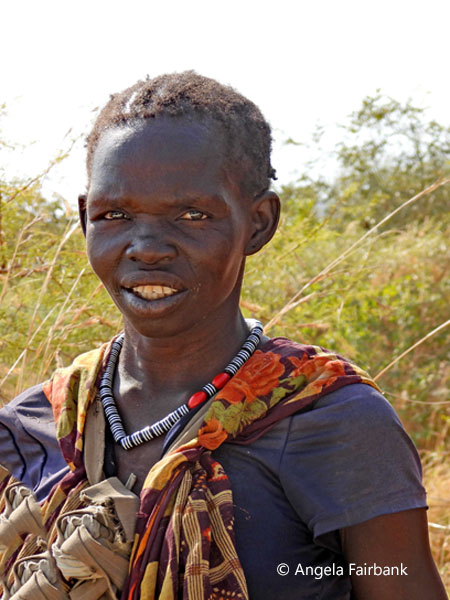   Sunday, January 25: Juba, South Sudan - Addis Ababa, Ethiopia
I asked the hotel for a late check-out after breakfast today and was picked up by Younger and taken to the business class side of Juba's airport. He then waited with me while my luggage was checked in and tagged, and my luggage tags delivered to me by the airport staff who looked after this process. The same staff member then took me to immigration so my passport could be stamped and then brought me back to the business lounge, at which time I said my good-byes to Younger. As I waited for my flight, I read a book and then, when called, walked on the tarmac over to the Ethiopian Airlines plane. I was somewhat sad to leave this place in the knowledge that I would probably never be back if I am to fulfill my quest. As we lifted off the ground and into the clouds, I sighed at the long flights ahead and arrived back in Addis Ababa for the third time this month. Monday, January 26: Addis Ababa, Ethiopia - Frankfurt, Germany - Vancouver, B.C., Canada
I had about five hours to wait between arriving in Addis and my just-after-midnight connecting Ethiopian Airlines flight to Frankfurt, during which I sat in the business lounge and processed my Mundari photos. After arriving in the snow in Frankfurt, I had another five hours to wait, so I sat in the Air Canada lounge, ate some breakfast, and worked again on my South Sudan photos (yes, there are a lot of them here but they were pared down from a whopping 2,171 of them, of which 1,191 were just of the Mundari! I was then placed in Business Class in a Lufthansa plane, although I had booked it with Air Canada, and there was some delay as it was debated whether the wings needed de-icing or not. It was finally decided not because the temperature had warmed up sufficiently. It did mean we had about a two-hour delay leaving Frankfurt, but after that, there were no more incidents. Now able to compare the two business classes, I will state my preference for Air Canada, where the flat-bed seats are more private, although the Belgian chocolates on Lufthansa are a definite treat! I arrived back in Vancouver airport and for the first time in memory was subjected to a random search of my luggage by the Canadian Border Control to make sure I had not exceeded my eight hundred Canadian dollar allowance after being away for more than seven days. I had not, although I did feel a bit sorry for the security staff who had to paw through my dirty laundry albeit wearing latex gloves. I was glad to be home finally but reflecting on all the places I had visited on this trip and these past 12 months, and all the people I had met, I would definitely say that my time in Africa was by far the more exciting continent for me. I was, at moments, awed by the beauty of the country and the people, especially. And then all those birds--and colourful ones too. There was plenty more fauna to photograph, I just didn't get the chance due to the fact that we were spending long days driving along roads. Also, despite travelling this time in countries that were on the advisory list, notably Somaliland and South Sudan, I did not feel in danger at any time. My advice is to get out there and see the world. Reading back over my travelogue, I am impressed by all the new things I learned and had not even given any thought to before. And I had fun learning new languages and practicing them on the locals and getting positive reactions. I can't wait for my next trip to Africa, although I have so far committed myself to visiting other continents this year. I hope you enjoyed your arm-chair travel by reading this and will be inspired to dip into some of my previous travelogues too! Back to Latest Travelogues page. |
All rights reserved. Website © Angela Fairbank 2005-2026.
|